


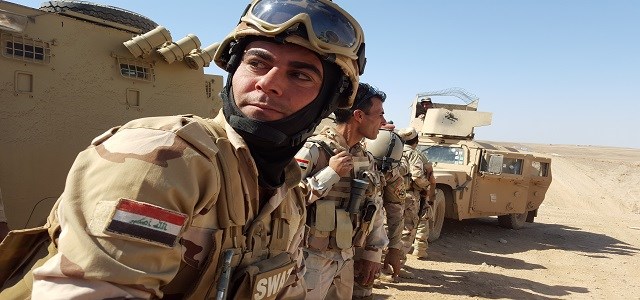
Around noon this past Tuesday Iraqi soldiers launched an attack against a remote, dusty and windswept village called al-Nasr west of the Tigress River. They believed capturing this tiny village would bring them one step closer to Mosul. I was there to see this rare battle of the Iraqi army so far away from Baghdad.
For more than two months the soldiers had camped out on a hill facing the village. White tents dotted the hillside. Discarded food containers, water bottles; empty bullet casings littered the ground as soldiers took shelter from the sun inside their tents or in the shade of their armors like an exhausted Roman army.
Almost all the soldiers here were the same height as if that was a requirement, to avoid the relentless sniper fire. They sat here for weeks, waiting and monitoring their radical opponents day in day out. “We are tired. We are having lunch they shell us. We are having dinner they shell us. I haven’t eaten properly for two months,” one soldier told me.
As I climbed the hill they kept saying, “The village is right over there” and when I finally took a peek from behind a protective dirt mound I was truly shocked by how close it really was. Less than half a kilometer away. I tried to imagine the dread in these young soldiers’ hearts for holding out so long so close to their vicious enemy.
 We are tired. We are having lunch they shell us. We are having dinner they shell us. I haven’t eaten properly for two months.
Snipers inside the village kept harassing the advancing troops and those on the hill. A soldier told everyone to keep their heads down as another said reassuringly, “Don’t worry, he will soon run out of ammo and he is done for.”
One of the soldiers was a new recruit from the southern Iraqi city of Nasriyah with a sunburnt pockmarked face who had been posted to this front after two short months of training in Basrah. Some of his friends had joined the Shiite militia but he had picked the army.
He was one of a few thousand soldiers the Iraqi government had deployed to the Makhmour front to prepare with the American and Kurdish forces for the future offensive against Mosul.
One soldier who had served nine of his twelve army years in Mosul was not very optimistic. “Mosul has never been an easy place,” he told me, as he constantly poured cold water on his face, head and neck only to be instantly dried by the hot air. “We were always under attack by assassins, snipers and car bombs even years before ISIS.”
The biggest menace to this drained group of soldiers was snipers. Unlike other fronts where they mostly attack by night or at dawn, on this front the militants assaulted by day, because, one soldier explained, “Their snipers work best in daylight and know that we couldn’t even raise our heads above our bunker.”
Before today’s offensive the soldiers had spent two nerve-racking months on this hill, pinned down by sharpshooters and mortar shells. To make their lives even more miserable rats and mice had joined the fight and harassed the poor souls. They crawled on them as they lay in ambush and nibbled at their skin and clothes. They couldn’t make the slightest move or any noise so as not to betray their position and all they could do “was to quietly shoo them away,”
For half an hour I sat on a wooden ammunition box inside a lookout post that was heavily fortified with green sandbags and an American machine-gun, and talked to a multiethnic group of soldiers. Every few seconds one of their comrades would come by, take a peek inside the post and walk away.
Their snipers work best in daylight and know that we couldn’t even raise our heads above our bunker. Near the post on the steep hillside there were four members of the Sunni Hashd al-Watani inside a white pickup truck. One of them was a skinny tall man with a goatee in a striped brown T-shirt and a pair of jeans who leaned against the truck and quietly scanned the vast plains in front of him like a hawk. He was from the Jibour tribe and, unlike many people in his area, he had pledged allegiance against ISIS.
While he was telling me about his tough time as a policeman in Mosul I saw a convoy of about four vehicles coming towards our position. Everyone saw them and no one said or did anything. But when a few seconds later one of the vehicles diverted from the main road to make a shortcut, the entire hill came alive with gunfire. The soldiers knew too well that it was part of the convoy and came from the safe rear, but they couldn’t take any risks. All the shouting and hand waving of those on the vehicle were ignored and bullets rained down on them until some officers ordered ceasefire. “See how they endanger themselves with such a stupid move,” I heard a soldier saying.
All the while truckloads of troops moved into the village and disappeared among its scattered homes as soldiers kept repeating that al-Nasr was under control at which point I too started walking towards the village. Along the way I couldn’t help noticing a stark difference between the equipment of the Iraqi army and that of the Kurdish Peshmerga. The Iraqis had brand new abrams tanks, hummers, Humvees, machine-guns, M16 rifles and countless boxes of ammunition. When I saw them carry away two destroyed Humvees with American-supplied cranes with much ease I remembered how hard the Peshmerga struggled with a punctured truck during one of their battles.
The heavy traffic of the day had turned the village road into a sea of fine dust. There was almost no spot on either side of the road without a bomb crater or the broken propellers of a mortar shell. Pieces of destroyed vehicles such doors, wheels and shattered windshields were scattered everywhere. In an area that until a few hours earlier was a no-mans-land a tall soldier in green uniform with an M16 in hand started walking behind me. He was a Sunni from the town of Rabia on the Iraq-Syria border. No sooner had we entered the village than he pointed to a burning barn and shouted, “Those ISIS dogs have done this everywhere,” A little further down the road I saw a house with its outer walls destroyed and the colorful red and pink tiles exposed like the insides of a carcass. Three soldiers stood on its rooftop and with their khaki uniform blended well into the dusty terrace.
The soldier in the green uniform kept walking by my side. He seemed a little disoriented and moved excitedly to and fro. Something was bothering him. Then out of the blue he yelled, “Those ISIS dogs beheaded my brother.”
But now it is all clear. Just pick up your gun and whoever is on the other side is an enemy. There was still the sound of gunfire everywhere and every now and then an RPG grenade exploded in the air before reaching its target. A Kurdish commander who showed up on our spot and said, “The snipers almost killed one of my guards,” Another soldier pointed to a single eucalyptus tree in the middle of the village and said, “If you want to see dead ISIS go there. The rest are trapped under the rubble.” One soldier said we are finished with this village while the one next to him said, “This is a very dangerous spot, militants are still inside the homes, get out of here.”
A congregation of Shiite, Sunni and Kurdish soldiers formed next to the mud barn. The Kurds hovered around their commander who gave a report on the day then grabbed a bottle of water from one of his men and gulped it down. The Shiites stayed around their two pickup trucks with a black flag and a picture of Imam Hussein dripping with blood. And the Sunni soldier jumped on an armor-plated vehicle to deliver some cold water to his friends deep inside the village. Then for fear of a surprise ISIS comeback all the soldiers disappeared as quickly as they had come.
I heard that soon after I left the Iraqi soldiers mistook one of their commanders for the enemy and killed him by firing a tank shell into his truck. This last bit of sad news reminded me of what one of the soldiers told me on the hill. “Before, it was a hard battle. You could never tell who was who. They would shoot at us from inside mosques, rooftops and homes. But now it is all clear. Just pick up your gun and whoever is on the other side is an enemy.”
Comments
Rudaw moderates all comments submitted on our website. We welcome comments which are relevant to the article and encourage further discussion about the issues that matter to you. We also welcome constructive criticism about Rudaw.
To be approved for publication, however, your comments must meet our community guidelines.
We will not tolerate the following: profanity, threats, personal attacks, vulgarity, abuse (such as sexism, racism, homophobia or xenophobia), or commercial or personal promotion.
Comments that do not meet our guidelines will be rejected. Comments are not edited – they are either approved or rejected.
Post a comment