


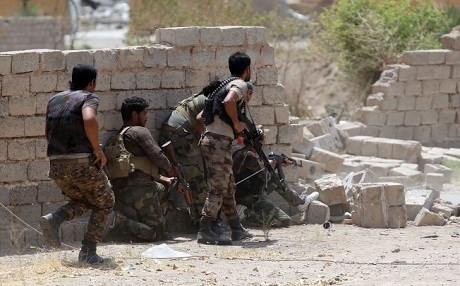
ERBIL, Kurdistan Region - Military clashes between Islamic State and Sunni tribesmen in Fallujah, an Iraqi city that ISIS has held for long, are ongoing since Friday, said local officials, complaining that tribal fighters must be better armed to make territorial gains against the jihadists.
"The tribesmen need to be armed and we are trying to earn them the support from the government as soon as possible," said Saadun Obeid, mayor of Fallujah. "The marksmen of the tribes have taken up positions inside buildings in the neighborhood of Askari eastern Fallujah."
Iraqi Sunni tribesmen and ISIS jihadists engaged in deadly clashes Friday in and near Fallujah in Anbar, Iraq’s largest province, which is Sunni dominated.
The exiled official responsible for Fallujah, Issa Sayir, told AFP that, "Clashes took place between sons of the al-Mahamda and al-Juraisat tribes against the al-Hisba group."
The fighting, he said, took place in al-Jolan to the northwest of the city and expanded to include al-Askari to the east and the Nazal area in the city-center.
Deteriorating conditions, described by Anbar Governor Sohaib al-Rawi as having "reached a state of famine," seem to be resulting in more tribesmen seeking to oust ISIS from their Sunni Arab-majority province.
The US has urged Baghdad to win the trust of the Sunni tribesmen of Anbar and solicit their help when it comes to uprooting ISIS from Anbar.
That is a policy not unlike the Sahwa, or Sunni Awakening force of tribal fighters used during the Iraq War against al-Qaeda, the predecessor of ISIS, in the same province.
There are an estimated 300 to 400 ISIS members still in Fallujah. A major Iraqi offensive backed by American-led coalition air-power recently descended on Ramadi last December and retook what is the provincial capital.
"The tribesmen need to be armed and we are trying to earn them the support from the government as soon as possible," said Saadun Obeid, mayor of Fallujah. "The marksmen of the tribes have taken up positions inside buildings in the neighborhood of Askari eastern Fallujah."
Iraqi Sunni tribesmen and ISIS jihadists engaged in deadly clashes Friday in and near Fallujah in Anbar, Iraq’s largest province, which is Sunni dominated.
The exiled official responsible for Fallujah, Issa Sayir, told AFP that, "Clashes took place between sons of the al-Mahamda and al-Juraisat tribes against the al-Hisba group."
The fighting, he said, took place in al-Jolan to the northwest of the city and expanded to include al-Askari to the east and the Nazal area in the city-center.
Deteriorating conditions, described by Anbar Governor Sohaib al-Rawi as having "reached a state of famine," seem to be resulting in more tribesmen seeking to oust ISIS from their Sunni Arab-majority province.
The US has urged Baghdad to win the trust of the Sunni tribesmen of Anbar and solicit their help when it comes to uprooting ISIS from Anbar.
That is a policy not unlike the Sahwa, or Sunni Awakening force of tribal fighters used during the Iraq War against al-Qaeda, the predecessor of ISIS, in the same province.
There are an estimated 300 to 400 ISIS members still in Fallujah. A major Iraqi offensive backed by American-led coalition air-power recently descended on Ramadi last December and retook what is the provincial capital.
Comments
Rudaw moderates all comments submitted on our website. We welcome comments which are relevant to the article and encourage further discussion about the issues that matter to you. We also welcome constructive criticism about Rudaw.
To be approved for publication, however, your comments must meet our community guidelines.
We will not tolerate the following: profanity, threats, personal attacks, vulgarity, abuse (such as sexism, racism, homophobia or xenophobia), or commercial or personal promotion.
Comments that do not meet our guidelines will be rejected. Comments are not edited – they are either approved or rejected.
Post a comment