


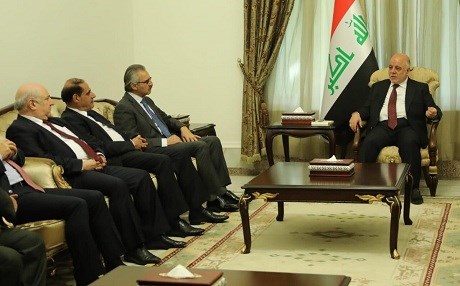
BAGHDAD – Two Kurdish parties separately met with Iraqi Prime Minister Haider al-Abadi in Baghdad on Wednesday as talks about the formation of the next government continue.
Abadi discussed the need to speed up the process of forming the next government in his meetings with delegations from the Patriotic Union of Kurdistan (PUK) and the Kurdistan Democratic Party (KDP).
"During the meeting, discussions were held regarding ongoing talks to form the next government and accelerate it. Views were exchanged between the parties and the importance of working to form a strong, national government," his office said of the meeting with the KDP delegation led by Fazil Mirani.
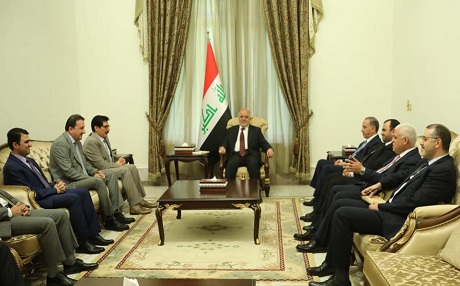
A KDP delegation met with PM Haider al-Abadi in Baghdad on Wednesday. Photo: Haider al-Abadi’s office
In his meeting with the PUK, Abadi also noted that formation of the government must come through “national negotiations.”
The PUK delegation, led by Mala Bakhtiar, told Abadi that “they want to be part of the solution,” according to the statement from Abadi’s office, stressing that their party wants to see a government that represents everyone.
Abadi came third in the election, after the Sayirun alliance of Muqtada al-Sadr and the Communist Party and the Fatih alliance tied to Iranian-backed militias. Though he did not win, it is widely expected that Abadi will remain in the post of prime minister in a broad coalition government.
KDP and PUK secured the bulk of the seats up for grabs in Kurdish areas. Delegations from the two parties are in Baghdad separately, meeting with various political leaders.
One issue that will likely arise between Abadi and the Kurdish parties is security in the disputed areas as PUK officials have expressed concerns about Abadi’s proposal for a Kurdish military unit in Kirkuk.
Abadi discussed the need to speed up the process of forming the next government in his meetings with delegations from the Patriotic Union of Kurdistan (PUK) and the Kurdistan Democratic Party (KDP).
"During the meeting, discussions were held regarding ongoing talks to form the next government and accelerate it. Views were exchanged between the parties and the importance of working to form a strong, national government," his office said of the meeting with the KDP delegation led by Fazil Mirani.
A KDP delegation met with PM Haider al-Abadi in Baghdad on Wednesday. Photo: Haider al-Abadi’s office
In his meeting with the PUK, Abadi also noted that formation of the government must come through “national negotiations.”
The PUK delegation, led by Mala Bakhtiar, told Abadi that “they want to be part of the solution,” according to the statement from Abadi’s office, stressing that their party wants to see a government that represents everyone.
Abadi came third in the election, after the Sayirun alliance of Muqtada al-Sadr and the Communist Party and the Fatih alliance tied to Iranian-backed militias. Though he did not win, it is widely expected that Abadi will remain in the post of prime minister in a broad coalition government.
KDP and PUK secured the bulk of the seats up for grabs in Kurdish areas. Delegations from the two parties are in Baghdad separately, meeting with various political leaders.
One issue that will likely arise between Abadi and the Kurdish parties is security in the disputed areas as PUK officials have expressed concerns about Abadi’s proposal for a Kurdish military unit in Kirkuk.
Comments
Rudaw moderates all comments submitted on our website. We welcome comments which are relevant to the article and encourage further discussion about the issues that matter to you. We also welcome constructive criticism about Rudaw.
To be approved for publication, however, your comments must meet our community guidelines.
We will not tolerate the following: profanity, threats, personal attacks, vulgarity, abuse (such as sexism, racism, homophobia or xenophobia), or commercial or personal promotion.
Comments that do not meet our guidelines will be rejected. Comments are not edited – they are either approved or rejected.
Post a comment