


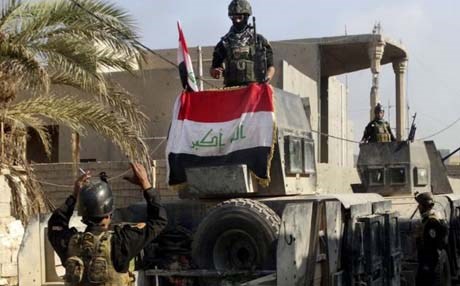
Ramadi has been liberated and that is good. Does the liberation portend a new era for Iraqi or foreshadow a sectarian rift. The Iraqi government maintained during the fight that only the Iraqi army was involved, without the help of Iranian backed Shia militias. This has now turned out not to be true, even Vice President Maliki congratulated the militias in a speech giving thanks for the victory.
The operation took several months to execute including a number of months in what was seen as the Iraqi army shaping the battlefield. This was done by maneuvering forces to surround the city to cut off supplies and reinforcements. Prior to major operations a leaflet drop was made to advise the population to leave the city and gave them directions to an open corridor. Of course this also let ISIS know the location of the corridor which allowed them to tell the population that any attempt at leaving would result in death.
While it is difficult to assess the operation, since all information came from the government, it is safe to say that the final assault was not a standard counter-insurgence operation. It was also not traditional urban warfare. What can be gleaned from the videos, photos and information coming out is that the city was simply rubbled.
Other information that has not been released or estimated are the casualty figures for the civilian population. It can be assumed however that the figure will be high considering the damage done to the city. The other aspect of the victory is the follow on actions of the Shia militias. As we saw in both Tikrit and Baiji militias committed acts of violence on the Sunni population in some cases to the degree that could be called atrocities.
Pictures that have come out show Ramadi civilians being marched out by the militias with little coverage by the press or objections from the coalition. The leaflet drop has given an excuse that anyone who remained in Ramadi is an ISIS sympathizer or collaborator. Regardless of the statements by the Iraqi government, with supporting statements from the US, there is still a militia presence guided by Iran engaged in the fight. The US is so intent on maintaining this line that recently it fell for an obviously fake document that would have blamed ISIS for any and all atrocities in the next battleground of Falluja.
The document called on ISIS fighters to dress as Iraqi Security Forces and Shia militia and to blow up mosques, bomb civilian areas, set up snipers, and kill and torture civilians. These acts are to be filmed and distributed to news outlets in order to incite Sunnis to rebel and join ISIS. Two experts on the region, Michael Pregent a former Intelligence advisor to Gen David Petraeus and a fellow at the Hudson Institute, and Phillip Smyth, a researcher at the University of Maryland who is a leading expert on Shia militias, have both casted doubt as to the authenticity of the document. The US government has not indicated how or if it ever authenticated the document.
While not known where this document came from it would have the effect of giving the militias carte blanche to commit atrocities and remain blameless. The appearance of this document and the ready acceptance is another indicator that Baghdad is still under Iranian control.
It remains to be seen whether or not Baghdad can retain control of Ramadi and if so, how long before it moves on to the next anticipated target of Falluja. The victories will remain hollow however, and possible short lived unless Baghdad builds an army that is inclusive of Sunni and Kurds. Until that time it remains a Shia force attacking Sunnis at the command of Tehran.
Paul Davis is a retired US Army military intelligence and former Soviet analyst. He is a consultant to the American intelligence community specializing in the Middle East with a concentration on Kurdish affairs. Currently he is the President of the consulting firm JANUS Think in Washington D.C.
Comments
Rudaw moderates all comments submitted on our website. We welcome comments which are relevant to the article and encourage further discussion about the issues that matter to you. We also welcome constructive criticism about Rudaw.
To be approved for publication, however, your comments must meet our community guidelines.
We will not tolerate the following: profanity, threats, personal attacks, vulgarity, abuse (such as sexism, racism, homophobia or xenophobia), or commercial or personal promotion.
Comments that do not meet our guidelines will be rejected. Comments are not edited – they are either approved or rejected.
Post a comment