

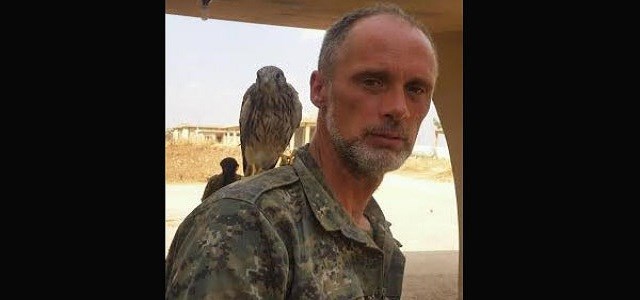
There are two quick things to know about the hundreds of foreigners fighting with the Kurdish People’s Protection Units, or YPG, in the area of northern Syria known as Rojava.
First, please don’t call them “foreign fighters,” as they have been labeled in the media. The term these expatiate warriors prefer is “freedom fighters.”
Second, when the fighters begin their respective journeys to their home countries, most use the same hotel in Erbil’s Christian neighborhood of Ainkawa.
On a recent evening, in the space of only 10 minutes, the lobby of the hotel was graced by “freedom fighters’ from three continents – a testament to the far-reaching appeal of the Kurdish forces and the war they are raging against the radical forces of the Islamic State, or ISIS.
Along with a Brazilian, Rudaw met with Keith Goings, a 43-year-old American from the state of Kentucky, and Jesper Soder, 25, from Trollhattan, Sweden. The name of the hotel has been omitted to allow the fighters some privacy.
Goings is a veteran of the US Army who recently joined the YPG. He had booked a room for three nights at the hotel because he needs to fly back to the US. Goings said the YPG is paying the cost of the hotel.
Like many others now fighting with the Kurdish forces, Goings and Soder joined the YPG through social media. Soder, known as Comrade Agid, is a high school teacher in his normal life. On June 11, he was injured by an ISIS bomb in Tal Abyad, knonw to Kurds as Gire Spi.
In the explosion five of his YPG companions were killed and Soder almost lost his right ear. His hearing is now greatly impaired.
“In a couple of days, I will fly to Stockholm. When my ear recovers, I will come back to Erbil and then to Kobani or Tal Abyad,” said Soder.
Goings and Soder joined the YPG in March. Goings, who is known as Comrade Kemal Ararat, has participated in 25 battles against ISIS. Soder said has been in 15 battles against ISIS. By their estimate, the men participate in a battle every two days.
“Usually, we don’t capture many [ISIS] because they want to die” said Soder.
Goings served in a US Army infantry unit from 2001 to 2006, taking part in the 2003 invasion that topple Iraq’s former dictator Saddam Hussein. He received his first impression of the Kurds that same year in Kirkuk.
“Once I was even accused of being Kurd in Kirkuk,” said Goings.
In those days, before the recent oil boom, Erbil was a much smaller city.
“There was no building over four floors high, said Goings, who said he was forced to return to the US when his father passed away in 2006.
Recently, Goings said he was promoted from team Captain to what the Kurds call “Tabur” Captain in Rojava.
“Right before I left, when talking with [General] Heval Boz I was promoted to Tabur Captain... Waiting to see when I come back how that is going to shake out,” Goings told Rudaw.
Three months fighting alongside the Kurds has made an impact on Goings, sometimes he speaks just like Kurdish patriot.
For example, he used the Kurdish terms - “Bakur, Bashur, Rojava and Rojhelat” - for the different parts of greater Kurdistan. In English, the words simple mean north, south, west and east, but to nationalistic Kurds the terms refer northern Iraq and Syria, the southeast of Turkey, and western Iran.
“I am here to fight against [Syrian President Bashar al-Assad] because he is a snake; [and] to fight against Turkey because it’s corrupt,” said Goings.
The American also criticized Iran for not allowing Kurdish inhabitants to live freely with human and political rights.
According to the foreign fighters – there are American and European military advisers in Rojava.
”There is strong coordination between YPG and the coalition forces. Last week, I saw two American military advisers in Rojava Canton,” said Goings, who added that one of the advisers was a colonel in the US Air Force.
“The task of the advisers is to make sure bombs are being dropped precisely. The main task is to coordinate between the YPG and the Joint Operation Center in Erbil,” he said.
Going said that for months a team of European military advisers has also been in Rojava.
He added that the YPG have taken weapons from ISIS, including anti-tank rockets and Russian rocket launchers.
“But,” he added, “We don’t use any Iranian weapons.”

Comments
Rudaw moderates all comments submitted on our website. We welcome comments which are relevant to the article and encourage further discussion about the issues that matter to you. We also welcome constructive criticism about Rudaw.
To be approved for publication, however, your comments must meet our community guidelines.
We will not tolerate the following: profanity, threats, personal attacks, vulgarity, abuse (such as sexism, racism, homophobia or xenophobia), or commercial or personal promotion.
Comments that do not meet our guidelines will be rejected. Comments are not edited – they are either approved or rejected.
Post a comment