


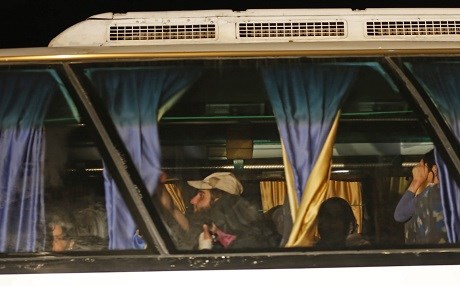
ERBIL, Kurdistan Region — The convoy transferring ISIS militants and their families from the Lebanon-Syria border to the province of Deir ez-Zor is no longer in territory controlled by the Syrian government, according to a statement by Hezbollah.
“The Syrian state and Hezbollah have fulfilled their obligations to transfer buses out of the area of Syrian government control without exposing them,” Reuters reported a statement from Hezbollah in Lebanon reading on Saturday evening.
However, six buses remain in government-held areas, according to the statement. Seventeen buses were originally in the convoy.
The Syrian army and Hezbollah in Lebanon agreed to a deal last weekend that allowed an ISIS convoy to relocate from their enclave on the Lebanon-Syria border to the eastern province of Deir ez-Zor.
The US-led Coalition to Defeat ISIS told Rudaw on Saturday that it had struck "more than 20 ISIS vehicles" trying to link up with the convoy and killing "an estimated 50 ISIS fighters."
“We as a coalition will continue to monitor that convoy of buses with ISIS fighters and we’ll continue to disrupt it and to prevent it from linking up with their fellow terrorists," US Army Col. and Coalition Spokesperson Ryan Dillon said.
Dillon explained that the Coalition initially assessed that the convoy was destined for the Iraq-Syria border.
"They had established a point to transfer to vehicles coming from Al Bukamal," Dillon said, referring to the Syrian border crossing that is called Al-Qaim on the Iraqi side.
The convoy was in the desert east of Humayma and As Sukhnah — located on the route between regime-held Palmyra and mostly ISIS-controlled Deir ez-Zor.
"That [the highway of Humayma] is where we struck many of the vehicles that were coming from ISIS held territory," Dillon added.
The buses then turned back for Palmyra and up towards As Sukhnah, Dillon detailed.
"Then we continued to disrupt this bus convoy by continuing to prevent them from moving further east. I think we’ve done a good job of killing many ISIS fighters and destroying some of their assets and preventing the link up of this terrorist group," he said.
Reports indicate more than 300 ISIS fighters with small arms are on the buses, though Iraqi intelligence officials fear that number may be much higher.
The Middle Euphrates River Valley stretching from Deir ez-Zor across the border and into Iraq currently has the largest concentration of ISIS fighters and leadership.
The Coalition has conducted nearly 100 strikes in the river valley over the past week targeting "vehicle borne improvised explosive devices, factories, some of their oil resources, [and] some of their weapons caches," Dillon explained.
The Syrian Army backed by Russia has also continued to target ISIS in Deir ez-Zor.
“Over the past two days, Russian planes have destroyed nine pieces of hardware, including two tanks, six artillery nests, one homemade multiple rocket launcher, three ammunition depots, a command center, as well as 20 trucks loaded with fuel, arms and ammunition near Deir ez-Zor city," read a statement from the Russian Defense Ministry on Saturday.
Russia and the Coalition have been in a so-called race to the oil-rich and geographically important Deir ez-Zor, where thousands of ISIS militants are expected to be hiding out.
US Defense Secretary James Mattis called the river valley "ISIS's last stand" while in Jordan last month.
“The Syrian state and Hezbollah have fulfilled their obligations to transfer buses out of the area of Syrian government control without exposing them,” Reuters reported a statement from Hezbollah in Lebanon reading on Saturday evening.
However, six buses remain in government-held areas, according to the statement. Seventeen buses were originally in the convoy.
The Syrian army and Hezbollah in Lebanon agreed to a deal last weekend that allowed an ISIS convoy to relocate from their enclave on the Lebanon-Syria border to the eastern province of Deir ez-Zor.
The US-led Coalition to Defeat ISIS told Rudaw on Saturday that it had struck "more than 20 ISIS vehicles" trying to link up with the convoy and killing "an estimated 50 ISIS fighters."
“We as a coalition will continue to monitor that convoy of buses with ISIS fighters and we’ll continue to disrupt it and to prevent it from linking up with their fellow terrorists," US Army Col. and Coalition Spokesperson Ryan Dillon said.
Dillon explained that the Coalition initially assessed that the convoy was destined for the Iraq-Syria border.
"They had established a point to transfer to vehicles coming from Al Bukamal," Dillon said, referring to the Syrian border crossing that is called Al-Qaim on the Iraqi side.
The convoy was in the desert east of Humayma and As Sukhnah — located on the route between regime-held Palmyra and mostly ISIS-controlled Deir ez-Zor.
"That [the highway of Humayma] is where we struck many of the vehicles that were coming from ISIS held territory," Dillon added.
The buses then turned back for Palmyra and up towards As Sukhnah, Dillon detailed.
"Then we continued to disrupt this bus convoy by continuing to prevent them from moving further east. I think we’ve done a good job of killing many ISIS fighters and destroying some of their assets and preventing the link up of this terrorist group," he said.
Reports indicate more than 300 ISIS fighters with small arms are on the buses, though Iraqi intelligence officials fear that number may be much higher.
The Middle Euphrates River Valley stretching from Deir ez-Zor across the border and into Iraq currently has the largest concentration of ISIS fighters and leadership.
The Coalition has conducted nearly 100 strikes in the river valley over the past week targeting "vehicle borne improvised explosive devices, factories, some of their oil resources, [and] some of their weapons caches," Dillon explained.
The Syrian Army backed by Russia has also continued to target ISIS in Deir ez-Zor.
“Over the past two days, Russian planes have destroyed nine pieces of hardware, including two tanks, six artillery nests, one homemade multiple rocket launcher, three ammunition depots, a command center, as well as 20 trucks loaded with fuel, arms and ammunition near Deir ez-Zor city," read a statement from the Russian Defense Ministry on Saturday.
Russia and the Coalition have been in a so-called race to the oil-rich and geographically important Deir ez-Zor, where thousands of ISIS militants are expected to be hiding out.
US Defense Secretary James Mattis called the river valley "ISIS's last stand" while in Jordan last month.
Comments
Rudaw moderates all comments submitted on our website. We welcome comments which are relevant to the article and encourage further discussion about the issues that matter to you. We also welcome constructive criticism about Rudaw.
To be approved for publication, however, your comments must meet our community guidelines.
We will not tolerate the following: profanity, threats, personal attacks, vulgarity, abuse (such as sexism, racism, homophobia or xenophobia), or commercial or personal promotion.
Comments that do not meet our guidelines will be rejected. Comments are not edited – they are either approved or rejected.
Post a comment