


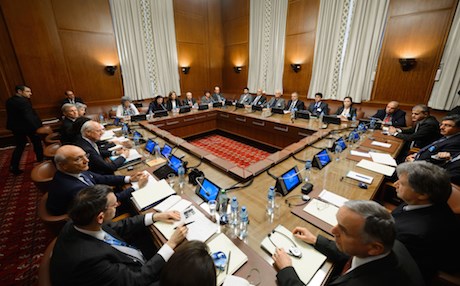
ERBIL, Kurdistan Region — The ruling Federal Council in Syria’s Kurdistan says the peace talks in Geneva have not been able to produce a common ground for the opposing parties in Syria towards a sustainable peace.
The council which represents the mainly Kurdish enclave in the northeastern corner of the country known as Rojava declared last month it was pushing for a federal system in Syria with more powers granted to its diverse regions.
Earlier last month, the representatives of the Syrian government and the opposition exchanged documents under the supervision of United Nations Special Envoy, Staffan De Mistura, in Geneva in which they outlined their basic positions.
But the documents have not addressed the Kurdish question in the country, according to the council.
“De Mistura’s documents do not embrace the requests of the Syrian people and could not solve the country’s many crises,” a statement issued by the council says.
Kurdish factions were not included in Geneva talks despite pressure from the US and Russia.
According to the documents, which have the explicit support of the UN’s Security Council, an interim government should be selected and become the authoritative body until the summer of 2017 when the county goes for general elections.
“I do not see any progress on the ground between the conflicting parties as a result of the Geneva talks but I think it has prolonged the ceasefire,” says Kurdish journalist Mustafa Abdi, based in Syria’s Kurdistan.
Abdi says the government and the opposition are still fundamentally against one another and accuse each other of terrorism and war crimes in their daily media outlets.
According to Kurdish political analyst in Syria, Masoud al-Hasani, both sides have been exhausted by years of fighting as they now try to reorganize themselves for new rounds of clashes, sponsored by their international allies.
“It is a chaotic situation we are witnessing in Syria. The opposition is not as united as it tries to pretend since it is composed of several opposing armed groups,” Al Hasani says. “I do not think they will find common grounds in the very near future.”
He says the government forces have been able to retake many areas from the ISIS militants due to the ceasefire with the opposition.
The army’s advance in central Syria after driving out the militants from the city of Tedmur (Palmyra) has given weight to the government position in the talks, according to Al-Hasani.
“What can rebalance the positions now between the two sides is the ISIS capital of Raqqa if the opposition forces can retake it,” he says.
Comments
Rudaw moderates all comments submitted on our website. We welcome comments which are relevant to the article and encourage further discussion about the issues that matter to you. We also welcome constructive criticism about Rudaw.
To be approved for publication, however, your comments must meet our community guidelines.
We will not tolerate the following: profanity, threats, personal attacks, vulgarity, abuse (such as sexism, racism, homophobia or xenophobia), or commercial or personal promotion.
Comments that do not meet our guidelines will be rejected. Comments are not edited – they are either approved or rejected.
Post a comment