


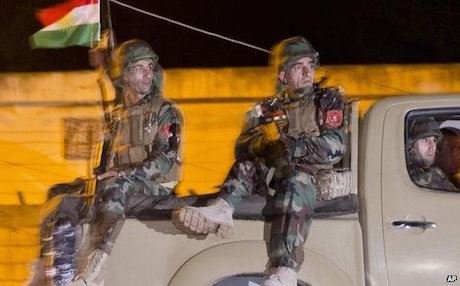
ERBIL, Kurdistan Region – The commander of Peshmerga forces in Kobane announced that Kurds now control 85 percent of the city in Syrian Kurdistan, and that the number of families now living there has doubled to 300.
Peshmerga troops arrived in Kobane at the start of November last year to help the Kurdish People’s Protection Units (YPG) in the fight to defend the city from being overrun by militants of the Islamic State, known as ISIS or ISIL.
"When we entered the city the ISIL was in control of 50 percent of the neighborhoods, but the Peshmerga forces and People's Protection Units have regained control over 85 percent of the city," said Brigadier Shawkat Mizuri, commander of Peshmerga forces in Kobane.
"When the first batch of Peshmerga reached Kobane the remaining families in the city did not exceed 150,” he told Rudaw in written comments. “A large part of the displaced families have returned to their homes in Kobane after the entry of the Peshmerga forces. Now there are around 300 families."
Mizuri said the Peshmerga were ready to pull out of the city whenever he receives the order from his superiors.
Meanwhile Rudaw’s reporter near Kobane, Omar Kalo, explained how residents have been surviving in the embattled city on the Turkish border.
"Parents rely on humanitarian aid that was given to them in the past by several entities, including the Barzani Charity Foundation. The aid was placed in stores supervised by the concerned authorities and it is distributed to displaced families," he said.
Kalo said that the Turkish government has positioned two mobile medical units on the Syrian-Turkish border to transport wounded Peshmerga and YPG fighters to hospitals in Turkey.
"There are medical teams on the Syrian-Turkish border, transporting the sick and wounded from displaced families as well as Kurdish fighters to Turkish hospitals,” he explained.
Abdullah Cifci, the governor of Suruc district in Turkey, previously told Rudaw that “Turkey has arranged for two trucks of humanitarian assistance and food for Kurdish families in Kobane.”
Comments
Rudaw moderates all comments submitted on our website. We welcome comments which are relevant to the article and encourage further discussion about the issues that matter to you. We also welcome constructive criticism about Rudaw.
To be approved for publication, however, your comments must meet our community guidelines.
We will not tolerate the following: profanity, threats, personal attacks, vulgarity, abuse (such as sexism, racism, homophobia or xenophobia), or commercial or personal promotion.
Comments that do not meet our guidelines will be rejected. Comments are not edited – they are either approved or rejected.
Post a comment