


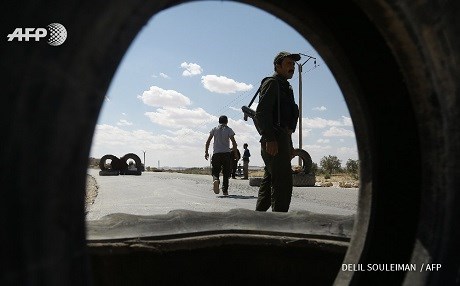
ERBIL, Kurdistan Region—Damascus has claimed that French and German special forces are on the ground in Syria in the areas of Kobane and Manbij, and has strongly condemned their presence as an “overt unjustified aggression.”
An official source at the Foreign and Expatriates Ministry, in a statement to Syrian state media SANA, called the French and German troops on Syrian soil a violation of the UN Charter. “[T]he Syrian Arab Republic vehemently condemns this blatant interference that constitutes a flagrant violation of UN Charter’s principles and an overt unjustified aggression on the sovereignty and independence of Syria,” the unnamed source said.
The source accused the French and German troops of giving legitimacy to terrorist groups by considering them moderates and insisted that foreign forces cannot claim their presence in Syria falls under any counterterrorism operations because any legitimate counterterrorism moves must be done in coordination with the Syrian government.
The source called on the European governments to “wake up from daydreams,” realize that the colonial days are gone, and respect Syria’s territorial sovereignty.
Germany quickly denied that it has any troops in Syria. “There are no German special forces in Syria,” said spokesperson from the German defence ministry. “The accusation is false.”
France has already acknowledged that it has special forces advising Syrian Democratic Forces (SDF) in the battle for Manbij.
“The offensive at Manbij is clearly being backed by a certain number of states including France. It’s the usual support – it’s advisory,” a French defence ministry official told AFP last week.
The French are providing weapons and military advice to the SDF, a coalition of forces in northern Syria dominated by the Kurdish People’s Protection Units (YPG). The French forces are under order to not engage in combat with Islamic State militants.
The United States has some 250 special forces in Syria, working with the YPG and SDF.
All three nations have forces advising and training Peshmerga forces in the Kurdistan Region.
An official source at the Foreign and Expatriates Ministry, in a statement to Syrian state media SANA, called the French and German troops on Syrian soil a violation of the UN Charter. “[T]he Syrian Arab Republic vehemently condemns this blatant interference that constitutes a flagrant violation of UN Charter’s principles and an overt unjustified aggression on the sovereignty and independence of Syria,” the unnamed source said.
The source accused the French and German troops of giving legitimacy to terrorist groups by considering them moderates and insisted that foreign forces cannot claim their presence in Syria falls under any counterterrorism operations because any legitimate counterterrorism moves must be done in coordination with the Syrian government.
The source called on the European governments to “wake up from daydreams,” realize that the colonial days are gone, and respect Syria’s territorial sovereignty.
Germany quickly denied that it has any troops in Syria. “There are no German special forces in Syria,” said spokesperson from the German defence ministry. “The accusation is false.”
France has already acknowledged that it has special forces advising Syrian Democratic Forces (SDF) in the battle for Manbij.
“The offensive at Manbij is clearly being backed by a certain number of states including France. It’s the usual support – it’s advisory,” a French defence ministry official told AFP last week.
The French are providing weapons and military advice to the SDF, a coalition of forces in northern Syria dominated by the Kurdish People’s Protection Units (YPG). The French forces are under order to not engage in combat with Islamic State militants.
The United States has some 250 special forces in Syria, working with the YPG and SDF.
All three nations have forces advising and training Peshmerga forces in the Kurdistan Region.
Comments
Rudaw moderates all comments submitted on our website. We welcome comments which are relevant to the article and encourage further discussion about the issues that matter to you. We also welcome constructive criticism about Rudaw.
To be approved for publication, however, your comments must meet our community guidelines.
We will not tolerate the following: profanity, threats, personal attacks, vulgarity, abuse (such as sexism, racism, homophobia or xenophobia), or commercial or personal promotion.
Comments that do not meet our guidelines will be rejected. Comments are not edited – they are either approved or rejected.
Post a comment