


ERBIL, Kurdistan Region – Contemporary Kurdish poet Abdullah Pashew, known for campaigning against Kurdish infighting, has written a poem about the Kurdish nation looking for the sun to rise over the western frontier of greater Kurdistan – Afrin.
He titled the poem Afringrad, calling to mind the German siege of Russia’s Leningrad (present-day St. Petersburg) during World War II.
The short poem released in both text and audio praises the resistance in Afrin, Syrian Kurdistan or Rojava, against the Turkish military offensive that began four weeks ago.
"Eighty million eyes are looking towards Rojava," the poem reads, referring to the estimated 40 million Kurds, arguably the world’s largest stateless nation.
Rojava translates to English as west.
"They are waiting for the sun, it will rise from the west."
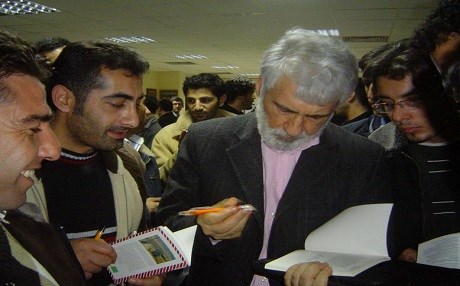
Pashew, a native of Erbil, was born in 1945. He has campaigned for the Kurdish cause since an early age through his poetry.
A popular literary figure, especially among the younger generation, he is most famous for writing against Kurdistan’s civil war in the mid-1990s.
He published a collection of his poems under the title "Civil War."
The PhD holder has been living in Finland since 1995, but visits the Kurdistan Region on occasion and holds poetry readings attended by hundreds of people.
This is not the first time he has written about the western corner of greater Kurdistan, which encompasses Kurdish lands in present day Turkey, Syria, Iraq, and Iran. A 1997 poem titled Afrin begins with the line, "I have been dreaming since I was born. I have been planting dreams since I was born," a reference to the Kurdish dream for an independent state.
The poem continues:
I take soft steps towards Afrin
So that I will wrap the scarf of siyaw chemane around the shoulder of lawk
Siyaw chemane is a form of Kurdish traditional music particular to the Hawraman region, located along the Iranian Kurdistan and Kurdistan Region border. Lawk is traditional music popular in parts of the Kurdistan Region, as well as Turkish and Syrian Kurdistan.
The following is the unofficial translation of Afringrad:
I hear the noise of F-16 in my ears
There I see the spark of hell fire and smell of smoke
80 million eyes are looking to the West
They are waiting for the sun, it will rise from the West
In the past, my hope was attached to the markets where they were preaching human rights
I was begging them to come to my rescue
They were asking: "Who are you?"
I was saying: "It was my mountain that sheltered Noah, I am the branch and trunk of the oak tree of Medes"
But from this point and on
If they ask me about my origins and my roots
I raise my head high
I say: "I share the same blood with the lions of Afringrad"
Comments
Rudaw moderates all comments submitted on our website. We welcome comments which are relevant to the article and encourage further discussion about the issues that matter to you. We also welcome constructive criticism about Rudaw.
To be approved for publication, however, your comments must meet our community guidelines.
We will not tolerate the following: profanity, threats, personal attacks, vulgarity, abuse (such as sexism, racism, homophobia or xenophobia), or commercial or personal promotion.
Comments that do not meet our guidelines will be rejected. Comments are not edited – they are either approved or rejected.
Post a comment