


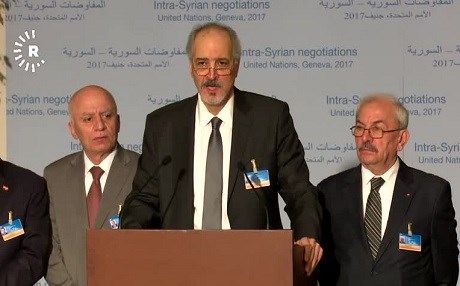
GENEVA – The Syrian envoy to the Geneva peace talks, Bashar Jaafari, welcomed help fighting terrorism in his country but said that is must be done only through cooperation and coordination with Damascus.
“We welcome all those who want to fight Daesh honestly and objectively in coordination with the Syrian government. Not by overlooking the Syrian government,” Jaafari said on Friday in response to a question from Rudaw on US-SDF coordination in Raqqa, using an Arabic acronym for ISIS.
“Fighting terrorism today is a global issue. It is not a purely American or British or Syrian or Iraqi issue. Fighting terrorism requires concerted efforts by all.”
However, he added, “the direct US military intervention in Syrian territory as well as arming factions in Syria and encouraging them to challenge the authority of the state does not serve the fight against terrorism. Fighting terrorism is not done by opening shops for this and that to fight Daesh. The only way to do that is to coordinate and to cooperate with the Syrian Arab Army.”
The US-led coalition has increased its support for the Syrian Democratic Forces (SDF) as they isolate Raqqa and prepare for an assault on the city itself to oust ISIS from their de facto capital.
The coalition is advising and assisting the SDF in northern Syria, and has provided some military equipment and training. Most recently, the coalition and the SDF carried out a joint operation, airdropping forces across the Euphrates River as part of their efforts to take control of the strategic Tabqa Dam.
Jaafari made his comments in Geneva where he is attending the fifth round of UN-sponsored peace talks aimed at finding a resolution to the Syrian civil war, now in its seventh year.
The intra-Syrian talks were scheduled to start on March 23 but were delayed one day as the UN’s special envoy heading the talks, Staffan de Mistura, visited Moscow and Ankara.
According to de Mistura, there are three plus one “baskets” on the table: transitional governance, constitutional process, elections, and, as requested by the Syrian government, counter-terrorism.
The High Negotiation Committee (HNC) representing opposition groups refused the addition of the fourth basket as part of the agenda at the talks. They also asked for point-by-point discussions on each of the main issues and direct negotiation with the government side.
Damascus, however, would prefer to continue with indirect talks through the UN mediator as well as negotiations on all four baskets simultaneously.
The HNC’s Naser al-Hariri, at his first appearance before the media in Geneva, said “We are here to join the political process with the aim to start a new era that leads to political transition without Bashar al-Assad and all his clique.”
This demand of the opposition will be a major hurdle on the progression of the talks.
The Kurdish National Council (KNC) is part of the HNC and they have members on all committees and institutions of the broad-based opposition. Hawas Khalil, Kurdish member of the political committee of the HNC and advisor to the delegation, told Rudaw in Geneva that “the Kurds will be part of all political organs and institutions, as will all other religious and ethnic groups in Syria, if we reach any kind of political progress or the new era of Syria is launched.”
Launching a new era in Syria will be difficult as a nation-wide ceasefire still has not taken hold and the parties remain far from each other in their demands. As the UN special envoy at the end of last round of talks said, “We did not expect miracles and frankly we did not have miracles.”
“We welcome all those who want to fight Daesh honestly and objectively in coordination with the Syrian government. Not by overlooking the Syrian government,” Jaafari said on Friday in response to a question from Rudaw on US-SDF coordination in Raqqa, using an Arabic acronym for ISIS.
“Fighting terrorism today is a global issue. It is not a purely American or British or Syrian or Iraqi issue. Fighting terrorism requires concerted efforts by all.”
However, he added, “the direct US military intervention in Syrian territory as well as arming factions in Syria and encouraging them to challenge the authority of the state does not serve the fight against terrorism. Fighting terrorism is not done by opening shops for this and that to fight Daesh. The only way to do that is to coordinate and to cooperate with the Syrian Arab Army.”
The US-led coalition has increased its support for the Syrian Democratic Forces (SDF) as they isolate Raqqa and prepare for an assault on the city itself to oust ISIS from their de facto capital.
The coalition is advising and assisting the SDF in northern Syria, and has provided some military equipment and training. Most recently, the coalition and the SDF carried out a joint operation, airdropping forces across the Euphrates River as part of their efforts to take control of the strategic Tabqa Dam.
Jaafari made his comments in Geneva where he is attending the fifth round of UN-sponsored peace talks aimed at finding a resolution to the Syrian civil war, now in its seventh year.
The intra-Syrian talks were scheduled to start on March 23 but were delayed one day as the UN’s special envoy heading the talks, Staffan de Mistura, visited Moscow and Ankara.
According to de Mistura, there are three plus one “baskets” on the table: transitional governance, constitutional process, elections, and, as requested by the Syrian government, counter-terrorism.
The High Negotiation Committee (HNC) representing opposition groups refused the addition of the fourth basket as part of the agenda at the talks. They also asked for point-by-point discussions on each of the main issues and direct negotiation with the government side.
Damascus, however, would prefer to continue with indirect talks through the UN mediator as well as negotiations on all four baskets simultaneously.
The HNC’s Naser al-Hariri, at his first appearance before the media in Geneva, said “We are here to join the political process with the aim to start a new era that leads to political transition without Bashar al-Assad and all his clique.”
This demand of the opposition will be a major hurdle on the progression of the talks.
The Kurdish National Council (KNC) is part of the HNC and they have members on all committees and institutions of the broad-based opposition. Hawas Khalil, Kurdish member of the political committee of the HNC and advisor to the delegation, told Rudaw in Geneva that “the Kurds will be part of all political organs and institutions, as will all other religious and ethnic groups in Syria, if we reach any kind of political progress or the new era of Syria is launched.”
Launching a new era in Syria will be difficult as a nation-wide ceasefire still has not taken hold and the parties remain far from each other in their demands. As the UN special envoy at the end of last round of talks said, “We did not expect miracles and frankly we did not have miracles.”
Comments
Rudaw moderates all comments submitted on our website. We welcome comments which are relevant to the article and encourage further discussion about the issues that matter to you. We also welcome constructive criticism about Rudaw.
To be approved for publication, however, your comments must meet our community guidelines.
We will not tolerate the following: profanity, threats, personal attacks, vulgarity, abuse (such as sexism, racism, homophobia or xenophobia), or commercial or personal promotion.
Comments that do not meet our guidelines will be rejected. Comments are not edited – they are either approved or rejected.
Post a comment