


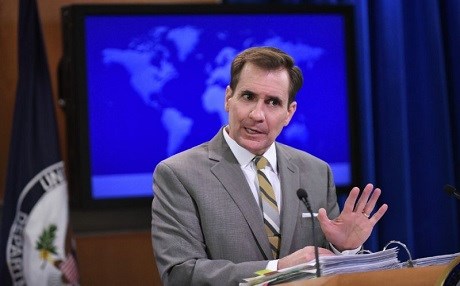
ERBIL, Kurdistan Region – The US State Department’s spokesperson John Kirby has warned that Turkey is giving “oxygen” to the Islamic State (ISIS) militants by bombing its Syrian Kurdish enemies.
“We do not support nor condone any maneuvers in this area which can only give new oxygen to [ISIS],” Kirby said in a tweet early on Monday.
Kirby was tweeting in response to Turkish airstrikes on the Syrian Kurdish Peoples’ Protection Units (YPG), which began on Wednesday, and ongoing clashes between the YPG and the Turkish-backed Free Syrian Army (FSA) group in northwest Syria.
“Call on all sides to stand down and focus on greater threats,” Kirby tweeted.
Since both these groups are fighting ISIS, Kirby fears that ISIS will be empowered if they end up just fighting each other.
“Contrary to reports, the US has nothing to do with reported clashes west of Marea,” he added, referring to a town where the YPG has been clashing with Turkey’s FSA proxies.
The spokesperson also said he was, “Concerned of reports about civilian casualties in recent air and artillery strikes in northern Syria,” launched by Turkey.
“We do not support nor condone any maneuvers in this area which can only give new oxygen to [ISIS],” Kirby said in a tweet early on Monday.
Kirby was tweeting in response to Turkish airstrikes on the Syrian Kurdish Peoples’ Protection Units (YPG), which began on Wednesday, and ongoing clashes between the YPG and the Turkish-backed Free Syrian Army (FSA) group in northwest Syria.
“Call on all sides to stand down and focus on greater threats,” Kirby tweeted.
Since both these groups are fighting ISIS, Kirby fears that ISIS will be empowered if they end up just fighting each other.
“Contrary to reports, the US has nothing to do with reported clashes west of Marea,” he added, referring to a town where the YPG has been clashing with Turkey’s FSA proxies.
The spokesperson also said he was, “Concerned of reports about civilian casualties in recent air and artillery strikes in northern Syria,” launched by Turkey.
Comments
Rudaw moderates all comments submitted on our website. We welcome comments which are relevant to the article and encourage further discussion about the issues that matter to you. We also welcome constructive criticism about Rudaw.
To be approved for publication, however, your comments must meet our community guidelines.
We will not tolerate the following: profanity, threats, personal attacks, vulgarity, abuse (such as sexism, racism, homophobia or xenophobia), or commercial or personal promotion.
Comments that do not meet our guidelines will be rejected. Comments are not edited – they are either approved or rejected.
Post a comment