


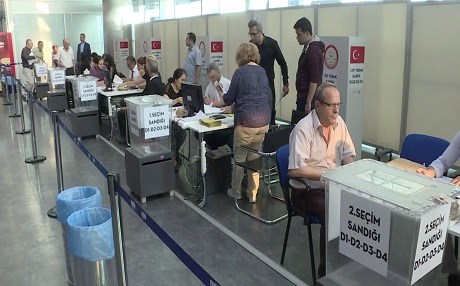
ERBIL, Kurdistan Region — Turks living abroad began voting in presidential and parliamentary elections on Thursday.
“I am very happy to have cast the first vote here. We love our country so much,” Suheyla Kara told Turkey's Anadolu Agency. Kara was the first expatriate to cast a vote at Kapikule border gate.
More than 3 million Turks are eligible to vote out of the country.
Turkey has a consulate general in the Kurdistan Region's capital of Erbil.
Eight parties are contending for seats in Turkey's Grand Assembly. It is currently controlled by the Justice and Development Party (AKP).
Its main opposition is the Republican People's Party (CHP).
Other opposition includes the pro-Kurdish People's Democratic Party (HDP).
HDP chose to run Selahattin Demirtas, a jailed Kurd, for president.
"Unfortunately, Turkey as a whole, has been transformed into a semi-open prison. They want to build a society of fear, an empire of fear, whereas the function of the state is not to terrify its citizens but to serve them," Demirtas wrote in a party statement on Wednesday.
The AKP is running incumbent President Recep Tayyip Erdogan. Following the constitutional referendum that passed in 2017, a presidential system will go into effect in Turkey after these snap elections.
Outgoing PM Binali Yildirim addressed the AKP's stance towards the HDP.
"The harm HDP did to the Kurds is innumerable," he said, claiming that the HDP has ties to the banned PKK.
Yildirim was speaking at an election rally in eastern Kars province.
"They are receiving votes and support from you, my Kurdish brothers, but they receive orders from Qandil," Yildirim said.
Turks will vote in-country on June 24. It is the first election to be held in Turkey since the failed military coup of July 2016. Turkey is currently in a state of emergency.
Comments
Rudaw moderates all comments submitted on our website. We welcome comments which are relevant to the article and encourage further discussion about the issues that matter to you. We also welcome constructive criticism about Rudaw.
To be approved for publication, however, your comments must meet our community guidelines.
We will not tolerate the following: profanity, threats, personal attacks, vulgarity, abuse (such as sexism, racism, homophobia or xenophobia), or commercial or personal promotion.
Comments that do not meet our guidelines will be rejected. Comments are not edited – they are either approved or rejected.
Post a comment