


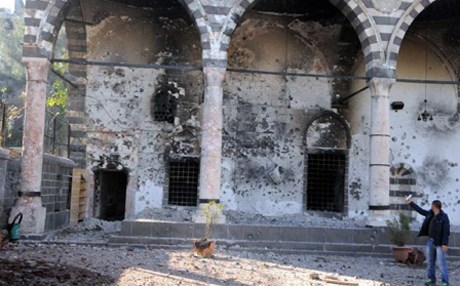
ERBIL, Kurdistan Region — The United Nation’s human rights agency acknowledged the complex situation Turkey has been facing in light of the July 2016 attempted coup and ongoing terrorist attacks, but the organization is "deeply concerned at the significant deterioration of the human rights situation in South-East Turkey since July 2015” and its unanswered May 2016 request to “grant a team of human rights officers full and unhindered access to the concerned area” to “substantiate facts and ascertain reported human rights concerns.”
The Office of the United Nations High Commissioner for Human Rights (OHCHR) released on Friday a report — the first in a series — on the human rights situation in predominately-Kurdish southeastern Turkey. The report was produced through remote monitoring, using both public and confidential sources, satellite imagery, and interviews to gather information about the conduct and impact of the security operations in the southeast of the country.
A new round of clashes reignited the conflict between the army and Kurdistan Workers Party (PKK) guerrillas after peace talks collapsed in mid-2015. The PKK is banned in Turkey, and is a designated terrorist organization by the United States, the European Union, and Turkey.
“I am particularly concerned by reports that no credible investigation has been conducted into hundreds of alleged unlawful killings, including women and children over a period of 13 months between late July 2015 and the end of August of 2016. It appears that not a single suspect was apprehended and not a single individual was prosecuted,” UN High Commissioner for Human Rights, Zeid Ra’ad Al Hussein stated in the report.
Nils Muiznieks, the commissioner for Human Rights of the Council of Europe, visited Turkey in April 2016. During his visit, he was “provided full access to all the places he requested to see and all the persons he requested to meet during his visit in Ankara, Istanbul and Diyarbakır,” Turkey stated in its observations on Muiznieks’ report on his visit.
A summary of Muiznieks observations of the Turkish government’s position: “While Turkish security authorities have been conducting counter-terrorism efforts in line with legal principles as well as norms and standards enshrined in human rights instruments, Turkey has been targeted by ungrounded allegations, mostly as a result of PKK [Kurdistan Workers’ Party] propaganda.”
The report from Muiznieks’ visit cited statistics provided by the Turkish government: “in the course of the terrorist campaign since July 2015 (as of Nov. 28, 2016), 323 civilians and 799 security personnel were murdered; 2,040 civilians and 4,428 security personnel were wounded; 231 civilians were kidnapped by the PKK.”
The Turkish Human Rights Foundation, a non-governmental organization (NGO), published a report in August 2016 that “identifies by name 321 local residents who were allegedly killed between 16 August 2015 and 16 August 2016, including 79 children, 71 women and 30 people over the age of 60. Up to 189 local residents are believed to have been killed in the town of Cizre alone (Sırnak province) in three related incidents.”
The International Crisis Group (ICG) reported earlier this year that 2,481 people have lost their lives since July 2015 in the army-PKK conflict. The group has based its detailed figures of the death toll on verified media reports, accounts of international and domestic rights groups, and the Turkish army’s official data. The ICG says it has not taken into account reports provided by the Turkish government or the PKK since their records have too often been impossible to verify.
Hussein contended that the UN has not been granted to affected areas, and that the magnitude of the destruction and displacement makes its requested investigation necessary.
“The Government of Turkey has failed to grant us access, but has contested the veracity of the very serious allegations made in this report. But the gravity of the allegations, the scale of the destruction and the displacement of more than 355,000 people mean that an independent investigation is both urgent and essential,” he said.
The Internal Displacement Monitoring Centre (IDMC), an international body producing information on internally displaced people around the world, believes the number of displaced in the renewed conflict is actually much higher — 945,000.
In the absence of an investigatory team in Turkey, the UN used its own Institute for Training and Research (UNITAR) and Operational Satellite Applications Programme (UNOSAT) to analyze satellite imagery of two cities: Nusaybin in Mardin province and the Sur district of Diyarbakir.
The UN images depict what is claimed to be the destruction of Suleyman Nazif School in Sur. The image from June 22, 2015 shows three large red-roofed buildings at the location of the school. A second black-and-white image taken on March 5, 2016, shows apparent damage to the buildings, and a third image taken on July 26, 2016, shows just one of the three red-roofed buildings left standing with the other two red buildings missing and more than half of the surrounding structures also gone.
A similar satellite image dated May 25, 2016, shows the city of Nusaybin, which sits across the border from the Syrian city of Qamishli. More than half of east Nusaybin is labeled as having “moderate damage” or “destroyed” to structures, while a pocket in the far southwest has many structures marked as “destroyed.”
The July 26, 2016-dated analysis of Sur marks most of its southeastern quadrant “destroyed,” as well as almost complete destruction of Sur’s 2,000 year-old city walls, which are a UNESCO-designated site of World Heritage.
The Diyarbakir city walls were built in 349 AD, during the reign of Roman Emperor Constantine II. The walls of the fortress, which are almost five kilometers long, contain 82 bastions and have four gates. The 8,000-year old Hevsel Gardens are the fertile lands between the city walls and the Tigris River valley.
Out of 90,000 people who lived in the city of Sirnak, only 15,000 have returned, a resident told Rudaw earlier this year. Sirnak has been one of the towns most affected by the conflict.
The OHCHR alleged interference with freedom of opinion and the media as a limiting factor in covering the carnage in Turkey.
“On 20 January 2016, we were trying to film and document what was happening in Cizre,” OHCHR quoted a Kurdish journalist as saying. “We were in the Cudi neighbourhood, unarmed, in a group with other unarmed people. We were carrying a white flag and filming people removing dead bodies. As we were trying to cross a street, my cameraman was shot at from distance.”
On September 4, 2016, the Turkish government announced a reconstruction and economic development package for southeast Turkey. According to the plan, Turkey would spend 21 billion US dollars in the regions “destroyed by the PKK since July 2015.”
The 25-page report produced by the Office of the United Nations High Commissioner for Human Rights is available online, which includes satellite imagery.
Comments
Rudaw moderates all comments submitted on our website. We welcome comments which are relevant to the article and encourage further discussion about the issues that matter to you. We also welcome constructive criticism about Rudaw.
To be approved for publication, however, your comments must meet our community guidelines.
We will not tolerate the following: profanity, threats, personal attacks, vulgarity, abuse (such as sexism, racism, homophobia or xenophobia), or commercial or personal promotion.
Comments that do not meet our guidelines will be rejected. Comments are not edited – they are either approved or rejected.
Post a comment