


ERBIL, Kurdistan Region – Selahattin Demirtas, former co-chair of the pro-Kurdish Peoples’ Democratic Party (HDP), spoke Kurdish in his defence in an Ankara court on Wednesday where he is facing new terror-related charges.
“Before anything, I would like to say explicitly that I really wanted to defend myself in my mother tongue throughout my trial. Unfortunately, however, under heavy pressure for 100 years, I, like millions of Kurdish children, have been distanced from my language,” he told the court.
Demirtas, who is not fluent in Kurdish, has been studying the language while in prison.
“In Turkey, Kurdish education is banned and Kurdish language isn’t recognized as an official language. The language, culture, history, and identity of my nation isn’t recognized and they want to destroy it,” he said.
In Turkey’s Grand Assembly in 1920, Kurdish members were able to wear their traditional clothing and speak their native language and were recognized as representatives of Kurdistan, Demirtas added. But now, their language is considered “alien” or recorded as “X” when Kurdish deputies speak in the parliament.
He urged Kurds to speak their language and not give up.
Demirtas, who is facing multiple terror-related charges, faces up to 142 years if he is convicted on all counts. He has been in jail since his arrest in November 2016.
Most of the charges stem from allegations of ties with the PKK – a banned organization in Turkey. Demirtas led negotiations during peace talks between the PKK and the Turkish government five years ago.
The new charges put before him in the trial that opened on Wednesday include managing a terror organization, conducting propaganda for a terrorist organization, and “enmity of the people.”
Prosecutors have demanded 10 years jail time, according to state media Anadolu Agency.
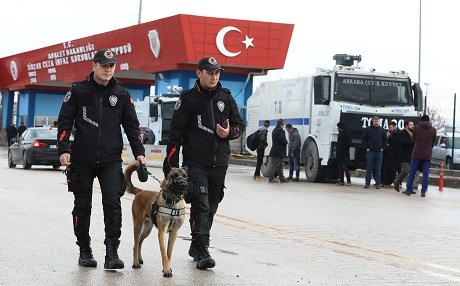
Security was tight outside the courthouse.
A Turkish-born German politician, Hakan Tas, had traveled to Ankara to attend the hearing, but was denied entry. Foreign observers have been routinely blocked from attending Demirtas’ court hearings.
Europeans have been closely following the trial following a decision last month by the European Court of Human Rights (ECHR), which ruled that Demirtas should be released from lengthy pre-trial detention pending an appeal of his case.
Turkey’s President Recep Tayyip Erdogan said the court’s decision has no bearing on Turkey. Demirtas was kept in jail and an Istanbul court subsequently denied his appeal.
"This is a position that completely goes against international law," said Tas, AFP reported.
He said he doubts the Kurdish leader will be released ahead of local elections planned for March 2019.
This is ‘definition of a political prisoner’
The European Parliament discussed Demirtas’ continued detention in a session on Tuesday,
Federica Mogherini, high representative of the EU for Foreign Affairs and Security Policy, argued in the European Parliament that the ECHR does have jurisdiction in Turkey. She pointed out that the court was established by the Council of Europe, of which Turkey is a founding member, and the European Convention on Human Rights is “embedded in Turkey’s domestic law.”
“So this is not a violation of a recommendation coming from the European Union,” she said of Erdogan’s rejection of the court’s decision, “but of Turkey’s own principles and values.”
Kati Piri, member of the European Parliament and special rapporteur on Turkey, said Demirtas’ case “is the definition of a political prisoner.”
“This is the reason why President Erdogan has no plans to release his political opponent. It’s easier to rule without an opposition, without free press, and without civil society,” she said.
Piri also addressed Demirtas’ spouse Basak, saying the whole European Parliament supports her.
“Selahattin, em bi tere ne. We are with you,” she concluded in Kurdish.
Kurdish language is banned in the Turkish parliament.
“Before anything, I would like to say explicitly that I really wanted to defend myself in my mother tongue throughout my trial. Unfortunately, however, under heavy pressure for 100 years, I, like millions of Kurdish children, have been distanced from my language,” he told the court.
Demirtas, who is not fluent in Kurdish, has been studying the language while in prison.
“In Turkey, Kurdish education is banned and Kurdish language isn’t recognized as an official language. The language, culture, history, and identity of my nation isn’t recognized and they want to destroy it,” he said.
In Turkey’s Grand Assembly in 1920, Kurdish members were able to wear their traditional clothing and speak their native language and were recognized as representatives of Kurdistan, Demirtas added. But now, their language is considered “alien” or recorded as “X” when Kurdish deputies speak in the parliament.
He urged Kurds to speak their language and not give up.
Demirtas, who is facing multiple terror-related charges, faces up to 142 years if he is convicted on all counts. He has been in jail since his arrest in November 2016.
Most of the charges stem from allegations of ties with the PKK – a banned organization in Turkey. Demirtas led negotiations during peace talks between the PKK and the Turkish government five years ago.
The new charges put before him in the trial that opened on Wednesday include managing a terror organization, conducting propaganda for a terrorist organization, and “enmity of the people.”
Prosecutors have demanded 10 years jail time, according to state media Anadolu Agency.
Security was tight outside the courthouse.
A Turkish-born German politician, Hakan Tas, had traveled to Ankara to attend the hearing, but was denied entry. Foreign observers have been routinely blocked from attending Demirtas’ court hearings.
Europeans have been closely following the trial following a decision last month by the European Court of Human Rights (ECHR), which ruled that Demirtas should be released from lengthy pre-trial detention pending an appeal of his case.
Turkey’s President Recep Tayyip Erdogan said the court’s decision has no bearing on Turkey. Demirtas was kept in jail and an Istanbul court subsequently denied his appeal.
"This is a position that completely goes against international law," said Tas, AFP reported.
He said he doubts the Kurdish leader will be released ahead of local elections planned for March 2019.
This is ‘definition of a political prisoner’
The European Parliament discussed Demirtas’ continued detention in a session on Tuesday,
Federica Mogherini, high representative of the EU for Foreign Affairs and Security Policy, argued in the European Parliament that the ECHR does have jurisdiction in Turkey. She pointed out that the court was established by the Council of Europe, of which Turkey is a founding member, and the European Convention on Human Rights is “embedded in Turkey’s domestic law.”
"The fate of Selahattin Demirtaş is an issue that I believe lies close to the hearts of many of us" @FedericaMog #EPlenary. Read the full speech here https://t.co/uuEWJVBqLJ pic.twitter.com/Unhw9HEsmS
— European External Action Service - EEAS 🇪🇺 (@eu_eeas) December 11, 2018
“So this is not a violation of a recommendation coming from the European Union,” she said of Erdogan’s rejection of the court’s decision, “but of Turkey’s own principles and values.”
Kati Piri, member of the European Parliament and special rapporteur on Turkey, said Demirtas’ case “is the definition of a political prisoner.”
“This is the reason why President Erdogan has no plans to release his political opponent. It’s easier to rule without an opposition, without free press, and without civil society,” she said.
He is jailed, denied his freedom of expression and right to politics.
— Kati Piri (@KatiPiri) December 11, 2018
For what? For representing millions of people in Turkey who want peace and equal rights.
Selahattin, em bi tere ne! #freedemirtas pic.twitter.com/BPWayDGcCV
Piri also addressed Demirtas’ spouse Basak, saying the whole European Parliament supports her.
“Selahattin, em bi tere ne. We are with you,” she concluded in Kurdish.
Kurdish language is banned in the Turkish parliament.
Comments
Rudaw moderates all comments submitted on our website. We welcome comments which are relevant to the article and encourage further discussion about the issues that matter to you. We also welcome constructive criticism about Rudaw.
To be approved for publication, however, your comments must meet our community guidelines.
We will not tolerate the following: profanity, threats, personal attacks, vulgarity, abuse (such as sexism, racism, homophobia or xenophobia), or commercial or personal promotion.
Comments that do not meet our guidelines will be rejected. Comments are not edited – they are either approved or rejected.
Post a comment