


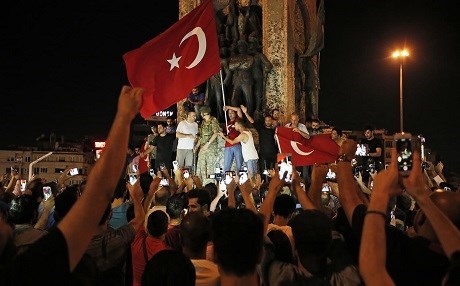
ERBIL, Kurdistan Region—Turkish forces backed by drones and helicopters launched a manhunt for 11 renegade special forces soldiers who attempted to capture or kill President Recep Erdogan at his coastal resort of Marmaris on the night of the July 15 coup attempt.
The forces had been unable to interdict Erdogan before he left Marmaris on his plane to Istanbul to rally the people against the coup plotters. The special forces subsequently fled as the coup failed.
Also on Tuesday Turkish Energy Minister Berat Albayrak said in a Television interview that security forces had detained two air force commanders in charge during the bombing of the Kurdish village of Roboski and the downing of a Russian jet over Syria.
According to Albayrak, the commander on the Roboski front was linked to the Gulen movement and is suspected of deliberately targeting a group of Kurdish civilians on the border with the Kurdistan Region with an air strike that killed 34 of them in December 2011.
The minister said that the investigation into the case will be reopened and examined in new light.
The same goes for investigating the downing of the Russian jet last November.
Since then Erdogan’s government has detained approximately 60,000 soldiers, judges and civil servants. The Turkish government blames the US-based Fethullah Gulen, saying he orchestrated the coup.
Gulen has denied he had any role in the attempt. The US has agreed they will extradite Gulen if Turkey can prove its allegations.
Turkey’s Justice Minister Bekir Bozdag claimed on Tuesday that “intelligence” indicated that Gulen was biding time to escape the US and take refuge in a country which doesn’t have an extradition treaty Turkey.
“There is no institution which this structure has not infiltrated,” said Turkey’s Energy Minister Berat Albayrak on Turkish television, in a clear reference to Gulen supporters in Turkey.
The July 15 coup attempt killed 246 people and wounded over 2,000.
Comments
Rudaw moderates all comments submitted on our website. We welcome comments which are relevant to the article and encourage further discussion about the issues that matter to you. We also welcome constructive criticism about Rudaw.
To be approved for publication, however, your comments must meet our community guidelines.
We will not tolerate the following: profanity, threats, personal attacks, vulgarity, abuse (such as sexism, racism, homophobia or xenophobia), or commercial or personal promotion.
Comments that do not meet our guidelines will be rejected. Comments are not edited – they are either approved or rejected.
Post a comment