


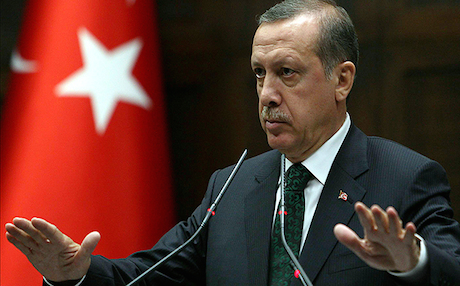
LONDON – Like some latter-day King Canute, Turkey’s Prime Minister Recep Tayyip Erdogan is attempting to stem the tide of social media, which he claims menaces Turkish society.
Unlike the 11th century English King, a subtle monarch who once commanded the sea not to advance on to his shores as a means of illustrating to his subjects the limits of his authority, Mr Erdogan appears to believe he can achieve the impossible.
Ahead of Sunday’s municipal elections, which may serve as an unofficial referendum on Mr Erdogan’s increasingly troubled premiership, he ordered the microblogging service Twitter to be blocked on national security grounds.
That was followed with a ban on YouTube, after the popular video-upload site carried a tape that contained seemingly incriminating conversations between the prime minister and his associates.
The Twitter ban was described by the US State Department as the 21st century version of book burning. A group of leading international writers, including the Turkish Nobel laureate Orhan Pamuk, denounced the measure in an open letter as "an unacceptable violation of the right to freedom of speech.”
Mr Pamuk and his fellow signatories noted that such attempts at censorship were not confined to suppression of social media. They highlighted the case of Muharrem Erbey, a human rights lawyer held since 2009 because of his alleged affiliation with Kurdish political parties.
Despite this and other international condemnation, Mr Erdogan remained defiant, even after Turkey’s President Abdullah Gul called the Twitter ban illegal and a Turkish district court ruled against it.
President Gul perhaps got to the heart of the matter when he noted that the use of Twitter among Turks actually went up after the ban was imposed. The resourceful Turkish social media community, with the help of allies abroad, rapidly set up proxies to circumvent the restrictions. Whether or not the ban was illegal, it certainly appeared to be ineffectual.
Authoritarian regimes have attempted, with limited success, to stifle the growth of social media in recent years. But it was rare for a democratically elected government to seek to outlaw a social media platform. Turkey briefly blocked YouTube access in 2007.
It has been widely held, by both supporters and detractors, that social media helped to fuel the unrest that accompanied the so-called Arab Spring. Regime opponents were able to coordinate their actions via Twitter and Facebook in a way that would have been impossible in a previous era.
Egypt’s Hosni Mubarak shut down Twitter at the height of the unrest that was eventually to unseat him. One unintended consequence was to drive even more protestors on to the streets.
Mr Erdogan’s animosity towards social media stems from last year’s Gezi Park protests in which riot police eventually broke up a long-running sit-in against redevelopment in central Istanbul.
The prime minister blamed the demonstrations on an extremist fringe, spurred on by his political opponents. "There is now a menace which is called Twitter," Mr Erdogan said at the time. "The best examples of lies can be found there. To me, social media is the worst menace to society."
Opposition politicians responded by urging the prime minister to listen to people instead of attempting to silence them. Hasip Kaplan, a parliamentarian from the pro-Kurdish Peace and Democracy party, said a government policy of “for the people despite the people” was bankrupt and it was time to allow the public to take part in decision-making.
Since the Gezi protests were suppressed, Mr Erdogan and his ruling Justice and Development Party (AKP) have faced mounting criticism over alleged corruption and political manipulation, much of it disseminated via social media.
However, such attacks are unlikely to evaporate even if Mr Erdogan could make Twitter disappear overnight. It may be that both he and those partisans of social media who see it as having a transformative influence on world affairs may be over-estimating its significance.
After all, some of the most defining revolutions in history took place even before the invention of the telephone. More recently, the late Shah of Iran castigated Britain’s BBC in 1978 for disseminating the inflammatory speeches of Ayatollah Ruhollah Khomeini, as if banning the cleric from the airwaves would have forestalled the Islamic Revolution.
What is important at the end of the day is the message rather than the medium. In pre-Internet days, it was certainly a simpler process for autocrats to control the flow of information by jailing troublesome journalists or blocking supplies of newsprint to the opposition press.
In the end, however, it proves remarkably difficult to stifle the voices of dissent, and those who try invariably end up like King Canute with the rising tide lapping around their feet.
Comments
Rudaw moderates all comments submitted on our website. We welcome comments which are relevant to the article and encourage further discussion about the issues that matter to you. We also welcome constructive criticism about Rudaw.
To be approved for publication, however, your comments must meet our community guidelines.
We will not tolerate the following: profanity, threats, personal attacks, vulgarity, abuse (such as sexism, racism, homophobia or xenophobia), or commercial or personal promotion.
Comments that do not meet our guidelines will be rejected. Comments are not edited – they are either approved or rejected.
Post a comment