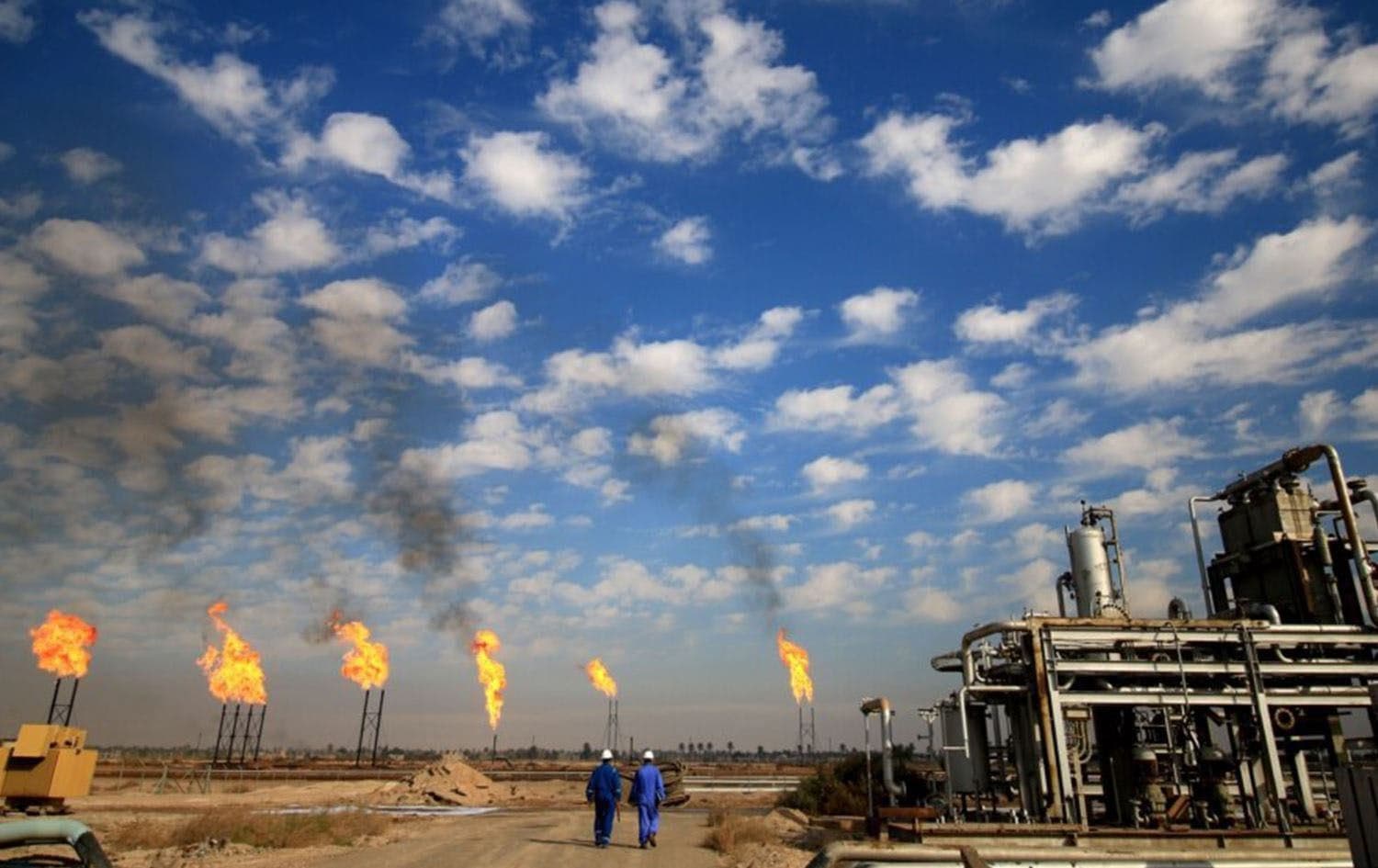
ERBIL, Kurdistan Region - Before the war, Iraq's goal was to reach a production of 6 million barrels of oil per day. Now that figure is becoming a dream, growing more distant day by day from the pre-war level of 4.5 million barrels per day - because Iran-backed Iraqi armed groups are targeting oil and gas fields in Iraq as a result of the ongoing war between the US and Israel against Iran, and foreign oil companies are withdrawing from Iraq one after another.
The latest attack by the armed groups of the "Islamic Resistance of Iraq" came on Saturday, which targeted the Majnoon oil field in Basra province, a giant oil field with reserves of more than 38 billion barrels. Additionally, the Sarsang and Atrush fields in Duhok province in the Kurdistan Region were attacked once again on Wednesday.
The primary targets of recent attacks on the oil industry in southern Iraq and the Kurdistan Region have been the American service company KBR at the Majnoon field and the American company HKN, which operates fields in the Kurdistan Region. However, the damage is far greater than that of those companies alone, severely weakening Iraq's capacity to produce oil and gas in the post-war period, since foreign international companies account for 68 percent of Iraq's daily oil output.
Without foreign companies, their advanced technology, and the human expertise of those major corporations, Iraq would not have been able to reach daily production exceeding 4.3 million barrels.
The clearest example is the comparison between the Rumaila and Majnoon oil fields. The Majnoon oil field, with reserves of 38 billion barrels and operated by the Basra Oil Company, has a production capacity of only 200,000 barrels per day. In contrast, the Rumaila field - with reserves of just 17.7 billion barrels - produces 1.35 million barrels per day, because it is jointly operated by British BP and China National Petroleum Corporation (CNPC).
Before the war, Iraq's total oil production was 4.34 million barrels per day, excluding the Kurdistan Region: 1.38 million barrels by Iraqi national oil companies, 1.57 million by foreign companies, and 1.38 million jointly with foreign companies. This means 31.8 percent of Iraq's oil was produced through national Iraqi companies such as the Basra, North, Midland, South, and Dhi Qar oil companies; 36.3 percent by foreign companies; and 31.9 percent jointly between Iraqi and foreign companies.
Across the world, more than 14 major oil and gas companies are investors and partners through service contracts in Iraq's oil and gas production. Chinese companies rank first, producing nearly 500,000 barrels of oil per day in Iraq.
Russian companies rank second, producing 322,000 barrels per day - though recently, due to American sanctions, Lukoil was forced to sell its share to American Chevron. American companies rank third, contributing to the production of 227,000 barrels of oil per day for Iraq.
Iraq's oil sector infrastructure and foreign companies
The total number of oil and gas fields across all three phases - production, development, and exploration - is 67, of which 41 are in the production phase, 21 are in exploration and development, and 3 are suspended.
Among those 67 fields in Iraq, 47 are oil fields, 4 are gas fields, and 16 are combined oil and gas fields. Iraq's total oil reserves are 143 billion barrels, of which 95 billion are in Basra, while Kirkuk province ranks second with 11 billion barrels - a disputed area between the Kurdistan Region and the Federal Government of Iraq under Article 140 of the Iraqi Constitution.
Among the 41 producing fields, the role of foreign companies in developing Iraq's oil and gas production infrastructure is clearly evident, as the fields with the highest production levels are jointly operated with foreign companies.
The best example is Iraq's five major oil fields, Rumaila, Kirkuk, West Qurna 1 & 2, and Zubair, which together produce nearly 3 million barrels of oil per day. These fields are jointly operated with several major companies, including British BP, CNPC, Japan's Inpex, Italy's Eni, and South Korea's KOGAS.
.JPG)
Impact of attacks on service companies
The companies listed in the table above do not include the foreign service companies operating in those fields, such as Schlumberger, Weatherford, Baker Hughes, Halliburton, and Oil Serv.
On the same day as the Majnoon attack, the warehouses of French Schlumberger in Basra were also struck by drones, sustaining major damage. This has a significant impact on the companies that provide high-level technology to the fields.
According to an oil sector expert who spoke on the condition of anonymity, if only the oil storage facilities and surface equipment at the fields are damaged, a few weeks are needed to resume normal production. However, if the damage reaches the oil extraction equipment, pumps, oil wells, and oil-gas separation processes, more than 3 to 6 months are required to return to previous production levels.
The production level of oil and gas that had been achieved before the drone attacks was reached at great cost. Over the decade from 2015 to 2025, Iraq's total investment across all ministries and governments reached 189 trillion dinars (around $145 billion). Of that, 113 trillion dinars (around $87 billion) were allocated to the Ministry of Oil - meaning 60 percent of the country's total investment was spent on the oil sector.
If the current situation is not halted, the oil and gas industry in Iraq will certainly be set back by an entire phase, and the goal of producing 6 million barrels per day will be delayed by another decade. Returning production to pre-militia-drone levels will also take considerable time, on top of the difficulty of bringing back foreign companies, external investment, and new industrial oil technology to Iraq.