


By Dr. Serhun Al
In the late 1990s, when a Turkish police chief named Gaffar Okkan was appointed to the major Kurdish city of Diyarbakir in southeastern Turkey, no one would imagine that he would win the hearts and minds of many Kurds in the city as well as the whole Kurdish region where police meant brutality and oppression. When he was assassinated in 2001, tens of thousands Kurds attended his funeral to pay their respect.
This people’s man gained the sympathy and affection of the Kurds with his efforts to learn and speak the Kurdish language with local people, by opening the doors of the police station to those in need, and investing into the success of the city’s popular soccer team, Diyarbakirspor.
What Okkan symbolized was that Turkey could become a state of the Kurds or in fact a Kurdish state as well. After more than a decade, Turkey once again is about to lose another opportunity to truly become the state of the Kurds due to recent escalation of violence with the Kurdistan Workers’ Party (PKK).
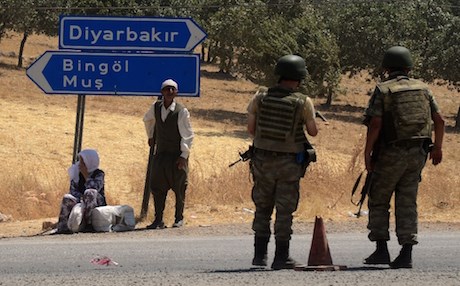
The two-year ceasefire and the peace process between the PKK and Turkey recently collapsed, frustrating the hopes and expectations for an end to a bloody conflict of three decades. In the last two months, the wave of violence between the PKK and Turkey has led to more than one hundred deaths and left many more wounded, including security personnel, civilians, and PKK militants. Amidst this conflict, lynching campaigns by nationalists against the pro-Kurdish Peoples’ Democratic Party (HDP) buildings throughout Turkey and recent curfews in Kurdish towns such as Cizre and Nusaybin has even led to fears of a civil war.
Although Turkey has initiated partial political and cultural reforms toward Kurds under the rule of the Justice and Development Party (AKP) since 2002, these attempts did not transform into a full and meaningful political change where democracy would prevail with strong political institutions, extensive civil liberties and separation of powers. Rather a single-party rule under Recep Tayyip Erdogan’s hegemony has haunted the political stability in the country. Moreover, although Mr. Erdogan has taken bold steps to initiate the peace process with the PKK despite nationalist reactions, he could not escape from becoming an aggressive nationalist himself as the PKK resisted disarming itself, especially after taking an active role in fighting against the Islamic State in Syria and Iraq (ISIS).
Traditionally, Turkey approached PKK’s resort to violence in a narrow mindset of simply framing the problem as a security issue. This logic largely neglected the civil liberties and freedoms such as cultural and linguistic rights that Kurds in Turkey were historically denied. The more Turkey relied on military measures and illegal paramilitary tactics against the PKK in the 1990s, the stronger the PKK and the legal pro-Kurdish political movement became. This does not necessarily mean that Turkey’s military measures have completely been ineffective to curb PKK’s military power.
To a certain extent, they actually have been, as in the late 1990s and early 2000s, particularly after the capture of PKK leader Abdullah Ocalan. However, what Turkey’s military methods could not dismantle was a broader transformation of the PKK beyond its immediate paramilitary function: its symbolic power in the hundreds of thousands Kurdish hearts and minds throughout the Middle East and Europe. The fight of the PKK against ISIS has recently accelerated this process.
Although not all Kurds support or sympathize with the PKK, Turkey failed to project itself as a Kurdish state by winning and representing the hearts and minds of its many Kurdish citizens that make up around eighteenth percent of Turkey’s total population. The resistance of the Kurds against ISIS in Kobani was a historic opportunity for Turkey to show its solidarity with all Kurds throughout the Middle East, but this opportunity turned into a crisis between Erdogan and the Kurds in 2014 due to his fears that PKK would become stronger on the other side of the border.
One significant reality that Mr. Erdogan forgets is that Turkey is the biggest Kurdish state in the world that borders Kurds in Syria, Iraq, Iran, but it is still more elusive than ever. While PKK exploited this political context in the region, Turkey could not show any meaningful effort to assure the security of millions of the Kurds due to its historical fear of an independent Kurdistan. If Turkey can act as a Kurdish state within the flexibilities of a sincere democracy, there will be no need for an independent Kurdish state, at least for Kurds in Turkey.
Winning Kurdish hearts and minds will be unlikely in the long run, unless Ankara comes to terms with it. The PKK has to some extent succeeded in exploiting this gap and largely benefit from it, despite its unpopular tactics of terror and violence. The war between Turkey and PKK is not just a rivalry to project hard military power on each other, it is also a cold war to gain the legitimacy of the locals.
Most Kurds in Turkey support a peaceful settlement between the PKK and Ankara and they do not desire any further militarization of the PKK. But if Turkey wants its Kurdish citizens to voice strongly against the PKK violence, it definitely needs to feel comfortable projecting itself as a Kurdish state in its domestic and foreign policies. Unless this is realized, PKK will continue to exploit this gap and mobilize ordinary Kurds though militant its methods might be.
Comments
Rudaw moderates all comments submitted on our website. We welcome comments which are relevant to the article and encourage further discussion about the issues that matter to you. We also welcome constructive criticism about Rudaw.
To be approved for publication, however, your comments must meet our community guidelines.
We will not tolerate the following: profanity, threats, personal attacks, vulgarity, abuse (such as sexism, racism, homophobia or xenophobia), or commercial or personal promotion.
Comments that do not meet our guidelines will be rejected. Comments are not edited – they are either approved or rejected.
Post a comment