


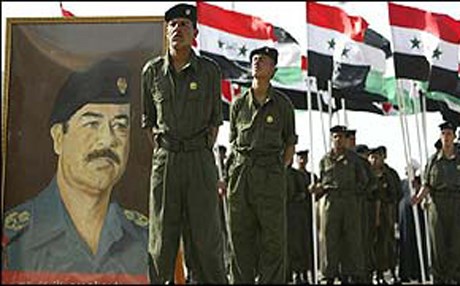
ERBIL, Kurdistan Region - The black clothes, balaclavas, boots, the violence—it took me a while to realize where I had seen them before they became ISIS’ trademarks. Then it struck me: the Fedayeen Saddam. A special force Saddam Hussein set up in the 1990s to fight a guerrilla war against any enemy—the most probable one being the American army—as the Americans were more and more critical of Saddam’s ambitions.
And these highly trained and hardened men in black did actually fight against them in the first weeks of the American invasion in 2003. I remember a location in Basra where the Fedayeen were said to have fought to their deaths to defend a water basin that could have hidden weapons or chemicals.
During the street battles reported then in Basra and Umm Qasr, many Fedayeen took part. Even in the battles in the center of Kirkuk with the Peshmerga, some witnesses say the black-clothed Fedayeen were there—fighting till their demise.
With more and more details becoming clear, the connections between Saddam’s rule and the extremist Islamic State have become more apparent than ever.
It is unknown if any Fedayeen members who survived in 2003 have actually joined ISIS, but it is clear many of their tactics have made their way into the organization’s training. This could mean that at least some of their trainers—and probably some of those in Saddam’s military responsible for setting up this fighting machine—have too.
Just like the fate of the Fedayeen, after 2003 it was unclear what had become of Saddam’s infamous secret service, the Mukhabarat. It seemed most of its members had left the country soon after April 9, 2003; even the lower brass, as I witnessed that Spring in one of Baghdad’s neighborhoods. Like many others, an officer of the secret service put his furniture on a truck and left for Jordan, leaving the neighbors wondering if this was a good or bad thing.
People who have been able to leave ISIS have told journalists that some of these security officers are now active inside the organization. If we hear about ISIS members being killed because they were spies or because they wanted to run away, we can be sure they had a hand in it.
ISIS-leader Abu Bakr al-Baghdadi put Iraqis in many of the leading positions inside his organization and the running of his “caliphate.” Next to them to keep an eye on things is always a former member of Saddam’s Mukhabarat, so witnesses say.
According to The Washington Post’s Liz Sly, almost all of the leaders of ISIS are former Iraqi officers, including the members of its shadowy military and security committees, and the majority of its emirs.
She spoke to a former ISIS emir who said that in Syria he and his colleagues were shadowed by a deputy who was Iraqi and made the real decisions. “All the decision makers are Iraqi, and most of them are former Iraqi officers. The Iraqi officers are in command, and they make the tactics and the battle plans,” he said. “But the Iraqis themselves don’t fight. They put the foreign fighters on the front lines.”
For Mukhabarat and army officials who stayed in Iraq, the debaathification policy of the new Iraqi governments has not only made a return to a job impossible, but often also took away their pensions. Their decline into powerless frustration and poverty made them easy targets for groups like Al-Qaida in Iraq and later ISIS.
Saddam’s Mukhabarat was infamous for the way its members knew everything in Iraqi society. It was active on all levels—gathering information at schools, mosques, on the streets and at meetings of the Baath party. Everything was recorded and kept to be used when needed.
Look at ISIS and its tactics and it is clear the people behind the organization have a huge knowledge of Iraq, its tribal relations and conflicts, its important families and their enemies, the lay of the land and geography.
They use it to set people against one another, to create fear, and if needed, to kill for effect—just like in Saddam’s days.
Experts say Saddam’s best officers are now in charge of ISIS’ military, which is why ISIS is so strong in intelligence and on the battlefield.
ISIS is much more than just Saddam’s legacy, but members of the past regime do play a huge role in its actions. It takes one to know the enemy, to be able to beat him.
Judit Neurink is the author of “The ISIS War,” a book recently published in the Netherlands.
The views in this article are those of the author and do not necessarily reflect the position of Rudaw.
And these highly trained and hardened men in black did actually fight against them in the first weeks of the American invasion in 2003. I remember a location in Basra where the Fedayeen were said to have fought to their deaths to defend a water basin that could have hidden weapons or chemicals.
During the street battles reported then in Basra and Umm Qasr, many Fedayeen took part. Even in the battles in the center of Kirkuk with the Peshmerga, some witnesses say the black-clothed Fedayeen were there—fighting till their demise.
With more and more details becoming clear, the connections between Saddam’s rule and the extremist Islamic State have become more apparent than ever.
It is unknown if any Fedayeen members who survived in 2003 have actually joined ISIS, but it is clear many of their tactics have made their way into the organization’s training. This could mean that at least some of their trainers—and probably some of those in Saddam’s military responsible for setting up this fighting machine—have too.
Just like the fate of the Fedayeen, after 2003 it was unclear what had become of Saddam’s infamous secret service, the Mukhabarat. It seemed most of its members had left the country soon after April 9, 2003; even the lower brass, as I witnessed that Spring in one of Baghdad’s neighborhoods. Like many others, an officer of the secret service put his furniture on a truck and left for Jordan, leaving the neighbors wondering if this was a good or bad thing.
People who have been able to leave ISIS have told journalists that some of these security officers are now active inside the organization. If we hear about ISIS members being killed because they were spies or because they wanted to run away, we can be sure they had a hand in it.
ISIS-leader Abu Bakr al-Baghdadi put Iraqis in many of the leading positions inside his organization and the running of his “caliphate.” Next to them to keep an eye on things is always a former member of Saddam’s Mukhabarat, so witnesses say.
According to The Washington Post’s Liz Sly, almost all of the leaders of ISIS are former Iraqi officers, including the members of its shadowy military and security committees, and the majority of its emirs.
She spoke to a former ISIS emir who said that in Syria he and his colleagues were shadowed by a deputy who was Iraqi and made the real decisions. “All the decision makers are Iraqi, and most of them are former Iraqi officers. The Iraqi officers are in command, and they make the tactics and the battle plans,” he said. “But the Iraqis themselves don’t fight. They put the foreign fighters on the front lines.”
For Mukhabarat and army officials who stayed in Iraq, the debaathification policy of the new Iraqi governments has not only made a return to a job impossible, but often also took away their pensions. Their decline into powerless frustration and poverty made them easy targets for groups like Al-Qaida in Iraq and later ISIS.
Saddam’s Mukhabarat was infamous for the way its members knew everything in Iraqi society. It was active on all levels—gathering information at schools, mosques, on the streets and at meetings of the Baath party. Everything was recorded and kept to be used when needed.
Look at ISIS and its tactics and it is clear the people behind the organization have a huge knowledge of Iraq, its tribal relations and conflicts, its important families and their enemies, the lay of the land and geography.
They use it to set people against one another, to create fear, and if needed, to kill for effect—just like in Saddam’s days.
Experts say Saddam’s best officers are now in charge of ISIS’ military, which is why ISIS is so strong in intelligence and on the battlefield.
ISIS is much more than just Saddam’s legacy, but members of the past regime do play a huge role in its actions. It takes one to know the enemy, to be able to beat him.
Judit Neurink is the author of “The ISIS War,” a book recently published in the Netherlands.
The views in this article are those of the author and do not necessarily reflect the position of Rudaw.
Comments
Rudaw moderates all comments submitted on our website. We welcome comments which are relevant to the article and encourage further discussion about the issues that matter to you. We also welcome constructive criticism about Rudaw.
To be approved for publication, however, your comments must meet our community guidelines.
We will not tolerate the following: profanity, threats, personal attacks, vulgarity, abuse (such as sexism, racism, homophobia or xenophobia), or commercial or personal promotion.
Comments that do not meet our guidelines will be rejected. Comments are not edited – they are either approved or rejected.
Post a comment