


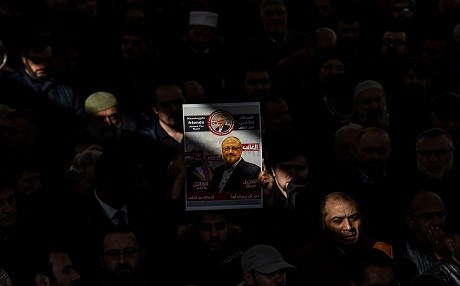
At first, it seemed the death of Jamal Khashoggi was a tragedy. Then it was labelled a "heinous crime that cannot be justified", by the very kingdom whose agents perpetrated it. Which in turn brought to mind a remark often attributed to a French diplomat: "It is worse than a crime — it is a mistake".
Now it seems the death of Khashoggi is a gift that keeps on giving, thanks to a cross section of people with a clear self-interest — from America's media liberals and showboating lawmakers on both sides of the aisle to faceless "US intelligence/CIA sources" and Turkish government officials.
Never mind that Saudi Arabia, after initial denials and a shifting narrative, did admit that Khashoggi's murder inside its consulate in Istanbul on October 2 was "premeditated", put 18 of its nationals behind bars over the incident and dismissed five high-ranking officials, including two close aides of the crown prince, Mohammed bin Salman.
Never mind too that Saudi Arabia's response did not come out of the playbook of Russia, Israel or Pakistan, whose spy agencies or rogue agents would have simply maintained plausible deniability had they been guilty of a similar crime, to say nothing of the US, which deployed drones halfway around the world to kill two citizens — Anwar al-Awlaki and Samir Khan — without a trial in 2011.
Never mind that a total of 1,324 journalists have been killed for "unconfirmed motive" worldwide since 1992, according to the Committee to Protect Journalists, without the international media and Western governments getting into a frenzy of moral outrage and denunciations for even a single death.
So why is the life of one slain Saudi commentator, in the eyes of American politicians and media liberals at least, worth more than the lives of 1,324 dead journalists (and thousands more imprisoned) put together?
An old newsroom thumb rule is that the value of one British, American or European life is worth in news value a hundred Asian or African lives. But even after factoring into the equation Khashoggi's status as a contributing columnist to a leading US newspaper and a permanent US resident, there is clearly much more to the uproar than meets the eye.
One could of course argue that without pressure from Ankara, international media outlets and anonymous US intelligence sources, Saudi Arabia would not have fessed up. By the same token, the connection between the diplomatic backlash and the lull in fighting between the Saudi-led coalition and the Houthi rebels in Yemen cannot be dismissed as merely a coincidence.
Be that as it may, one unintended consequence of the killing of Khashoggi has been to expose the entire cast of Western and Middle Eastern characters who were eager to see the downfall of the kingdom's hard-charging crown prince, long before the 59-year-old Khashoggi decided to visit the Saudi consulate in Istanbul for divorce-related paperwork.
Last week's leaks appear to have laid bare divisions within the seemingly pro-Saudi Trump administration, with the CIA quietly reinforcing Washington-based media outlets' confirmation bias by permitting them to attribute claims that the crown prince ordered Khashoggi's assassination to "people familiar with the matter".
The basis for the CIA's purported conclusions is far from solid, unless one is ready to treat its interpretation of alleged phone-call intercepts as the gospel truth and to establish guilt beyond reasonable doubt from circumstantial evidence related to the crown prince's de-facto rule of Saudi Arabia.
Regardless of how sound its assessment is, the Khashoggi case has certainly come in handy for the CIA to advance a narrative in which it is American media liberals' friend-in-need and the ultimate arbiter of truth, and, for all we know, to strengthen the hands of friendly factions within the Saudi royal family that had been sidelined by the rapid rise to power of Mohammed bin Salman.
At a time when key branches of the US administration have conceded defeat to geopolitical rivals in crucial battlegrounds in the Middle East and outsourced the heavy lifting to leftwing Kurdish groups and Israeli and Arab Gulf armed forces, the media pile-on targeting Mohammed bin Salman offers the CIA an opportunity to sow doubt and distraction when its single-minded focus ought to be on the tasks at hand.
That being said, what could be in the Khashoggi affair for Republican lawmakers such as Bob Corker, Lindsey Graham and Paul Rand that could explain their sporadic bombast and posturing? An educated guess would be their desire to get back in the good graces of America's elite liberal media after bruising nomination battles and to dispel the notion they are insufficiently critical of President Donald Trump.
In any case, if the macho blowhards of both the Republican and Democratic parties were a little more self-aware, they would tweet and talk less and travel more.
Regular visits to the Middle East would give them first-hand knowledge of the extent of the strategic defeat suffered by the US across vast swathes of the Middle East in recent years and the uphill struggle faced by Washington's partners and allies in a region beset with proxy wars, ethnic cleansing, violent extremism and sectarian political mobilisation.
Nobody expects such suave luminaries as Democrat Ro Khanna or Republican Jeff Flakes to ever bring a gun to a knife fight with the commander of the extraterritorial Quds Force of Iran's Islamic Revolutionary Guard Corps (IRGC). But a little less political grandstanding by them from the safety of California and Washington, D.C., could go a long way in boosting the morale of US partners in the "mean, nasty world out there", to borrow Secretary of State Mike Pompeo's colourful phrase.
As for international media outlets, the sad but inescapable truth is that from a purely business perspective, the word "Khashoggi" has taken on a search-engine-optimised life of its own, drawing tremendous amounts of traffic across all digital platforms that are surely breaking records of previous years. Therefore, until other big breaking news comes, the story is likely to retain significant traction going forward.
Looking back, Khashoggi may have only wanted to be a thoughtful critic of certain Saudi policies and get married to his Turkish fiancee. But his legacy has turned out to be way more complicated than that.
Arnab Neil Sengupta is an independent journalist and commentator on the Middle East.
The views expressed in this article are those of the author and do not necessarily reflect the position of Rudaw.
Now it seems the death of Khashoggi is a gift that keeps on giving, thanks to a cross section of people with a clear self-interest — from America's media liberals and showboating lawmakers on both sides of the aisle to faceless "US intelligence/CIA sources" and Turkish government officials.
Never mind that Saudi Arabia, after initial denials and a shifting narrative, did admit that Khashoggi's murder inside its consulate in Istanbul on October 2 was "premeditated", put 18 of its nationals behind bars over the incident and dismissed five high-ranking officials, including two close aides of the crown prince, Mohammed bin Salman.
Never mind too that Saudi Arabia's response did not come out of the playbook of Russia, Israel or Pakistan, whose spy agencies or rogue agents would have simply maintained plausible deniability had they been guilty of a similar crime, to say nothing of the US, which deployed drones halfway around the world to kill two citizens — Anwar al-Awlaki and Samir Khan — without a trial in 2011.
Never mind that a total of 1,324 journalists have been killed for "unconfirmed motive" worldwide since 1992, according to the Committee to Protect Journalists, without the international media and Western governments getting into a frenzy of moral outrage and denunciations for even a single death.
So why is the life of one slain Saudi commentator, in the eyes of American politicians and media liberals at least, worth more than the lives of 1,324 dead journalists (and thousands more imprisoned) put together?
An old newsroom thumb rule is that the value of one British, American or European life is worth in news value a hundred Asian or African lives. But even after factoring into the equation Khashoggi's status as a contributing columnist to a leading US newspaper and a permanent US resident, there is clearly much more to the uproar than meets the eye.
One could of course argue that without pressure from Ankara, international media outlets and anonymous US intelligence sources, Saudi Arabia would not have fessed up. By the same token, the connection between the diplomatic backlash and the lull in fighting between the Saudi-led coalition and the Houthi rebels in Yemen cannot be dismissed as merely a coincidence.
Be that as it may, one unintended consequence of the killing of Khashoggi has been to expose the entire cast of Western and Middle Eastern characters who were eager to see the downfall of the kingdom's hard-charging crown prince, long before the 59-year-old Khashoggi decided to visit the Saudi consulate in Istanbul for divorce-related paperwork.
Last week's leaks appear to have laid bare divisions within the seemingly pro-Saudi Trump administration, with the CIA quietly reinforcing Washington-based media outlets' confirmation bias by permitting them to attribute claims that the crown prince ordered Khashoggi's assassination to "people familiar with the matter".
The basis for the CIA's purported conclusions is far from solid, unless one is ready to treat its interpretation of alleged phone-call intercepts as the gospel truth and to establish guilt beyond reasonable doubt from circumstantial evidence related to the crown prince's de-facto rule of Saudi Arabia.
Regardless of how sound its assessment is, the Khashoggi case has certainly come in handy for the CIA to advance a narrative in which it is American media liberals' friend-in-need and the ultimate arbiter of truth, and, for all we know, to strengthen the hands of friendly factions within the Saudi royal family that had been sidelined by the rapid rise to power of Mohammed bin Salman.
At a time when key branches of the US administration have conceded defeat to geopolitical rivals in crucial battlegrounds in the Middle East and outsourced the heavy lifting to leftwing Kurdish groups and Israeli and Arab Gulf armed forces, the media pile-on targeting Mohammed bin Salman offers the CIA an opportunity to sow doubt and distraction when its single-minded focus ought to be on the tasks at hand.
That being said, what could be in the Khashoggi affair for Republican lawmakers such as Bob Corker, Lindsey Graham and Paul Rand that could explain their sporadic bombast and posturing? An educated guess would be their desire to get back in the good graces of America's elite liberal media after bruising nomination battles and to dispel the notion they are insufficiently critical of President Donald Trump.
In any case, if the macho blowhards of both the Republican and Democratic parties were a little more self-aware, they would tweet and talk less and travel more.
Regular visits to the Middle East would give them first-hand knowledge of the extent of the strategic defeat suffered by the US across vast swathes of the Middle East in recent years and the uphill struggle faced by Washington's partners and allies in a region beset with proxy wars, ethnic cleansing, violent extremism and sectarian political mobilisation.
Nobody expects such suave luminaries as Democrat Ro Khanna or Republican Jeff Flakes to ever bring a gun to a knife fight with the commander of the extraterritorial Quds Force of Iran's Islamic Revolutionary Guard Corps (IRGC). But a little less political grandstanding by them from the safety of California and Washington, D.C., could go a long way in boosting the morale of US partners in the "mean, nasty world out there", to borrow Secretary of State Mike Pompeo's colourful phrase.
As for international media outlets, the sad but inescapable truth is that from a purely business perspective, the word "Khashoggi" has taken on a search-engine-optimised life of its own, drawing tremendous amounts of traffic across all digital platforms that are surely breaking records of previous years. Therefore, until other big breaking news comes, the story is likely to retain significant traction going forward.
Looking back, Khashoggi may have only wanted to be a thoughtful critic of certain Saudi policies and get married to his Turkish fiancee. But his legacy has turned out to be way more complicated than that.
Arnab Neil Sengupta is an independent journalist and commentator on the Middle East.
The views expressed in this article are those of the author and do not necessarily reflect the position of Rudaw.
Comments
Rudaw moderates all comments submitted on our website. We welcome comments which are relevant to the article and encourage further discussion about the issues that matter to you. We also welcome constructive criticism about Rudaw.
To be approved for publication, however, your comments must meet our community guidelines.
We will not tolerate the following: profanity, threats, personal attacks, vulgarity, abuse (such as sexism, racism, homophobia or xenophobia), or commercial or personal promotion.
Comments that do not meet our guidelines will be rejected. Comments are not edited – they are either approved or rejected.
Post a comment