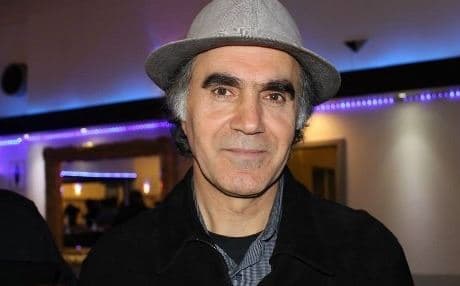
COPENHAGEN, Denmark – From his decades-long German exile Nizamettin Aric, a luminary of Kurdish music and cinema, recalls the day in 1979 when he decided to sing on stage in his mother tongue. It was the last he sang in his native Turkey, where until 1991 speaking Kurdish was a crime.
"After singing in Turkish for two hours I switched to Kurdish at the request of some guests,” Aric told Rudaw in Copenhagen, where he came for a benefit concert for Kobane, the Syrian-Kurdish city fighting an ISIS takeover for weeks.
“I was later arrested, tried and risked imprisonment for up to 15 years," said Aric, who chose to flee to Syria, and from there to Germany.
In Turkey, he had done as most other Kurdish artists, keeping his language and roots in low profile. His songs on the state-run TRT television had always been in Turkish – folk songs he himself had translated from Kurdish.
"I was fired from TRT and had to leave Turkey, which I have not seen now for 34 years," explained Aric, who was born in 1956 in the eastern Agri province.
In exile, he dreams of visiting the graves of his parents, who died after his sudden departure.
"I was not even given the opportunity to say goodbye to them. It was very hard for me. I would so much like to visit their graves in Turkey, which I have never seen."
In Germany, Aric released one album after another under the assumed name of Feqiye Teyran, a 17th century poet and writer who is considered among the giants of Kurdish literature. In 1992, Aric also wrote and directed one of the first Kurdish-language movies, “A Song for Beko,” which won 15 international awards.
From a distance, Aric has been observing the developments in Turkey, where the ruling Justice and Development Party (AKP) has made a number of reforms.
In 2009, it launched the Kurdish TRT-6 channel; in autumn 2013, President Recep Tayyip Erdogan announced a ”democracy package” which, among other things, gave the Kurds the right to Kurdish education at private schools; earlier this year, the government declared that the first Kurdish-language university would open soon in Diyarbakir, Turkey’s Kurdish heartland, where hospitals are now providing service in Kurdish for the first time.
Last year, another taboo was broken when, before thousands of fans, Kurdish singer Sivan Perwer sang in his own language in Diyarbakir, after returning from 37 years in exile.
After the return of Perwer, regarded as the foremost Kurdish singer, Turkish media have been looking to see if Aric will follow suit. The Hurriyet daily has called Aric "Sivan Perwer number two."
"Actually, I also want to return" said Aric, "because I never came to Europe out of my desire."
But he vows to go back only when Kurdish children can study in their mother tongue at state schools where they don’t have to pay to learn the language: “As long as Kurdish children can’t receive education in their mother tongue in state schools, I won’t return.
"I want my children to get the same treatment as theirs, as Turkish children. Do they, the Turkish schoolchildren, have to send their own children to private schools to learn their own language?” he asked.
“I left my country because my language was not free. The day my language is free, there will be no reason not to return,” he said, adding he feared that Kurds in Turkey may become so assimilated that they begin to “think in Turkish.”
“It is not enough that parents can give their children Kurdish names, they must also be able to dream in Kurdish, feel love in Kurdish and have a daily life in Kurdish,” Aric said. “Language is the identity of a people.”
Kurdish obviously remains very close to Aric’s heart. And yet, he learned to speak it fluently in exile.
"When I left Turkey, I could say something like ‘hello, how are you’ in Kurdish. When I came into exile, I learned my native language first, and then German theater and Western music."
At the concert in Copenhagen, Aric, expressed another wish: an end to intra-Kurdish divisions and rivalry.
“Thousands of Syrian-Kurdish youth voluntarily joined freedom fighters in Turkey and Iraq and thus sacrificed themselves. Of all parts of Kurdistan, Rojava (Syrian Kurdistan) is suffering most now. Therefore, we must support them," Aric appealed. “However, to support them in the best possible way, it is essential that the Kurds are united.”
That wish may have come a step closer to realization last week, when some 150 Peshmerga fighters from Iraqi Kurdistan crossed into Kobane from Turkey to fight alongside the People’s Protection Units (YPG), the Syrian Kurdish force that has been singlehandedly resisting an ISIS takeover for more than 40 days.
“When ISIS is so cruelly trying to wipe out the Kurds, our parties must put aside their ideologies and disagreements," Aric said.