


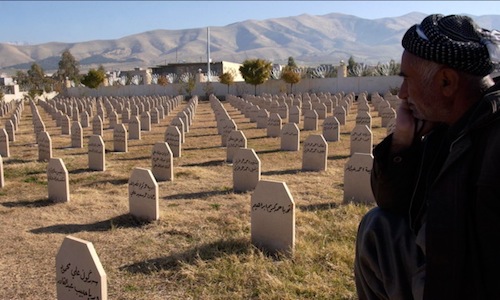
By DANA HALABJAYI
The artillery shells landed non-stop. It was March 1988, and Iraqi dictator Saddam Hussein had turned his guns on his own people, targeting the Kurds during the closing weeks of his eight-year war with Iraq.
After spending two days and nights in the basement of our home, our family decided to move to the basement of my elder brother's home on March 14, 1988.
We thought, ‘better to die together, if we must, or survive together.’ But a barrage of Rajima missiles destroyed the neighborhood, including the courtyard of my brother’s home. The bombs smashed a tractor and a car. I saw a man named Hama Tal lose his leg as a result of the bombardment and another man, Nasri Hama Karimi Chaychi, die before my very eyes. Moment by moment we felt death approaching. We could neither get out of the basement, nor run away from Halabja. We were trapped.
Suddenly, Jalal Azabani, a young poet, stormed into the basement with his face gleaming and his eyes shining. “Take this. I brought you cigarettes because I knew you were here. Get up. We will be free from the Baath’s reign. Friends will reach town tomorrow morning,” Jalal said, handing me a pack of Sommer cigarettes and kissing me on the cheeks.
“I will go to Bawa Kochak,” Jalal said. It was as if he knew it would be our last meeting. I never saw him again, and do not know where he took his last breath. His body was never recovered. I am sure that, up to the last beat of his heart, he was confident that “friends” would liberate the town. It is true greatness when one dies full of so much hope, and longing for freedom.
In the afternoon that same day, my brother-in-law Kawa and I decided to take his pick-up truck out of the garage and flee. Jeopardizing our lives as we ran under the shelling, we finally made it to the Osmani Hamay Pirajin garage. But there was a large bulldozer parked in front of the truck. We could not move the bulldozer or the truck and so returned home frustrated. One day, after our unsuccessful effort, the family of Kawa’s uncle was able to take the truck out of the garage, but they could not escape death. The truck became their final home. The picture of the truck with the dead inside later became an iconic image. The plate number of the car Sulaimaniya 5814. All 14 passengers in the truck went to their permanent rest. I can still remember the scene where I saw Mariwan, Mahabad and Uncle Ahmed in the basement of their home. Their eyes were full of waiting. It turned out they were waiting for the final farewell, just like Jalal.
It was a day of shortages. People were running out of food, including bread or milk for their children. They had to do something about it. Death was pouring down on the town. Fear and darkness had taken over. After a while, we learned my brother had parked his mud-covered bus at the other end of the alley, waiting to save us, like an angel. “Hurry up, get on the bus now that the shelling has lessened,” he shouted.
He hadn’t yet put his own children on the bus. There was no room. All the residents of the neighborhood and the basement were inside. The minibus could only hold 21 people, but 64 had crowded in. My father and uncle decided to stay back and protect our home. They had a car and thought they could escape to the Iranian border if things got worse. We begged for them to come with us, but to no avail.
“You are young. You should survive. We will take care of ourselves anyway,” said my father.
It was the afternoon of March 15, 1988, and raining lightly. I had never seen Halabja in such darkness, and so filled with anxiety. People were all out on the main road from Halabja to Sulaimani, some on foot, others in cars and tractors. Soldiers, just like the civilians, were trying to save their lives. All were exhausted. Our bus was the last vehicle able to cross a bridge that connected Sulaimani to Halabja. After we passed, an artillery shell destroyed the bridge. There were many military trucks and armored vehicles going toward Halabja, clueless that the Zalm Bridge had been destroyed. When we reached the town of Sayid Sadiq, we found out people had been waiting to hear news from Halabja. They threw bread through the windows into our bus. They were crying for us in sympathy. They did not know that, soon, they too would be forced to leave their homes.
When we reached Sulaimani, my brother stopped the bus in front of the Bardarki Sara Square so everybody could get off and find their way to the homes of relatives. The first thing that struck me was the electricity. I hadn’t seen any in Halabja for the last three days. Then I noticed I had no shoes on. I was wearing a shirt and a pair of Kurdish trousers covered with blood. I had brought the blood of the injured and dead to Sulaimani. We split into groups, each going to the home of a relative or acquaintance. Next day, when we returned downtown for some news, Bardarki Sara Square and the Ashapa Sepi area looked as though the ashes of death had rained down on them. You could not find a face that did not look full of sorrow, or like it was waiting for someone.
We were like children separated from our mothers. Soon, we learned about the poison gas attack on Halabja. We learned that death had been poured on our town. When I returned back home, we were all overcome with sadness, remaining silent and still. We were waiting for the situation to calm down so that we could get some news about our father and relatives back in Halabja. As if it were not enough that we had been struck by tragedy, the government forces began detaining and rounding up people from Halabja who were in Sulaimani.
There was no news of my father. After almost a month, a friend named Burhan Haji Mohammedi Bamoki told us that he had seen my father with his head against the truck’s steering wheel and his hands over his eyes.
“His body was swollen. I think he was dead,” said Burhan. I did not tell the family about the news and Burhan promised not to tell anyone either. Unfortunately, that good friend of mine later died in an accident.
After a while, we got another piece of news.
“Your dad is alive but he is blind,” someone said. This news consoled us a bit, because at least we knew he had been seen alive.
My father had gone blind on the road to a village near Halabja called Anab. He could no longer drive. Later, someone took him and his car to the village of Balkha. There, he had stayed with some acquaintances, and had been treated by Iranian soldiers. They provided him with food and a blanket. He did not want to move to Iran, like many people from Halabja did after the attack. He wanted to stay and see us.
We were finally able to rent a house, despite the odds. The owner was a benevolent man from Sulaimani. He did not want Saddam’s forces to find out about it and get into trouble. He did not take any rent from us. To this day, I still look for this man to offer my gratitude. Unfortunately, he never introduced himself to us.
After the Iraq-Iran war came to an end on Aug. 8, 1988, the Iranian army withdrew from Halabja. We expected our father and people like him from the border areas to be allowed to return to their families. But that did not happen. They were all rounded up as part of the genocidal Anfal campaign and taken to Sulaimani Stadium, the headquarters of the military intelligence and emergency forces.
I finally managed to get a five-minute appointment with my father in prison. I took two packs of Sommer cigarettes and 25 Iraqi dinars to him. He looked tired and full of sorrow. When he saw me, his face lit up. After kissing each other, he immediately said, “Take care of yourselves. You may never see me again.”
After a pause, he continued, “I wish I had died and had not seen that massacre in Halabja. I don’t know why God kept me alive.” We were in the middle of the conversation when two guards came, blindfolded him and took him away. All I could hear him say was: “Don’t worry about me.”
After a week, they separated the women and children from the men and took them to Topzawa military base near Kirkuk. They apparently shot dead some of the men. My father and some of the other men were transferred from Topzawa to Nogra Salman camp in southern Iraq. It was in this camp that many were massacred.
After that, nobody knew what happened to those people from Halabja. Where were they massacred or imprisoned? Or were they still alive? The Anfal operations had ended. We had given up all hope to see our father return to us.
After two months, the Baath regime issued a general amnesty. We could move freely and start breathing again. We were allowed to visit Halabja to fetch the furniture we had left behind, only to find there was nothing left. Everything was in ruins. Not even a single one of my books was left for me to take back as a memory. Our home had been completely looted.
One day around noon, the doorbell rang. My younger sister told me, “There is a man at the door. He might be a beggar. See what he wants.” When I opened the door, I saw a dirty, white-bearded man with a thin face. He was so thin and frail he looked as though he was about to fall over. He wore an old, worn-out pair of Kurdish trousers and a military jacket.
“How can I help you, uncle?” I asked politely. When I looked at his face more carefully, I saw tears had welled in his eyes.
“My son, it seems you don’t recognize me,” he said, as the tears ran down his face. It was only through his voice that I recognized my father.
Comments
Rudaw moderates all comments submitted on our website. We welcome comments which are relevant to the article and encourage further discussion about the issues that matter to you. We also welcome constructive criticism about Rudaw.
To be approved for publication, however, your comments must meet our community guidelines.
We will not tolerate the following: profanity, threats, personal attacks, vulgarity, abuse (such as sexism, racism, homophobia or xenophobia), or commercial or personal promotion.
Comments that do not meet our guidelines will be rejected. Comments are not edited – they are either approved or rejected.
Post a comment