


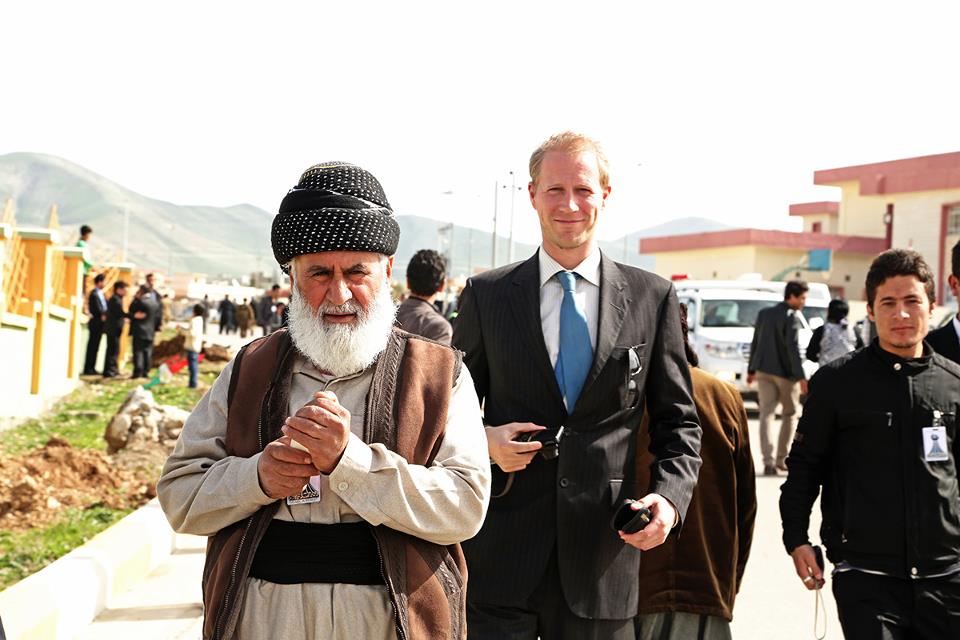
By OLIVER MOSS
Photo: Seivan Mohammad Salim
Back in early February, I was sitting at home in England looking at the dank grey sky, when the phone rang. It was the office. “Oliver, we would like you to go to Kurdistan next week, start doing some research.”
Kurdistan. My mind scrambled for bits of information and scraps of conversation I had picked up over the years. I confess, I knew little about it apart from a vague notion that Kurdistan, or at least Greater Kurdistan, spanned across the modern borders of Turkey, Iraq, Iran and Syria.
I knew that the Kurds were not to be confused with Arabs or Turks or Persians, that they were a distinct and proud people who had been striving for a homeland of their own, against the flow of 20th and 21st Century geo-political interests.
However in the UK we hear little of the concept of Kurdistan, apart from a few reports of skirmishes between the PKK and the Turkish forces. Most of my friends thought it was somewhere near Uzbekistan.
“No, no” I replied a little mischievously, “the part of Kurdistan I am going to is an autonomous region in the north-east corner of Iraq”. They raised their eyebrows in alarm.
It sounded too good an opportunity to miss and the mystery made it all the more appealing. Besides, anything would be better than sitting out a long, brutal British winter.
My mind cast back to a book I had read a few years ago and I dug it out of my bookshelf. ‘The Way of the World’ by Nicolas Bouvier is an extraordinarily beautiful travel memoir of two friends from Geneva who set out in a Fiat Topolino in the early 1950s, travelling from their home city in the Alps to the Khyber Pass in Afghanistan. They passed through Kurdistan and I set about re-reading those specific chapters.
“Below the village, the stream cascaded between willows, hazel-trees and Asian poplars: a sparse Eden, but Eden nonetheless.”
It certainly sounded quite different from the Iraq that appeared on our evening news bulletins every day of bombings, kidnappings and spiraling violence in the desert. So if the Kurdish landscapes, people, the history and the culture are unique, why is so little known of Kurdistan in the West?
As the famous US investor Warren Buffett once said: ‘It takes 20 years to build a reputation and five minutes to ruin it.’ Perhaps Kurdistan would be a case in point.
It has been a month now since I have been in Kurdistan. I remember arriving bleary-eyed at 4 am on a cold February morning and driving through the empty streets of Erbil to my hotel, steel and glass buildings lining the side of the road, occasionally lit by glowing neon signs and LCD screens.
Modernity has certainly hit Erbil, although the Eden that Bouvier describes still does exist as I have discovered on trips through the majestic mountains north to Rawanduz and Soran, or east to Sulaimani and Halabja.
The famous Kurdish hospitality is also intact, as I have experienced on many occasions when attempting to pay for my meal only to be waved down with a simple “you are our guest in Kurdistan, you do not pay.” We do not always treat our guests in Europe with the same courtesy and duty.
Kurdistan is booming and nowhere is this more apparent than in Erbil. While the citadel retains its charm and aura of centuries gone by, and the traditional tea-houses and bazaars of downtown Erbil continue in their business much as they have done for countless generations, on the outskirts of town a different city and vision is becoming apparent.
Cranes and newly finished high-rise apartment and office blocks peer into the blue sky, while massive tracts of freshly-churned land compete by displaying futuristic posters of a ‘new city’. It took me back to my first impressions on arriving in Riyadh many years ago: my romantic notions of an Arabia of deserts, palaces and frankincense quickly dashed by the monotony of glass, steel and traffic jams.
Kurdistan has a rich and beautiful culture and heritage. I have read many articles labeling Erbil as ‘next Dubai’, and although these comparisons have been rightly dismissed by most, it does show that Kurdistan needs to be careful in its vision and development.
Kurdistan will undoubtedly achieve greater success and prosperity by promoting its own sense of identity, while differentiating itself from the instability that continues to afflict the rest of Iraq.
To achieve this it is vital not to simply ‘copy and paste’ the model of development and skyline of other cities and regions, but instead to highlight its individuality, not just geographically and politically, but also culturally, socially and historically.
Oliver Moss is the Editorial Director of the Report Company. He is in Kurdistan producing a report that will be published in the British daily newspaper The Guardian.
Comments
Rudaw moderates all comments submitted on our website. We welcome comments which are relevant to the article and encourage further discussion about the issues that matter to you. We also welcome constructive criticism about Rudaw.
To be approved for publication, however, your comments must meet our community guidelines.
We will not tolerate the following: profanity, threats, personal attacks, vulgarity, abuse (such as sexism, racism, homophobia or xenophobia), or commercial or personal promotion.
Comments that do not meet our guidelines will be rejected. Comments are not edited – they are either approved or rejected.
Post a comment