

By Ann-Catrin Emanuelsson
GOTEBORG, Sweden - War in Syria, Europe’s refugee policy and freedom of speech were in focus at the annual Goteborg Book Fair, gathering the Arab world’s most celebrated fiction writer, an activist speaking for Kurdish child brides and a young Iranian exile for writers at risk.
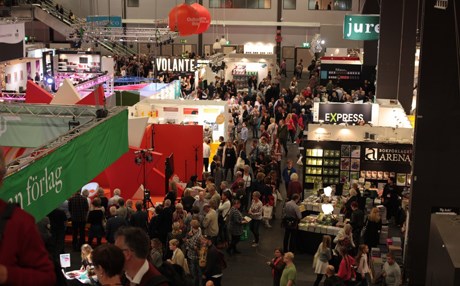
One of the world’s biggest book fairs and Scandinavia’s largest cultural event drew 95,000 publishers, authors, book lovers and journalists, including writers Hassan Blasim from Iraq and Babak from Iran, and the Kurdish activist Sara Mohammed.
Blasim, a refugee from Baghdad who was recently declared "perhaps the best writer of Arabic fiction alive” by Britain’s Guardian newspaper after publication of his book Iraqi Christ, participated in several discussions on writing from exile.
”It is with sadness I now watch all refugees crossing the same border I crossed in 2004 after my refuge in Mosul,” he said.
”Media reporting is not comprehensive enough to make Europeans understand why people are fleeing,” Blasim added in a discussion with a Chinese exiled writer.
“Westerners need to read more literature from the region to get closer to reality. This Book Fair needs to invite more writers from Middle East and Africa,” he said.
The fair, which ran from Sep. 25-28, provided opportunities to speak for writers-at-risk, who are offered temporary shelter in cities and towns around the world who are part of the International Cities of Refuge Network (ICORN).
”I was kicked out from university because of my writing in underground magazines and activities in the leftist student movement,” said Babak, an exile from Iran.
“After a number of threats and interrogations I went to Turkey and found out about the ICORN program,” said the former student from Tehran after reading poetry together with a writer-at-risk from Honduras.
On stage were also Sara Mohammed, a Kurdish activist, and Birgitta Ohlsson, an MP from the Swedish Liberal Party, both working for gender equality, against underage girls being forced to marry and eradication of so-called “honor killings” and violence.
”Someone forcing a person to get married in Sweden or abroad can be sentenced to prison,” she added. “As many as 70,000 in Sweden say they are afraid of being married off against their own will,” according to Ohlsson.
”It is important those who feel threatened to get married away are met with respect,” said Sara Mohammed, a Kurdish activist and the founder of GAPF (Never forget Pela and Fadime).
”In Southern Kurdistan we also have laws against honor-related violence but there are problems of implementation,” she said in response to a question. She added that the Kurdistan Regional Government (KRG) should hand out folders with information and contact details to consulates, hopefully reaching young people whose European passports have been confiscated by relatives or close ones.
This year the urgency of war in the Middle East and the flood of refugees challenging the EU borders and policies hijacked the fair’s main focus on Hungarian literature.
Masha Gessen, a Russian-American writer, criticized the partnership between the organizer and official representatives from Hungary in her opening speech, covering threats against freedom of expression around the world. Hungarian officials rejected her criticism and walked out of the inauguration ceremony.
This was followed by an act of spontaneous protest against Hungary’s treatment of asylum seekers by hundreds of visitors forming a human chain at the fair.
Over the next two days the fair organizer and Swedish PEN, the world association of writers, added two demonstrations in favor of a humane refugee policy, democracy and compassion to the program.
The fair opened its doors for the 31st time since 1985, and offered 3,600 seminars.
The event’s rich program offered seminars with world-renowned names such as Ian Buruma, professor in human rights and renowned for articles on the attack on the Charlie Hebdo magazione in Paris and awarded PEN’s 2015 prize for his latest novel.
Loretta Napoleoni presented her newest book on the brutal advancements of the Islamic State, among the many authors speaking at the event.
Later that day two Swedish journalists, who last year spent 45 days as hostages in war-torn Syria, shared their experiences of fear with the audience.
Close to GAPF’s book stand, the Swedish International Liberal Centre (SILC) presented a new book on the Syrian conflict written by a Swedish journalist.
”In springtime SILC visited refugee camps in the Kurdistan Region. We are now discussing how displaced people can practice their right to freedom of speech,” said Amanda Lovkvist from the Liberal Centre.
Freedom of Speech is the theme for the fair next year, when the Swedish Freedom of the Press Act marks its 250th birthday.

Comments
Rudaw moderates all comments submitted on our website. We welcome comments which are relevant to the article and encourage further discussion about the issues that matter to you. We also welcome constructive criticism about Rudaw.
To be approved for publication, however, your comments must meet our community guidelines.
We will not tolerate the following: profanity, threats, personal attacks, vulgarity, abuse (such as sexism, racism, homophobia or xenophobia), or commercial or personal promotion.
Comments that do not meet our guidelines will be rejected. Comments are not edited – they are either approved or rejected.
Post a comment