
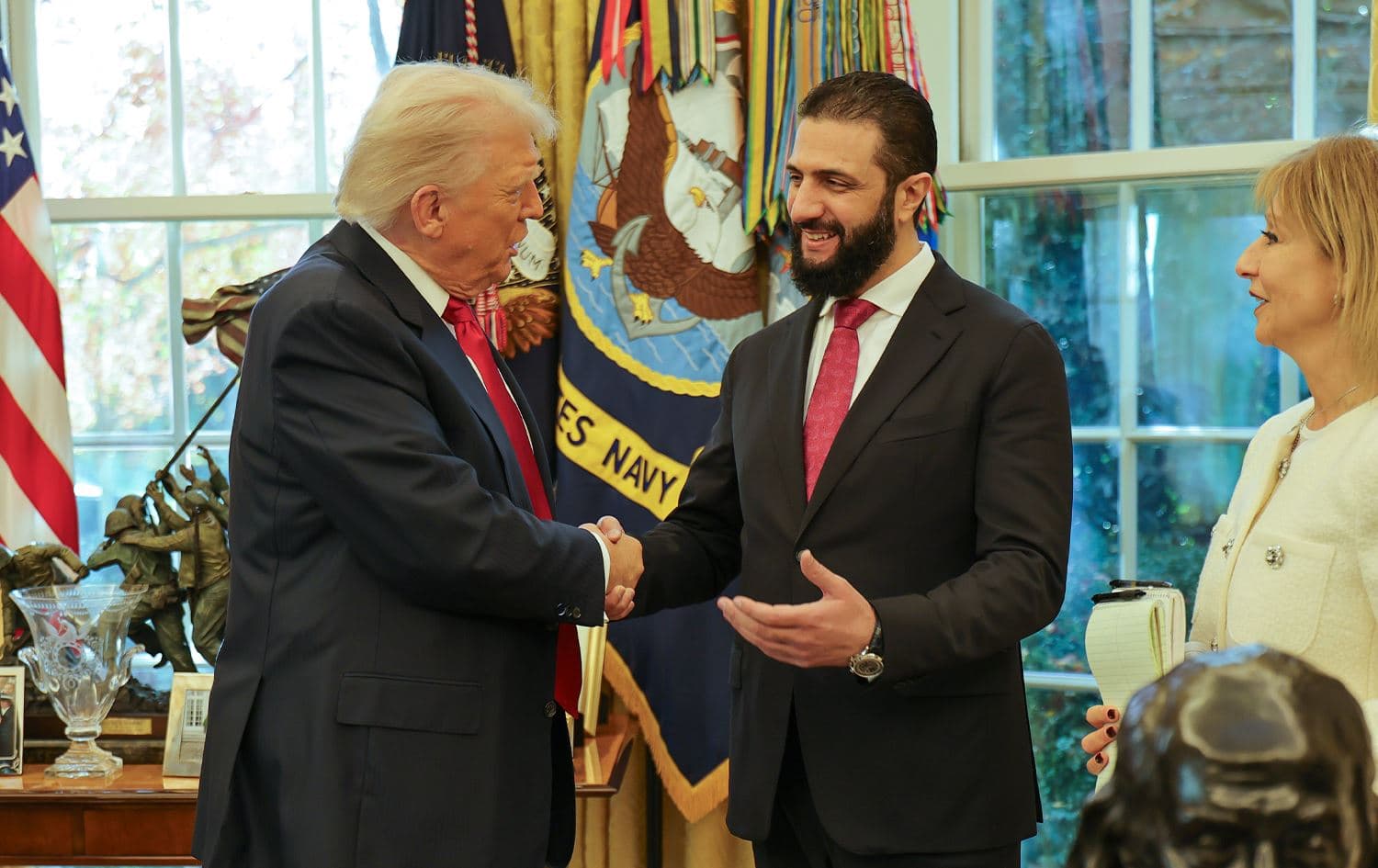

ERBIL, Kurdistan Region - The United States on Monday announced a 180-day suspension of the Caesar Act sanctions on Syria, the Treasury Department confirmed, with exceptions for certain transactions involving Russia and Iran. The move coincides with a key meeting between US President Donald Trump and Syrian interim President Ahmed al-Sharaa at the White House - the first visit by a Syrian leader in 80 years.
In a statement, the Treasury Department said that President Trump “is delivering on his commitment to give Syria ‘a chance at greatness’” by suspending the Caesar Act, “to let them rebuild and thrive by lifting US sanctions and ensuring accountability for harmful actors”.
“The US government has adopted new policies and regulatory posture to encourage US businesses and banks, the international community, the Syrian people, and regional partners to contribute to Syria’s stability while denying resources to harmful actors,” the statement added.
The Treasury Department further elaborated that the decision replaces an earlier waiver of Caesar Act sanctions issued in May.
The Caesar Syria Civilian Protection Act of 2019, commonly known as the Caesar Act, is a US legislation that sanctions the former Syrian government, including ousted Syrian dictator Bashar al-Assad, for war crimes against the Syrian population.
The Act was signed into law in late December of 2019, while its provisions came into effect on June 17 of the following year, when the US administration rolled out the first round of designations under the Act.
Based on the statement, the US has lifted comprehensive sanctions and placed the Caesar Act on suspension - except for sanctionable transactions involving Russia and Iran - and has begun permitting the license-free transfer of most basic civilian-use US-origin goods, software, and technology to Syria, certain significant restrictions still remain.
However, sanctions will continue to target Assad and his associates, individuals involved in human rights abuses, Captagon drug traffickers and other destabilizing regional actors.
Additionally, Washington will continue to review Syria's designation as a State Sponsor of Terrorism (SST) and most items listed on the Commerce Control List (CCL) which still require a US export license before being shipped to or within Syria.
The state-run Syrian Arab News Agency (SANA) reported Monday that, in a joint statement issued by the US Departments of State and Commerce along with the Office of Foreign Assets Control (OFAC) at the US Treasury Department, the agencies announced “the suspension of the Caesar Act.”
SANA added that the US reaffirmed its “commitment to supporting a stable, unified, and peaceful Syria, and the lifting of sanctions is intended to support its efforts to rebuild its economy, achieve prosperity for all its citizens, and combat terrorism."
Ahead of the suspension of the Caesar Act, US Congressman Joe Wilson shared a picture with Sharaa and Shaibani, remarking, “[I am] grateful to meet with President al-Sharaa,” adding that “a free, united, prosperous Syria is the biggest opportunity since the end of the Cold War.”
He further urged that Syria be given a chance and “achieve a COMPLETE and TOTAL repeal of Caesar [Act].”
Grateful to meet w President al-Sharaa. A free, united, prosperous Syria is the biggest opportunity since the end of the Cold War. We must give Syria a chance and achieve a COMPLETE and TOTAL repeal of Caesar. pic.twitter.com/tnSshRs3vy
— Joe Wilson (@RepJoeWilson) November 10, 2025
Setting the scene
The key waiver notably came against the backdrop of a high-level meeting between Syrian Interim President Sharaa and US President Trump at the White House.
Rudaw’s Diyar Kurda, on-site at the White House, reported that Sharaa departed the Oval Office after a one-hour and thirty-five-minute meeting with US officials. He added that shortly before his departure, US Defense Secretary Pete Hegseth and the commander of United States Central Command (CENTCOM), Admiral Brad Cooper, were seen leaving the Oval Office.
Syrian interim President Sharaa departs the Oval Office after a one-hour and thirty-five-minute meeting with US officials. Shortly before his departure, Defense Seceratry Hegseth and CENTCOM Cmndr. Adm. Cooper were seen leaving the Oval Office.
— Rudaw English (@RudawEnglish) November 10, 2025
📹: Diyar Kurda/Rudaw pic.twitter.com/W5FQ8dE5Ow
In early November, White House Press Secretary Karoline Leavitt confirmed that the meeting between Trump and Sharaa “will be taking place here at the White House on Monday [November 10].”
“This is part of the President’s ongoing diplomatic efforts to meet with leaders around the world in the pursuit of peace,” Leavitt told reporters. “As you know, when the President was in the Middle East, he made the historic decision to lift sanctions on Syria to give them a real chance at peace. We’ve seen good progress on that front under their new leadership, and so he [Sharaa] will be here at the White House on Monday, and I’ll let the President speak further on it then.”
Around the same time, Syrian Foreign Minister Asaad al-Shaibani described the talks as “the first visit by a Syrian president to the White House in 80 years,” adding that it would help open “a new chapter” in US-Syrian relations and include discussions “beginning with the lifting of sanctions.”
While in Washington, Sharaa met on Sunday with members of the Syrian community in an event attended by Foreign Minister Shaibani and US Special Envoy to Syria Tom Barrack. The meeting focused on strengthening ties between Syrians abroad and their homeland and on Syria’s reintegration into the international community.
“The president emphasized the importance of Syrians abroad maintaining their connection to their homeland and their role in conveying its true image and defending its just causes, praising their efforts and initiatives that reflect their deep belonging and pride in Syria,” read a statement from Sharaa’s office.
For his part, Barrack praised the Syrian diaspora for helping foster relations between Syria and the international community and reaffirmed Washington’s “keenness to support initiatives that facilitate Syria’s return to regional and international surroundings,” Syrian state media cited the US special envoy as saying.
Sharaa also visited the International Monetary Fund (IMF) on Sunday, where he met with Managing Director Kristalina Georgieva. In a post on X, Georgieva wrote that “it was a privilege to welcome President Ahmad al-Sharaa to the IMF.”
“We discussed the economic transformation Syrians need and deserve - which his government is making possible. I reiterated the IMF’s readiness to help, including through our existing technical support for key institutions,” Georgieva added.
Washington’s stake
Since seizing power from Syria’s long-time dictator Bashar al-Assad in December of last year and being appointed interim president in late January, Sharaa has worked to reestablish ties with the international community - especially with the United States.
In May, President Trump met with Sharaa in Saudi Arabia, a move widely interpreted as a significant diplomatic boost for the Syrian interim government. Several months later, Sharaa addressed the United Nations General Assembly in New York, becoming the first Syrian leader in decades to do so.
Analysts told Rudaw earlier this month that Washington’s renewed engagement with Damascus reflects the Trump administration’s interest in a stable Syria - particularly under a leader who appears, at least for now, willing to work with the US.
“President Trump met with Sharaa in Riyadh at the behest of Mohammed bin Salman, the Saudi crown prince. Trump wanted to do him a favor … and there was also the issue of maintaining Syria’s unity in the heart of the Middle East,” said Gregory Aftandilian, an expert on Middle East politics and US foreign policy.
"So, if Syria could be stable under strong leadership, that would presumably help US strategic interests in at least calming that area down. And then obviously he said in Riyadh he was going to lift sanctions. He did lift most US sanctions, but Congress still has to lift some of them that remain. On the other hand, there is concern, especially in Congress, over the treatment of minority rights in Syria,” he added.
Importantly, Sharaa’s visit to the White House notably comes just days after the lifting of sanctions against him by the United Nations Security Council (UNSC), the US and the United Kingdom, with the European Union expected to follow suit.
Washington and London have likewise lifted sanctions on Syria’s Interior Minister Anas Khattab, according to statements on their official websites. Sharaa and Khattab had previously been subject to financial sanctions over alleged links to ISIS and al-Qaeda.
In a Friday statement, the US State Department said the actions were “taken in recognition of the progress demonstrated by the Syrian leadership following the departure of Bashar al-Assad and more than 50 years of repression under the Assad regime.”
It added, “This new Syrian government, led by President al-Sharaa, is working hard to [locate] missing Americans, fulfill its commitments on countering terrorism and narcotics, eliminating any remnants of chemical weapons, and promoting regional security and stability as well as an inclusive, Syrian-led and Syrian-owned political process.”
However, many American lawmakers remain concerned about the rights of Syria’s minorities - Kurds, Druze, Christians, and Alawites. They insist that any easing of sanctions or renewed engagement with Damascus must be tied to clear guarantees on human rights and political freedoms.
If sanctions are to be lifted, “There must be strict conditions to ensure that civil liberties and individual lives are preserved and protected,” Senator Richard Blumenthal told Rudaw, adding that Syria must prove that “it is genuinely committed to peace and stability - not only with its Arab neighbors, but also with Israel.”
.png&w=3840&q=75)