


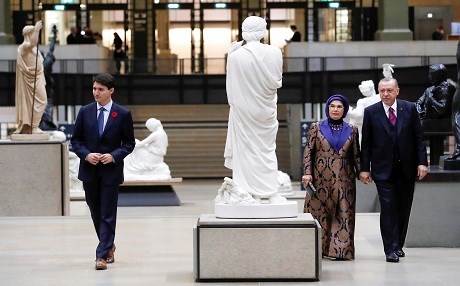
Canadian PM Justin Trudeau (left) and Turkish President Recep Tayyip Erdogan (right) and his wife Emine Erdogan walk in the Musee d'Orsay in Paris on November 10, 2018 to attend a state diner and a visit of the Picasso exhibition as part of ceremonies marking the 100th anniversary of the 11 November 1918 armistice, ending World War I. Photo: Ian Langsdon | AFP
PARIS, France — Empires would fall, regions reconfigure, new countries form: the end of World War I overhauled the global balance of power and redrew the maps of Europe and the Middle East.
Here is an overview.
Revolution in Russia
The war rang the death knell for a Russian empire already in bad shape.
Repeated defeats, crippling military spending, famines, popular anger at the World War I bloodbath: all came together in the Marxist Bolshevik Revolution of 1917.
In March that year a first revolution lead to the abdication of Nicholas II, Russia's last tsar, and the formation of a new government that proved unable to assert control.
In November the Bolsheviks seized power in a second revolution. They immediately sought an exit from the devastating war, in which Russia had sided with the Allies against the Central Powers coalition of Germany, Austria-Hungary and others.
By December Bolshevik leader Vladimir Lenin had agreed an armistice to end combat; in March he agreed to a peace treaty with Germany and its allies that saw Russia give up large swathes of territory at the cost of 30 percent of its population.
Four states were created from territory once held by Russia: Estonia, Finland, Latvia and Lithuania.
Demise of old Austria-Hungary
At the outbreak of war in 1914, the Habsburg dynasty's Austro-Hungarian empire -- which had dominated central Europe for five centuries -- stretched from Switzerland to Ukraine, grouping within it a dozen nationalities and more than 52 million people.
By the end of the conflict, the empire had exploded into several new countries, amid a nationalist fervour for autonomy.
Czechoslovakia was the first to be created, proclaimed in October 1918, and followed immediately by Yugoslavia, made up of Slavs in the southernmost parts of the empire.
Austria-Hungary's break-up was sealed in November with its signing of an armistice with the victorious Allied powers led by Britain, France and the United States.
The Paris Conference of 1919, where the final post-war peace treaty was reached, recognised the new countries and also resulted in the birth of Poland, previously divided between Austria and Russia.
Hungary lost two-thirds of its land, with Italy getting a section of the Alps region of Tyrol. And "the rest is Austria", as the French prime minister, Georges Clemenceau, famously put it.
The separated Austria and Hungary that remained were reduced to small, landlocked countries.
Ottoman fallout
When Ottoman sultan Mehmed V proclaimed the "holy war" against France, Britain and Russia in November 1914, siding with the Central Powers, his empire had already lost most of its European possessions.
The setbacks it went on to suffer on the Russian front from 1915 served as a pretext to turn on its Armenian minority, labelled as traitors and suspected of harbouring nationalist sentiment.
Armenians say up to 1.5 million of their people were killed during the war, and almost 30 countries have recognised the killings as genocide. Turkey refuses the term but accepts that massacres took place that, along with a famine, resulted in the deaths of 300,000-500,000 Armenians and as many Turks.
The Ottoman defeat in World War I led to the final break-up of the once-mighty empire.
A first treaty signed with the victors in Sevres, France, in 1920 chopped off enormous parts of its territory, including Arab lands, and provided for an independent Armenia and autonomous Kurdistan and ceding other areas to Greece.
It was rejected by Turkish nationalists, led by Mustafa Kemal Ataturk, who went on to topple the sultan and establish a Turkish republic.
They imposed a new treaty that was signed in Lausanne in 1923 and in which the republic retained Anatolia and areas around the Bosphorus Strait.
Arab raw deal
The British were able to triumph over the Ottoman empire thanks to the revolt of the Arab tribes in Mesopotamia and Palestine, for whom they held out the promise of independence.
But Britain was also in secret talks with France to share out the Middle East between them, as set out in the Sykes-Picot Agreement signed in May 1916.
They decided that Lebanon and Syria were to go to France, and Jordan and Iraq to Britain.
The partition would feed Arab frustration. This mounted with the 1917 Balfour Declaration that led to the establishment within Palestine of "a national home for the Jewish people".
The state of Israel was created 30 years later, its troubled foundations causing a conflict that continues to disrupt the region today.
Comments
Rudaw moderates all comments submitted on our website. We welcome comments which are relevant to the article and encourage further discussion about the issues that matter to you. We also welcome constructive criticism about Rudaw.
To be approved for publication, however, your comments must meet our community guidelines.
We will not tolerate the following: profanity, threats, personal attacks, vulgarity, abuse (such as sexism, racism, homophobia or xenophobia), or commercial or personal promotion.
Comments that do not meet our guidelines will be rejected. Comments are not edited – they are either approved or rejected.
Post a comment