


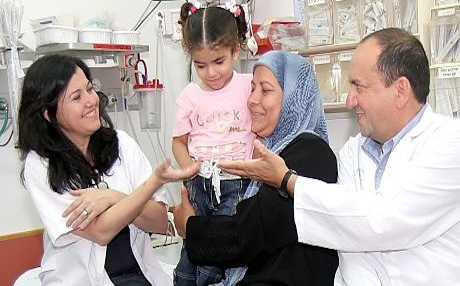
MONTREAL, Canada – Israeli-based Christian non-profit organization Shevet Achim helps children from the Middle-East with congenital heart defects receive life-saving surgery by Jewish cardiologists, regardless of their nationality, religion and financial situation.
In partnership with a number of hospitals in Israel like the Wolfson Medical Centre and international non-profit organizations Save a Child’s Heart (SACH), Shevet Achim offers sponsored heart-surgery and treatment for children who could not otherwise have a chance to live.
‘’People from all backgrounds unite around these children to save their lives: Christians, Jews, religious, secular,’’ says Jonathan Miles, an American journalist who started Shevet Achim, soon after volunteering with a Christian organization helping with the resettlement of Russian Jews.
It all started when Jonathan met Andrei, a 13-year-old non-Jewish Ukrainian resettling with his mother in Israel.
‘’Andrei needed a bone marrow transplant as the last hope to save his life. The family had no money and the hospital wanted $64,000,’’ Jonathan recalls. When he heard the doctors say they would leave Andrei die of leukemia in the doorway of the emergency room unless every dollar was paid, Jonathan started to tell the story -- and pray.
“In response a coalition of Jews and Christians -- secular and religious -- came together to raise funds and managed to convince the hospital to lower the cost of the treatment by more than one-third,’’ Jonathan says. ‘’In less than a month, Andrei had his treatment.”
At Wolfson, a partner hospital based in Holon, Israel, 70 doctors volunteer their time, evenings and weekends included, to treat children coming from Palestine, Syria, Jordan and -- against all odds -- from Iraq.
There are no separate departments for foreign children, explains Dr Alona Raucher, Senior Pediatric Cardiologist at Wolfson. A child from the Gaza strip might well share a room with an Israeli child, she says.
‘’Whether the children are Muslims, Christians, Buddhists, a child is a child. Regardless of its origins, a child ought to receive the best medical treatment available and have a chance to live like any other child,’’ Raucher told Rudaw.
Since Wolfson started pairing with Shevet Achim to help children with heart defects, 3,300 children who would otherwise likely have died, have been treated at the hospital.
In addition to the Palestinian children crossing the border to receive treatment in Israel, families from Iraq are also traveling to Israel to receive life-saving services. Flying via Amman airport in Jordan and being driven through the Israeli border to Jerusalem by a Shevet Achim staff member was a routine logistics feat for Goran Hassan, a former Shevet Achim staffer.
Based in Sulaimani in northern Iraq, Goran still remembers the story of Herzan, an18 year-old Iraqi who needed heart surgery. ‘’Doctors in the neighboring countries categorized his condition as inoperable or gave him a very low survival chance,” Goran remembers.
Despite the high risks, Herzan asked for a life or death intervention to be undertaken. He and his family stayed at a Shevet Achim guesthouse in Jerusalem for almost a year, Goran told Rudaw. Thanks to a successful intervention, Hezran has now become a healthy strong young man pursuing his dreams.
Bringing children from Iraq was far from easy when it started in 1993, after the Iraqi war and the bombing by Saddam Hussein of Tel Aviv. Jonathan could hardly imagine bringing an Iraqi child to Israel when he first visited Iraq to assess the needs of children for heart surgery.
Today, about 40 Iraqi children are coming each year to Israel for heart surgeries. Wolfson has treated 200 children from Iraq since then. A good number of them came from the Kurdistan Region, says Tamar Shapira, Director of International and Public Relations at Save a Child’s Heart, an Israeli-based international humanitarian project that helps find sponsors for the children received at Wolfson.
’We’ve come to know and love the Kurdish people, and many of our volunteers are learning Kurdish,’’ Jonathan told Rudaw. ‘’We’re helped often by some of the tens of thousands of Kurdish-speaking Jews in Israel, who are excited to learn that their former neighbors are coming to Israel,’’he added.
Comments
Rudaw moderates all comments submitted on our website. We welcome comments which are relevant to the article and encourage further discussion about the issues that matter to you. We also welcome constructive criticism about Rudaw.
To be approved for publication, however, your comments must meet our community guidelines.
We will not tolerate the following: profanity, threats, personal attacks, vulgarity, abuse (such as sexism, racism, homophobia or xenophobia), or commercial or personal promotion.
Comments that do not meet our guidelines will be rejected. Comments are not edited – they are either approved or rejected.
Post a comment