


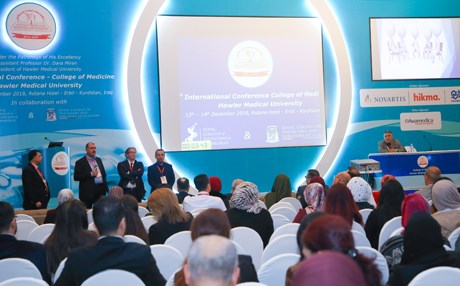
ERBIL, Kurdistan Region — Medical caregivers putting the patient first was a primary focus as doctors and experts met on the first of a three-day international conference the Kurdistan Region's capital of Iraq.
An all-day assessment workshop helped Hawler Medical University professors improve their assessment techniques for medical students and young doctors from Kurdistan and Iraq.
It was taught by Professors Nigel Bax and Deborah Bax from Sheffield, United Kingdom, who have been working with Iraqi medical colleges for nine years.
"This course we've run today has been all about assessment and all about how you best assess medical students at all stages of their training in a medical college," said Professor Nigel Bax.
First working with 15 colleges in Iraq, they have now expanded their training to 20 different Arab countries across North Africa and the Middle East.
"This is all for the benefit not of the doctors, not of the colleges, not of the Arab boards of specialization but the patient," Dr. Nigel Bax said. "The patient is the center of everything that we do."
"It's been really exciting because some of the ideas that we've been discussing are ones now that I think might get adopted," he added.
Some points discussed were how to write good examinations and if it is best fit for its purpose as well as how to determine pass marks.
"At the moment many examinations use a passing mark of 50 percent. Which means the people you are graduating are 50 percent incompetent," he said.
He also added that assessment is to aid learning, not just to make judgments about performance which was one of the main topics of discussion with the medical faculty.
Dr. Chato Ali Taher, a medical doctor in infection and immunity from Erbil and faculty at Hawler Medical University, participated in the assessment workshop.
"I think it's quite good," he said, adding that implementing different ways of teaching will be beneficial to medical students.
Dr. Mohammed Meena who specializes in internal medicine also enjoyed the workshop.
"It was very new for us because we didn't have such meetings in the past really. We are just starting our medical education in our college," he said, adding that he plans on joining the conference’s upcoming workshops.
Dr. Tara Shalal, a pathologist originally from Duhok but now also teaching at Hawler Medical University, said she found many aspects of the workshop interesting.
"First of all was the brainstorming because it introduced many new concepts that we lack in our curriculum," she said. "Also it was an eye opener for many inspirational ideas that we can pursue from now on that we can really work on and build on."
The College of Medicine was just founded two years ago, she revealed, which is why such workshops are important for medical education.
"We are relatively new in medical education so that's why such workshops are really necessary, in fact crucial, for our work as a new department," she added.
The Third International Conference of the College of Medicine was organized by Hawler Medical University in collaboration with the Royal College of Physicians of Edinburgh and the Royal College of Physicians and Surgeons of Glasgow from the United Kingdom. Rudaw is a media sponsor.
Other workshops which will take place this week include: Principles of Good Medical Practice, Principle of Assessment in Medical Education, Introduction to Interventional Radiology, How to Set Up a Modern Standard Obesity Treatment Center, Child Abuse, and Advances in Medical Education.
An all-day assessment workshop helped Hawler Medical University professors improve their assessment techniques for medical students and young doctors from Kurdistan and Iraq.
It was taught by Professors Nigel Bax and Deborah Bax from Sheffield, United Kingdom, who have been working with Iraqi medical colleges for nine years.
"This course we've run today has been all about assessment and all about how you best assess medical students at all stages of their training in a medical college," said Professor Nigel Bax.
First working with 15 colleges in Iraq, they have now expanded their training to 20 different Arab countries across North Africa and the Middle East.
"This is all for the benefit not of the doctors, not of the colleges, not of the Arab boards of specialization but the patient," Dr. Nigel Bax said. "The patient is the center of everything that we do."
"It's been really exciting because some of the ideas that we've been discussing are ones now that I think might get adopted," he added.
Some points discussed were how to write good examinations and if it is best fit for its purpose as well as how to determine pass marks.
"At the moment many examinations use a passing mark of 50 percent. Which means the people you are graduating are 50 percent incompetent," he said.
He also added that assessment is to aid learning, not just to make judgments about performance which was one of the main topics of discussion with the medical faculty.
Dr. Chato Ali Taher, a medical doctor in infection and immunity from Erbil and faculty at Hawler Medical University, participated in the assessment workshop.
"I think it's quite good," he said, adding that implementing different ways of teaching will be beneficial to medical students.
Dr. Mohammed Meena who specializes in internal medicine also enjoyed the workshop.
"It was very new for us because we didn't have such meetings in the past really. We are just starting our medical education in our college," he said, adding that he plans on joining the conference’s upcoming workshops.
Dr. Tara Shalal, a pathologist originally from Duhok but now also teaching at Hawler Medical University, said she found many aspects of the workshop interesting.
"First of all was the brainstorming because it introduced many new concepts that we lack in our curriculum," she said. "Also it was an eye opener for many inspirational ideas that we can pursue from now on that we can really work on and build on."
The College of Medicine was just founded two years ago, she revealed, which is why such workshops are important for medical education.
"We are relatively new in medical education so that's why such workshops are really necessary, in fact crucial, for our work as a new department," she added.
The Third International Conference of the College of Medicine was organized by Hawler Medical University in collaboration with the Royal College of Physicians of Edinburgh and the Royal College of Physicians and Surgeons of Glasgow from the United Kingdom. Rudaw is a media sponsor.
Other workshops which will take place this week include: Principles of Good Medical Practice, Principle of Assessment in Medical Education, Introduction to Interventional Radiology, How to Set Up a Modern Standard Obesity Treatment Center, Child Abuse, and Advances in Medical Education.
Comments
Rudaw moderates all comments submitted on our website. We welcome comments which are relevant to the article and encourage further discussion about the issues that matter to you. We also welcome constructive criticism about Rudaw.
To be approved for publication, however, your comments must meet our community guidelines.
We will not tolerate the following: profanity, threats, personal attacks, vulgarity, abuse (such as sexism, racism, homophobia or xenophobia), or commercial or personal promotion.
Comments that do not meet our guidelines will be rejected. Comments are not edited – they are either approved or rejected.
Post a comment