


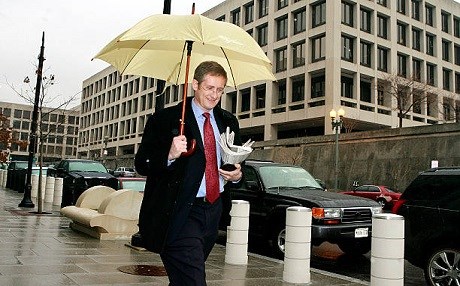
ERBIL, Kurdistan Region — John Hannah, a security advisor to former US Vice President Dick Cheney, is expected to be nominated as the next US envoy to Syria.
At least two unnamed people familiar with the decision told Al-Monitor on Wednesday that Hannah was likely to fill the post.
Hannah is working as a senior counselor at the conservative Defense of Democracies think tank in Washington, D.C. and often testifies on Middle East policy at Congress.
The think tank advocates hawkish policies on national security, and especially on Iran, whose growing influence in Syria has been a major concern for the United States and Israel.
There was no US military force reduction for Iraq and Syria in the 2019 draft defense spending bill, which was published this week.
Brett McGurk, US Special Presidential Envoy to the anti-ISIS coalition stated in January that the United States will remain in Syria.
"The focus will then shift to stabilization, and the United States is prepared to remain in Syria until we are certain that ISIS is defeated, stabilization efforts can be sustained, and there is meaningful progress in the Geneva-based political process pursuant to UNSCR 2254, ultimately leading to constitutional reform and UN-supervised elections," he wrote in a year-end briefing to coalition partners.
When the United States announced in January a plan to train a 30,000-strong border force with the SDF to secure the borders of Rojava, the self-autonomous Kurdish enclave in northern Syria, Washington’s NATO-ally Ankara was enraged.
On Tuesday, the Director of National Intelligence for the US testified to the Senate that "The Kurdish People’s Protection Unit — the Syrian militia of the Kurdistan Workers’ Party (PKK) — probably will seek some form of autonomy but will face resistance from Russia, Iran, and Turkey."
The US State Department has stated "98 percent of the territory once held by ISIS in Iraq and Syria has now been liberated, approximately four and a half million Iraqis, and 3.2 million Syrians have now been freed."
At least two unnamed people familiar with the decision told Al-Monitor on Wednesday that Hannah was likely to fill the post.
The 56-year-old would replace Michael Ratney, an Obama-administration holdover.
Hannah is working as a senior counselor at the conservative Defense of Democracies think tank in Washington, D.C. and often testifies on Middle East policy at Congress.
The think tank advocates hawkish policies on national security, and especially on Iran, whose growing influence in Syria has been a major concern for the United States and Israel.
There was no US military force reduction for Iraq and Syria in the 2019 draft defense spending bill, which was published this week.
Brett McGurk, US Special Presidential Envoy to the anti-ISIS coalition stated in January that the United States will remain in Syria.
"The focus will then shift to stabilization, and the United States is prepared to remain in Syria until we are certain that ISIS is defeated, stabilization efforts can be sustained, and there is meaningful progress in the Geneva-based political process pursuant to UNSCR 2254, ultimately leading to constitutional reform and UN-supervised elections," he wrote in a year-end briefing to coalition partners.
At least 1,000 SDF fighters suffered casualties fighting ISIS, according to the coalition.
When the United States announced in January a plan to train a 30,000-strong border force with the SDF to secure the borders of Rojava, the self-autonomous Kurdish enclave in northern Syria, Washington’s NATO-ally Ankara was enraged.
On Tuesday, the Director of National Intelligence for the US testified to the Senate that "The Kurdish People’s Protection Unit — the Syrian militia of the Kurdistan Workers’ Party (PKK) — probably will seek some form of autonomy but will face resistance from Russia, Iran, and Turkey."
The US State Department has stated "98 percent of the territory once held by ISIS in Iraq and Syria has now been liberated, approximately four and a half million Iraqis, and 3.2 million Syrians have now been freed."
Comments
Rudaw moderates all comments submitted on our website. We welcome comments which are relevant to the article and encourage further discussion about the issues that matter to you. We also welcome constructive criticism about Rudaw.
To be approved for publication, however, your comments must meet our community guidelines.
We will not tolerate the following: profanity, threats, personal attacks, vulgarity, abuse (such as sexism, racism, homophobia or xenophobia), or commercial or personal promotion.
Comments that do not meet our guidelines will be rejected. Comments are not edited – they are either approved or rejected.
Post a comment