


World

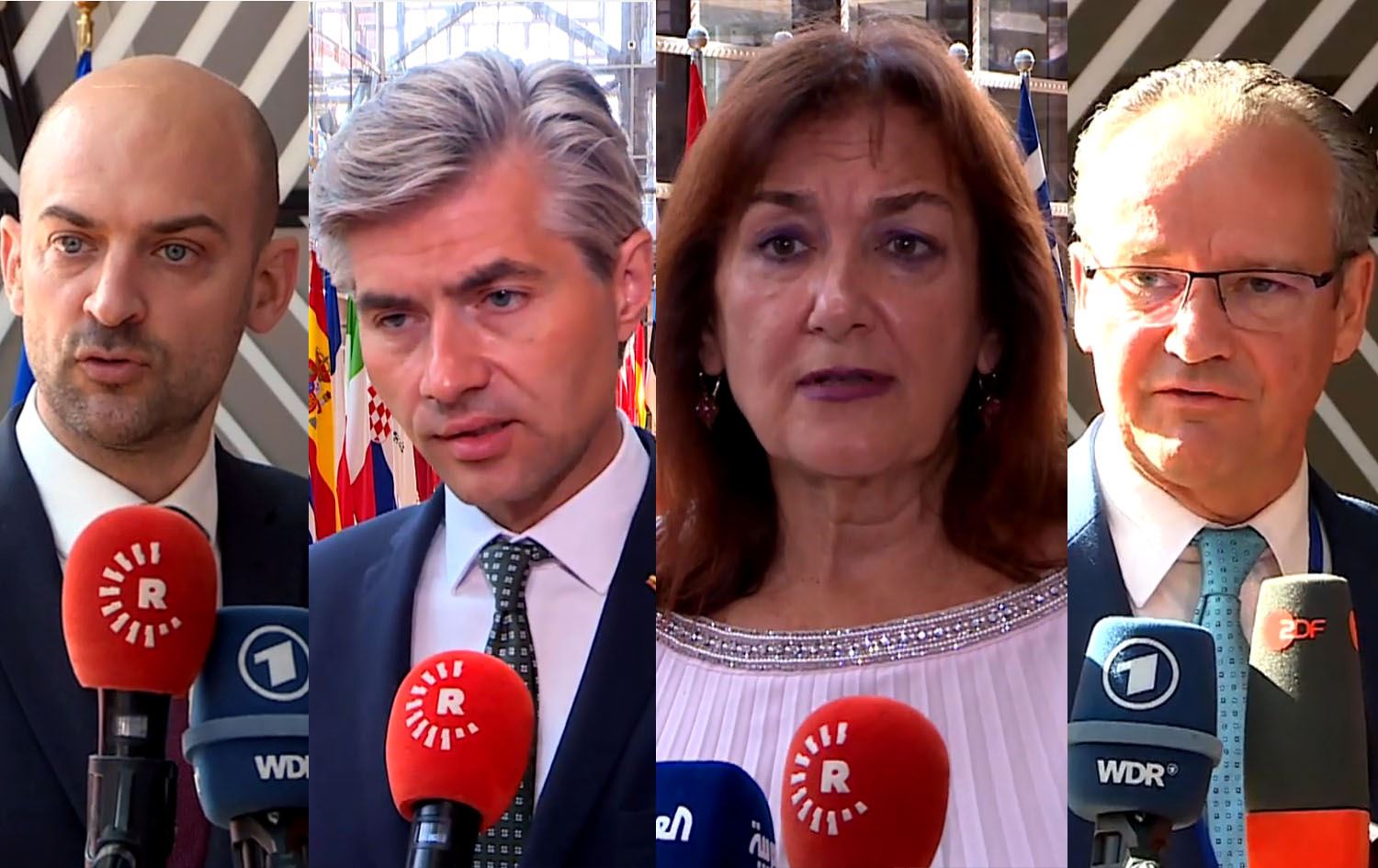
From left to right: French Foreign Minister Jean-Noel Barrot, Lithuanian Foreign Minister Kestutis Budrys, Dubravka Suica, the European Commissioner for Democracy and Demography, Germany’s Minister of State for Europe Gunther Krichbaum speak to Rudaw in Brussels on July 15, 2025. Graphic: Rudaw
ERBIL, Kurdistan Region - European officials on Tuesday stressed that Syria’s future must be shaped through an inclusive, Syrian-led political process that safeguards minority rights and reflects the country’s diverse social fabric. They warned that failure to do so could trigger the reinstatement of European Union (EU) sanctions.
Speaking to Rudaw on the sidelines of the EU Foreign Ministers’ meeting in Brussels, French Foreign Minister Jean-Noel Barrot said France is actively supporting dialogue between the interim authorities in Damascus and the Kurdish-led Democratic Autonomous Administration of North and East Syria (DAANES) in northeast Syria (Rojava).
“Certainly, we continue working with the Americans to facilitate dialogue between Syrian authorities and Kurdish authorities,” Barrot said, affirming France’s ongoing commitment to Kurdish rights.
"The Kurds were trusted allies in the fight against the [Islamic State] ISIS,” he emphasized, adding that France’s priority is for the people of Rojava to “enjoy full citizenship rights in Syria.” Barrot expressed hope that the talks between Damascus and the Kurdish-led administration would “continue under the best conditions.”
However, the interim government has faced criticism from minority groups, including the Kurds, who accuse it of exclusionary policies and centralization of power.
A key breakthrough came in early March, when Sharaa and Mazloum Abdi, commander of the US-backed Syrian Democratic Forces (SDF), signed an agreement to integrate the Kurdish-led force, which serves as the de facto army in Rojava.
The accord also outlined the integration of “all civil and military institutions” in Rojava under the Syrian state, including border crossings, Qamishli International Airport, and oil and gas fields.
Since then, multiple rounds of negotiations have taken place between DAANES and Syrian government delegations, with the presence of both US and French representatives.
While some progress has been made, a central disagreement remains unresolved.
Damascus maintains that DAANES’s administrative and military structures must be fully absorbed into a centralized state, adhering to the principle of “one Syria, one army, one government.”
In contrast, the Kurdish parties in Rojava are advocating for a decentralized, democratic Syria that preserves the autonomy and institutions developed in Rojava over the past decade.
In its Sunday statement, DAANES welcomed the latest meetings with the Syrian government - held in the presence of US and French representatives - as “a crucial step toward launching a serious Syrian-Syrian dialogue.” It also expressed “sincere thanks and gratitude” to both countries for their “constructive role and continuous efforts in supporting stability, peace, and democracy in Syria.”
Speaking to Rudaw on Tuesday, Dubravka Suica, the European Commissioner for Democracy and Demography, reiterated the EU’s position in favor of a “Syrian-led and Syrian-owned” process that ensures representation of all societal segments - including minorities and women.
“We trust in this government and we are looking forward to talking about all the parts of the society,” she said, noting that a “national dialogue” with different groups will be held in November. Crucially, Suica stressed the effort should not be confined to Damascus, urging locations “at the [Syrian] coastal [areas] or in Aleppo or somewhere else.
“Syria is not only Damascus,” she said. The initiative follows recent diplomatic engagements with the Syrian government, who are "aware of the situation" and "trying to make what they can," Suica said, adding that “the minister hoped these discussions will "cover the whole country."
For his part, Germany’s Minister of State for Europe Gunther Krichbaum also underscored that discussions on Syria's future must prioritize the country's sovereignty and avoid confusing federalism with separatism.
"In the case of sovereign states, it is always the state itself that is asked how it wants to organize itself," the official stated, stressing that "one must always be a bit careful that [federalism] is not confused with separatism."
Krichbaum further highlighted the immense challenge for Syria to "bring together the different social currents, and also tribes." This internal cohesion, he stressed, "will be the great task for the future” to achieve “stability for the country.”
On May 20, the EU officially decided to lift all economic sanctions on Syria, removing 21 entities from “the EU list of those subject to the freezing of funds and economic resources,” the EU Council then said. “Several of these entities are banks, including the Central Bank of Syria, or companies operating in key sectors for Syria’s economic recovery,” the Council elaborated.
EU foreign policy chief Kaja Kallas then hailed the decision, saying it comes at a “historic” time to safeguard Syria’s economic recovery. “The EU has stood with the Syrian people throughout the last 14 years, and it will continue to do so. Today the EU reaffirms its commitment as a partner for the transition,” she said.
However, according to Budrys, a key condition for any lifting or suspension of sanctions in Syria is its adherence to principles that safeguard all societal groups and minorities, regardless of their religious, ethnic, or other identities.
“Be it religion, ethnicity, or any other identity - it must be protected,” he said. “If these protections are not provided, the EU reserves the right to reimpose sanctions.”
He acknowledged the scale of destruction in Syria following years of war, but stressed that “international laws and principles must still be followed.”


Comments
Rudaw moderates all comments submitted on our website. We welcome comments which are relevant to the article and encourage further discussion about the issues that matter to you. We also welcome constructive criticism about Rudaw.
To be approved for publication, however, your comments must meet our community guidelines.
We will not tolerate the following: profanity, threats, personal attacks, vulgarity, abuse (such as sexism, racism, homophobia or xenophobia), or commercial or personal promotion.
Comments that do not meet our guidelines will be rejected. Comments are not edited – they are either approved or rejected.
Post a comment