


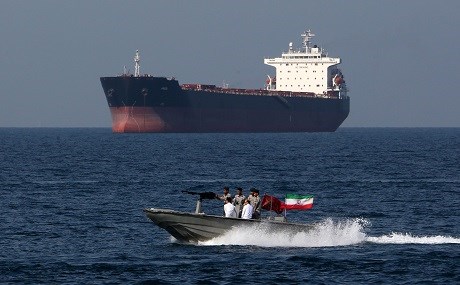
ERBIL, Kurdistan Region – Deploying warships to escort tankers through the strategic Strait of Hormuz could provoke Iran and further escalate tensions between the US and the Islamic Republic, the UK’s Minister for the Middle East Andrew Murrison warned MPs on Monday.
MPs roundly condemned the June 13 attack on two tankers in the Gulf of Oman, which British Foreign Secretary Jeremy Hunt said was “almost certainly” carried out by Iran and its proxies amid escalating tensions with the US.
Following an urgent question from Liberal Democrat MP Jo Swinson concerning the tanker attacks, Murrison reiterated the foreign secretary’s judgement.
“Following our own assessment, the UK concludes that it is almost certain that a branch of the Iranian military, the Islamic Revolutionary Guard Corps (IRGC) attacked the two tankers on June 13. No other state or non-state actor could plausibly have been responsible,” he told MPs.
Murrison said he has met with the Iranian Ambassador to London to discuss the matter and would soon visit Tehran for talks.
Asked whether the Royal Navy should be deployed to the strategic Strait of Hormuz to escort tankers, Murrison said such a move could provoke Iran and further raise tensions.
“It is not our judgment at the moment that that would be appropriate,” Murrison told MPs. “I think it would be seen as provocative and escalatory.”
“My view—the Government’s view—is that our interests are best served at this time by trying to turn down the heat on this, and that is what we will continue to do. But clearly we keep all these things under review.”
Pressed further on the point, Murrison said: “The straight answer is that we do not propose, as things stand at the moment, to escort vessels through the straits of Hormuz. We do not feel that is necessary, based on what we know, and we feel that it would be escalatory, so there are no plans to do such a thing.”
It emerged over the weekend that 100 Royal Marines are to be deployed to patrol the Gulf.
The Middle East minister acknowledged that a failure to protect the freedom of shipping through the strategic Strait, which Iran routinely threatens to close, would prove very costly and could lead to war.
“A great deal of Europe’s liquefied natural gas comes from the Gulf. Inevitably, after a fairly short space of time, there would be severe economic penalties,” he said.
“Above all, of course, we are concerned about the human cost of another conflict, which has, sadly, been seen too much in this region over the past few years.”
Questioned about the strength of US evidence which appears to implicate Iran in the tanker attacks, Murrison said he would not comment on intelligence matters, but insisted it is of “high quality and is highly reliable”.
Several MPs, including Labour’s Fabian Hamilton, said de-escalation efforts must be led by the United Nations to investigate the tanker attacks and salvage the 2015 nuclear deal.
“What we must now do as a country, through the United Nations—as both Secretary-General Guterres and the German Government have called for—is to work to de-escalate the situation as the Minister has suggested, so that it is not just Ali Khamenei on one side and John Bolton on the other deciding to plunge the Middle East into this catastrophe, but sensible diplomats from all countries working to independently investigate and verify the facts around the tanker attacks, to prevent any repeat of them and, most of all, to stop the descent into a war that we all fear, and getting the nuclear deal back on track instead,” Hamilton said.
Scottish National Party MP Martin Docherty-Hughes echoed the call for a UN-led probe.
“The idea that the Government’s assessment leads to ‘responsibility for the attacks almost certainly’ — ‘almost certainly’ being the operative words — lying with Iran gives cause for concern. I therefore hope that the call by the United Nations, as we have heard, for an independent entity to conduct an investigation would be the next step,” Docherty-Hughes said.
Murrison insisted the responsibility for an independent investigation lies with the shipping companies that operate the tankers. He also ruled out plans to follow the US in designating the IRGC as a foreign terrorist organization.
Swinson warned any moves by the UK to pressure Iran could prove harmful to Nazanin Zaghari-Ratcliffe, a British-Iranian national who has been detained by Iran since 2016.
Two tankers caught fire in the Gulf of Oman on Thursday, forcing the crews of the Norwegian-owned Front Altair and the Japanese-owned Kokuka Courageous to abandon ship.
Though it remains unclear what caused the fires, the US and its Gulf allies have leveled the blame at Iran. The US Navy has published footage and photographs appearing to show IRGC Navy boats removing limpet mines from the hull of one of the vessels.
Iran vehemently denies the accusations.
MPs roundly condemned the June 13 attack on two tankers in the Gulf of Oman, which British Foreign Secretary Jeremy Hunt said was “almost certainly” carried out by Iran and its proxies amid escalating tensions with the US.
Following an urgent question from Liberal Democrat MP Jo Swinson concerning the tanker attacks, Murrison reiterated the foreign secretary’s judgement.
“Following our own assessment, the UK concludes that it is almost certain that a branch of the Iranian military, the Islamic Revolutionary Guard Corps (IRGC) attacked the two tankers on June 13. No other state or non-state actor could plausibly have been responsible,” he told MPs.
Murrison said he has met with the Iranian Ambassador to London to discuss the matter and would soon visit Tehran for talks.
Asked whether the Royal Navy should be deployed to the strategic Strait of Hormuz to escort tankers, Murrison said such a move could provoke Iran and further raise tensions.
“It is not our judgment at the moment that that would be appropriate,” Murrison told MPs. “I think it would be seen as provocative and escalatory.”
“My view—the Government’s view—is that our interests are best served at this time by trying to turn down the heat on this, and that is what we will continue to do. But clearly we keep all these things under review.”
Pressed further on the point, Murrison said: “The straight answer is that we do not propose, as things stand at the moment, to escort vessels through the straits of Hormuz. We do not feel that is necessary, based on what we know, and we feel that it would be escalatory, so there are no plans to do such a thing.”
It emerged over the weekend that 100 Royal Marines are to be deployed to patrol the Gulf.
The Middle East minister acknowledged that a failure to protect the freedom of shipping through the strategic Strait, which Iran routinely threatens to close, would prove very costly and could lead to war.
“A great deal of Europe’s liquefied natural gas comes from the Gulf. Inevitably, after a fairly short space of time, there would be severe economic penalties,” he said.
“Above all, of course, we are concerned about the human cost of another conflict, which has, sadly, been seen too much in this region over the past few years.”
Questioned about the strength of US evidence which appears to implicate Iran in the tanker attacks, Murrison said he would not comment on intelligence matters, but insisted it is of “high quality and is highly reliable”.
Several MPs, including Labour’s Fabian Hamilton, said de-escalation efforts must be led by the United Nations to investigate the tanker attacks and salvage the 2015 nuclear deal.
“What we must now do as a country, through the United Nations—as both Secretary-General Guterres and the German Government have called for—is to work to de-escalate the situation as the Minister has suggested, so that it is not just Ali Khamenei on one side and John Bolton on the other deciding to plunge the Middle East into this catastrophe, but sensible diplomats from all countries working to independently investigate and verify the facts around the tanker attacks, to prevent any repeat of them and, most of all, to stop the descent into a war that we all fear, and getting the nuclear deal back on track instead,” Hamilton said.
Scottish National Party MP Martin Docherty-Hughes echoed the call for a UN-led probe.
“The idea that the Government’s assessment leads to ‘responsibility for the attacks almost certainly’ — ‘almost certainly’ being the operative words — lying with Iran gives cause for concern. I therefore hope that the call by the United Nations, as we have heard, for an independent entity to conduct an investigation would be the next step,” Docherty-Hughes said.
Murrison insisted the responsibility for an independent investigation lies with the shipping companies that operate the tankers. He also ruled out plans to follow the US in designating the IRGC as a foreign terrorist organization.
Swinson warned any moves by the UK to pressure Iran could prove harmful to Nazanin Zaghari-Ratcliffe, a British-Iranian national who has been detained by Iran since 2016.
Two tankers caught fire in the Gulf of Oman on Thursday, forcing the crews of the Norwegian-owned Front Altair and the Japanese-owned Kokuka Courageous to abandon ship.
Though it remains unclear what caused the fires, the US and its Gulf allies have leveled the blame at Iran. The US Navy has published footage and photographs appearing to show IRGC Navy boats removing limpet mines from the hull of one of the vessels.
Iran vehemently denies the accusations.
Comments
Rudaw moderates all comments submitted on our website. We welcome comments which are relevant to the article and encourage further discussion about the issues that matter to you. We also welcome constructive criticism about Rudaw.
To be approved for publication, however, your comments must meet our community guidelines.
We will not tolerate the following: profanity, threats, personal attacks, vulgarity, abuse (such as sexism, racism, homophobia or xenophobia), or commercial or personal promotion.
Comments that do not meet our guidelines will be rejected. Comments are not edited – they are either approved or rejected.
Post a comment