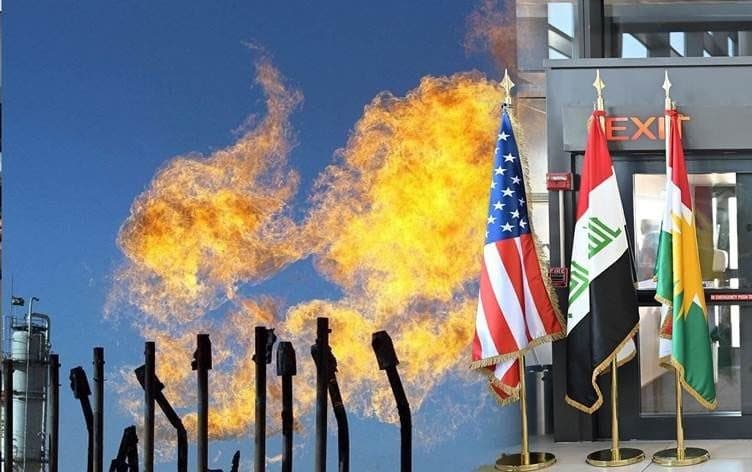

ERBIL, Kurdistan Region – The United States on Wednesday welcomed the expansion of its commercial ties with the Kurdistan Region, following the signing of two major energy agreements valued at a combined $110 billion over their lifespans.
The deals were signed under the supervision of Kurdistan Region Prime Minister Masrour Barzani during his visit to Washington. US officials further praised the agreements for enhancing gas production and delivering mutual benefits.
In a statement on X, the US State Department’s Bureau of Near Eastern Affairs said, “We are pleased to see the commercial relationship between the United States and Iraqi Kurdistan Region expand with the signing of agreements with U.S. companies,” adding that “these types of partnerships will strengthen gas production in Iraq and benefit both of our peoples.”
The Kurdistan Region Premier personally oversaw the signing of the multibillion-dollar deals during his visit to Washington, which began Saturday and included high-level talks on energy cooperation and broader regional developments.
The agreements are part of the Kurdistan Regional Government’s (KRG) wider initiative to achieve round-the-clock electricity for the Region.
The first deal was signed between the KRG and HKN Energy, in partnership with ONEX, to develop the Miran Gas Field through their newly established joint venture, Miran Energy.
The second agreement, with U.S.-based WesternZagros, grants the company rights to develop the Topkhana-Kurdamir block in southwestern Sulaimani province for oil and gas production.
Speaking at the signing ceremony, Prime Minister Barzani said the deals “underscore Kurdistan’s commitment to peace and progress through economic development.”
In a post on X, he declared, “A new phase of Kurdistan–USA ties begins as we sign two multibillion-dollar deals,” adding that the agreements “will power millions, create jobs, and strengthen the foundation of Kurdistan’s economy.”
A new phase of Kurdistan-USA ties begins as we sign two multi-billion dollar deals with HKN Energy and WesternZagros Resources.
— Masrour Barzani (@masrourbarzani) May 20, 2025
These deals will power millions, create jobs and strengthen the foundation of Kurdistan’s economy. pic.twitter.com/v1WYeXybiU
During his trip, the KRG reported that Prime Minister Barzani held a series of meetings with US lawmakers, both Republican and Democrat, to discuss deepening ties between Erbil and Washington.
From the Republican side, PM Barzani met with Congressman Joe Wilson to discuss “the importance of further strengthening and expanding ties between the Kurdistan Region and the United States.”
The Kurdistan Region Premier “conveyed his appreciation for US support to the Kurdistan Region,” while Congressman Wilson “reiterated his firm support for a strong and prosperous Kurdistan Region” and “welcomed the investments in Kurdistan’s energy sector.”
Premier Barzani held another meeting with Congressman Mario Diaz-Balart where they “discussed the situation in Iraq and the Kurdistan Region, and the importance of further strengthening ties” between Erbil and Washington.
Congressman Diaz-Balart “reaffirmed his support for the Kurdistan Region and the [Kurdish] Peshmerga forces.”
The Kurdistan Region Premier also met with Congressman and Chairman of the House Foreign Affairs Committee Brian Mast, who “expressed his respect and appreciation for the sacrifices made by the Peshmerga forces in the fight against terrorism.”
Congressman Mast “reaffirmed his full support for the Kurdistan Region as a key US ally in the region.”
Both sides “agreed on the importance of strengthening bilateral relations, particularly in the fields of investment and energy,” and “highlighted the significance and benefits of the two recent agreements signed between the KRG and U.S. companies HKN Energy and WesternZagros.”
On the Democratic side, the Kurdistan Region Premier met with Congressman Adam Smith to discuss “the latest developments in Iraq, the Kurdistan Region, and the broader region.”
The two officials “emphasized the importance of further strengthening bilateral relations across all sectors” and “underlined the need to accelerate the formation of the tenth cabinet in the KRG.”
PM Barzani also held talks with independent Senator Angus King and republican Senator James Lankford.
Both senators welcomed Prime Minister Barzani’s visit to the US, reaffirming “their appreciation for the heroic role of the Peshmerga forces in the fight against the [Islamic State] ISIS,” while “highlighting the Kurdistan Region’s importance in confronting terrorism.”
“The senators acknowledged the significance of these deals, noting that they will support economic development not only in the Kurdistan Region but across all of Iraq.”
Speaking to reporters on the sidelines of his meetings, including Rudaw’s Diyar Kurda, Prime Minister Barzani stressed the strength of the alliance between Erbil and Washington, referring to it as a “credible” partnership.
He further expressed gratitude to “President Trump, the US government, this administration, and the American people for their continuous support to our people, to our [Kurdish] Peshmerga who have fought alongside the Americans against terrorism.”
“We are friends and allies - credible allies, I hope - to the United States, and we expect that our relationship will deepen and continue for our common purposes,” the Prime Minister stated, highlighting, “We share many of the values of the United States.”
PM Barzani went on to voice his deep belief “in the policy of President Trump for peace, stability, and economic development,” adding, “We are here to seek the American support to do just that in our region.”
“Now is the time to contribute to a more stable and more developed region,” he underscored.
The remarks came during a meeting with Republican Congressman Abraham Hamadeh, one of the first Kurdish Americans elected to the US Congress.
Congressman Hamadeh reaffirmed Washington’s support for the Kurdistan Region, praising its leadership for "doing so well on their own,” while warning that “some actors in the region are trying to stop its growth.”
Calling the Kurdistan Region a “success story,” Hamadeh emphasized the need to ensure the Region is equipped with “the tools and policies necessary to flourish,” especially in the face of regional challenges.
“They have my support, and they have the support of many members of Congress as well,” he said.
Speaking to Rudaw’s Diyar Kurda, Hamadeh described the signing of the energy deals as “a positive development,” saying, “It looks like a lot of good economic development wants to go into Kurdistan, so we have to allow that to happen.”
He also praised the Kurdistan Region for its protection of minority communities, stating, “They have been a beacon of hope and stability for a very long time. We’ve got to make sure that their success continues.”
Hamadeh additionally lauded the Kurdish Peshmerga for their decisive role in the fight against the ISIS, calling them a reliable partner during times of need.
“When we saw the rise of ISIS… nobody wanted to take them on - yet the Kurdish Peshmerga, they did such an effective job at rooting out terrorism,” Hamadeh underscored, vowing to do “whatever we can to make sure that society is flourishing economically.”
“We have got to make sure that the [Kurdistan] Region is protected,” the US Congressman emphasized.