


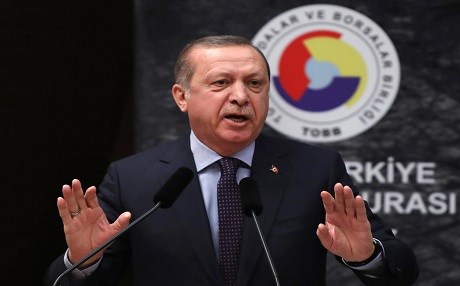
ANKARA, Turkey – The Turkish president Recep Tayyip Erdoğan has signed the constitutional amendments passed by the Turkish parliament last month, which drastically changes the current parliamentary system into an executive presidency, giving the president unprecedented powers, among others, to name the government cabinet, allows the president to be partisan, and also propose the annual budget.
The Turkish people are now set to vote on the changes to the constitution in a national referendum to be held in nine weeks.
“Our president has approved the bill. So the date for a public vote is fixed. The referendum will be held on April 16,” Prime Minister Binali Yildirim told reporters on Friday in the central Anatolian province of Nevsehir, Anadolu Agency reported.
The new proposed constitution allows for the president to maintain ties to a political party. President Erdoğan was obliged to officially give up leading the ruling Justice and Development Party (AKP) when he became president in 2014, in line with the current constitution.
He had said earlier that the new constitution will have a galvanizing effect on Turkey while adding that there was an “understanding” in the Turkish parliament in line with “the national will.”
The constitutional reforms, which number 18 articles in total, aiming to found a presidential system in place of the current parliamentary system, are fiercely opposed by the main opposition Republican People’s Party (CHP) and pro-Kurdish People’s Democratic Party (HDP), the second opposition party in the country.
The CHP has said that the changes amount to a regime change, a phrase that the President has strongly opposed.
If approved by the Turkish voters, it may pave the way for President Erdoğan to stay in power until 2029 as he would have the right to stand in the presidential elections for two more terms under the new constitution.
The constitutional amendments give the president the power to propose the country’s annual budget to the parliament, and replace Turkey’s Supreme Council of Judges and Prosecutors with a new body of just 13 members, three of whom would be named by the president, while the rest would be elected by the parliament, chaired by the justice minister under the new name of the Judges and Prosecutors’ Council.
Comments
Rudaw moderates all comments submitted on our website. We welcome comments which are relevant to the article and encourage further discussion about the issues that matter to you. We also welcome constructive criticism about Rudaw.
To be approved for publication, however, your comments must meet our community guidelines.
We will not tolerate the following: profanity, threats, personal attacks, vulgarity, abuse (such as sexism, racism, homophobia or xenophobia), or commercial or personal promotion.
Comments that do not meet our guidelines will be rejected. Comments are not edited – they are either approved or rejected.
Post a comment