


Error occured during this request! Please try again later.
World

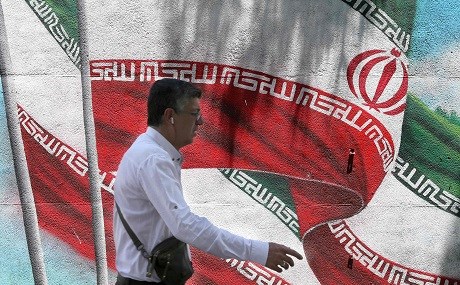
An Iranian man walks past a mural painted with the Iranian flag in Tehran, June 25, 2019. Photo: Atta Kenare / AFP
ERBIL, Kurdistan Region – French President Emmanuel Macron said Thursday he intends to ask the US to ease sanctions on Iran in order to save the 2015 nuclear deal. Iran says it is scaling back its commitments to the deal by increasing its stockpiles of heavy water and low level enriched uranium.
“I want to convince Trump that it is in his interest to re-open a negotiation process (and) go back on certain sanctions to give negotiations a chance,” Macron told reporters on a train from Tokyo to Kyoto.
Iranian officials are to meet with their counterparts from France, Britain, China, and Russia in Vienna on Friday in a last ditch attempt to save the nuclear deal, the European Union said in a statement on Thursday.
The US withdrew from the nuclear deal, officially known as the Joint Comprehensive Plan of Action (JCPOA), in May 2018, claiming it did not go far enough to prevent Iran acquiring nuclear weapons.
Iran’s decision to increase its stockpiles in contravention of the landmark accord comes on the heels of rising tensions in the Persian Gulf following the downing a US Navy reconnaissance drone by the Islamic Revolutionary Guard Corps (IRGC) Aerospace division last week.
The incident prompted US President Donald Trump to impose sanctions on Iran’s supreme leader and a number of IRGC commanders.
Enraged by the Trump administration’s decision to cancel sanctions waivers given to eight major Iranian oil customers in May, Iran suspended two articles of the JCPOA. It gave the deal’s remaining signatories just 60 days to rescue the accord. The ultimatum expired on Thursday.
Rosemary DiCarlo, the United Nations Political Affairs chief, called on all parties to abide by the nuclear deal. She told the UN Security Council on Wednesday the nuclear deal was the result of “12 years of intense diplomatic efforts and technical negotiations,” setting out rigorous mechanisms for monitoring restrictions imposed on Iran’s nuclear program.
“Recent events in the Gulf are a reminder that we are at a critical juncture. The Secretary General calls on member states to avoid actions that may result in a further deterioration of the current situation… he urges all parties to engage in dialogue and diplomacy … to exercise maximum restraint, and to de-escalate current tension to avoid the risk of miscalculation and accidents,” she said.
Germany, France, and Britain called on Iran to avoid taking further actions that would weaken the nuclear deal.
“It is absolutely essential that [Iran] sticks to that deal in its entirety for it to be preserved and for us to have a nuclear-free Middle East,” UK Foreign Secretary Jeremy Hunt told MPs on Tuesday.
Iran has maintained a consistent position, with its supreme leader Ayatollah Ali Khamenei ruling out calls for negotiation as “deception” and branding the US “the most vicious regime”.
Major Mohammad Ali Khodabakhsh, a member of the IRGC Aerospace unit responsible for the downing the US spy drone, said Wednesday his forces would not hesitate to shoot down a US F-35 or F-22 jet if it ventured into Iranian airspace.
Meanwhile, the United Arab Emirates (UAE) appeared to distance itself from US claims that pinned recent attacks on tankers near the Strait of Hormuz on Iran.
“Honestly we can’t point the blame at any country because we don’t have evidence,” Foreign Minister Sheikh Abdullah Bin Zayed Al Nahyan said on Wednesday in Moscow.
“If there is a country that has the evidence, then I’m convinced that the international community will listen to it. But we need to make sure the evidence is precise and convincing.”
The UAE, alongside Norway and Saudi Arabia, did however claim the tanker attacks had been conducted by a “state actor”.
The US withdrew from the JCPOA in May 2018 and re-imposed one of its toughest sanction regimes on Iran as part of a “campaign of maximum financial pressure” primarily targeting Iran’s oil and banking industries.
US-imposed sanctions have dealt a massive blow to Iran’s economy. The national currency has lost around 70 percent of its value, and rates of unemployment and inflation have skyrocketed.


Comments
Rudaw moderates all comments submitted on our website. We welcome comments which are relevant to the article and encourage further discussion about the issues that matter to you. We also welcome constructive criticism about Rudaw.
To be approved for publication, however, your comments must meet our community guidelines.
We will not tolerate the following: profanity, threats, personal attacks, vulgarity, abuse (such as sexism, racism, homophobia or xenophobia), or commercial or personal promotion.
Comments that do not meet our guidelines will be rejected. Comments are not edited – they are either approved or rejected.
Post a comment