The ambiguities between Washington and Tehran regarding an agreement and the reopening of the Strait of Hormuz for maritime traffic have caused Iraq's oil exports and revenues to decline day by day. Consequently, the export level for May has dropped to its lowest point in the past two decades.
More than two months have passed since the fragile truce that ended weeks of conflict involving the United States, Israel, and Iran. However, Iraq has still not been able to restore its production and export levels to even a portion of pre-war figures (not to mention full recovery, it hasn't reached even half). This comes despite government decisions to diversify export pipelines, transport oil via tankers, and hold talks with the Kurdistan Region and foreign oil companies to resume production.
In reality, the current situation confronting Iraq's oil sector should have been prepared for a decade ago during previous administrations. An export pipeline cannot be built in a month, and the necessary agreements to transport crude oil in daily quantities exceeding three million barrels cannot be implemented overnight.
Before the war, 94 percent of Iraq's oil was exported from the Port of Basra, passing through the Strait of Hormuz. Now, that volume is steadily dwindling, having plummeted to 2.4 million barrels for the entire month of May (which equates to roughly one or two tankers a month).
While the continuation of this situation threatens the global stage with inflation, economic recession, and surging prices, it pushes Iraq to the brink of bankruptcy. Month after month, oil exports shrink and revenues fall. Just last month, oil revenue (excluding company entitlements) dropped to below $1 billion.
Exports from Basra, Kirkuk, Kurdistan
In January 2026, total exports of both types of Basra oil (Medium and Heavy) stood at 3.2 million barrels per day, meaning total monthly exports from Basra alone reached 101 million barrels. In contrast, total oil exports from the Kurdistan Region's fields to the Port of Ceyhan in Turkey amounted to 6.4 million barrels (208,000 barrels per day). Meanwhile, oil exports from Kirkuk and Qayyarah were zero during that month.
Meanwhile, In May 2026, total oil exports from Basra consisted only of the Medium grade, totaling just over 2.4 million barrels for the entire month (a daily average of approximately 80,000 barrels). Concurrently, the volume of oil exported from Kurdistan's fields dropped to 340,000 barrels for the month (15,000 barrels per day), whereas Kirkuk's oil exports rose to 3.8 million barrels (165,000 barrels per day).
Based on these figures, total oil production in Iraq (including the Kirkuk fields) averaged roughly 1.3 million barrels per day, while total production from the Kurdistan Region's fields was a mere 65,000 barrels per day. This disparity exists because federal Iraq produces around 1.1 million barrels of crude oil daily for local refineries, whereas the Kurdistan Region produces only 50,000 barrels per day for its domestic refineries.
In recent days, the new Prime Minister of Iraq Ali al-Zaidi met with a delegation from the Kurdistan Regional Government along with foreign oil companies and investors. The meeting resulted in a decision to resume oil production in the Kurdistan Region's fields by guaranteeing field security and promising future compensation to the companies if they face attacks. However, ever since the Paris court’s initial ruling to halt the Kurdistan Region's oil exports, foreign companies have demanded formal documentation rather than verbal promises before taking any step. For this reason, as of the writing of this article, American and British companies—which produce one-third of the Kurdistan Region's oil—have not restarted operations. Even if they do resume production, they will be unable to reach pre-war levels because the attacks have inflicted severe damage on the fields.
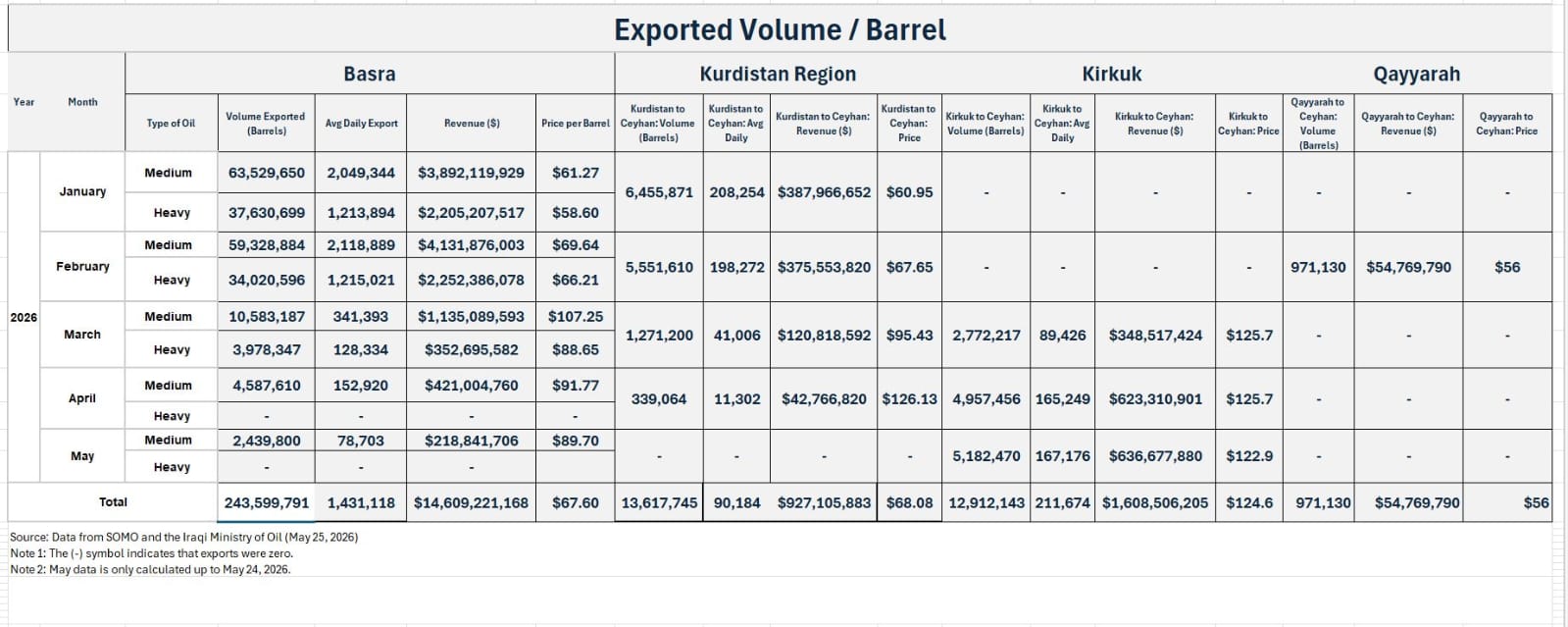
Table One: Oil exports from Basra, Kirkuk, and the Kurdistan Region from January to late May 2026.
Oil Revenue: From SOMO to the Central Bank of Iraq
Iraq's oil revenue is transferred to the Central Bank of Iraq after deducting the financial entitlements of foreign companies. The monthly figures announced by the Ministry of Oil and SOMO do not reflect the actual revenue that reaches the state treasury. This is because SOMO's data only represents the gross value of exported oil without deducting company costs (which, during a normal month, account for 17-25 percent of the oil value). Furthermore, the revenue reaching the Central Bank does not correspond to the sales revenue of that same month, as processing takes time.
An analysis based on SOMO data for January reveals that 17 percent of the generated revenue went toward company entitlements during that month: The total oil exports of Iraq and the Kurdistan Region for that month were 107.6 million barrels (3.47 million barrels per day), with a total value of $6.48 billion (averaging $60.26 per barrel). Of this amount, the share for service and foreign companies was 18.5 million barrels, valued at $1.12 billion. From this, it becomes clear that the actual revenue for January that reached the Central Bank of Iraq was not $6.48 billion, but rather $5.38 billion after company entitlements were deducted.
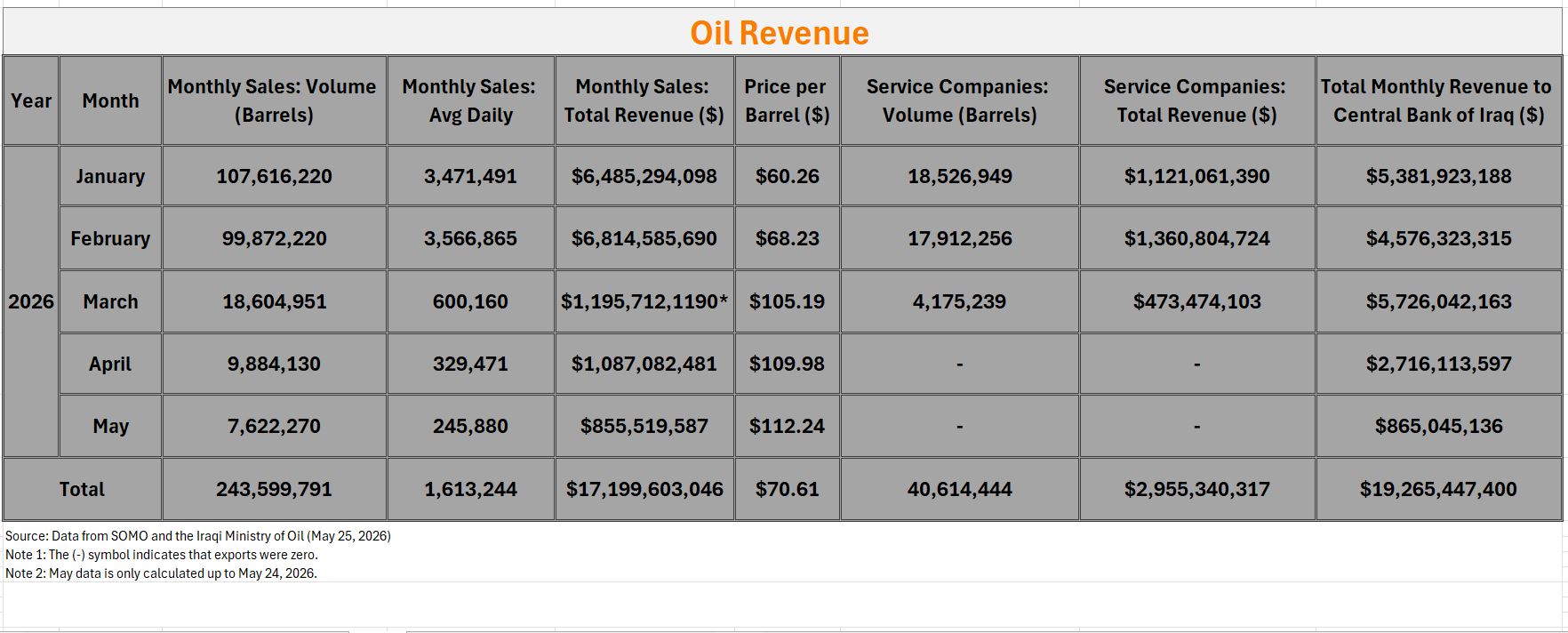 Table Two: Export volumes, oil revenues for Iraq and the Kurdistan Region, and foreign company entitlements from January to May 2026.
Conclusion
At the end of May, the price of exported Iraqi oil stood at $13 above the average price of the three major markets (Asia, Europe, and America). The average price of a barrel of Iraqi oil reached $113.74, while the average across those three markets was $100.48 per barrel. However, when export outlets and production security are compromised, high prices yield no benefit, leaving the country stranded in its current high-expense, low-income crisis.
At the onset of the war and the closure of the Strait of Hormuz, the Iraqi Ministry of Oil and officials from state-owned oil companies issued optimistic statements, claiming the Kirkuk–Turkey oil pipeline would be repaired within two days or two weeks. Yet, two months have passed, and the pipeline remains fully unrepaired.
Similarly, during the days when fields in the Kurdistan Region and southern Iraq (including the Majnoon field) were being attacked, the Ministry of Oil spoke of contracts to export crude oil via tankers to Syria and building a Basra–Haditha pipeline. To date, neither initiative has materialized.
Building a 685-kilometer oil export pipeline from Basra to Haditha requires a budget of $4.5 to $5 billion and more than two years of work—not two months. This comes at a time when Iraq's current financial situation is in crisis, with revenues covering only one-ninth (1/9) of its expenditures.
Ultimately, overcoming this financial and oil crisis—spawned by the closure of export outlets—cannot be achieved solely by the return of foreign companies to the Kurdistan Region and an export increase of 200,000 barrels (which constitutes only one-fifteenth of the lost oil volume). Instead, Iraq requires a radical plan to end its total, multi-faceted reliance on a single source, particularly regarding revenue.