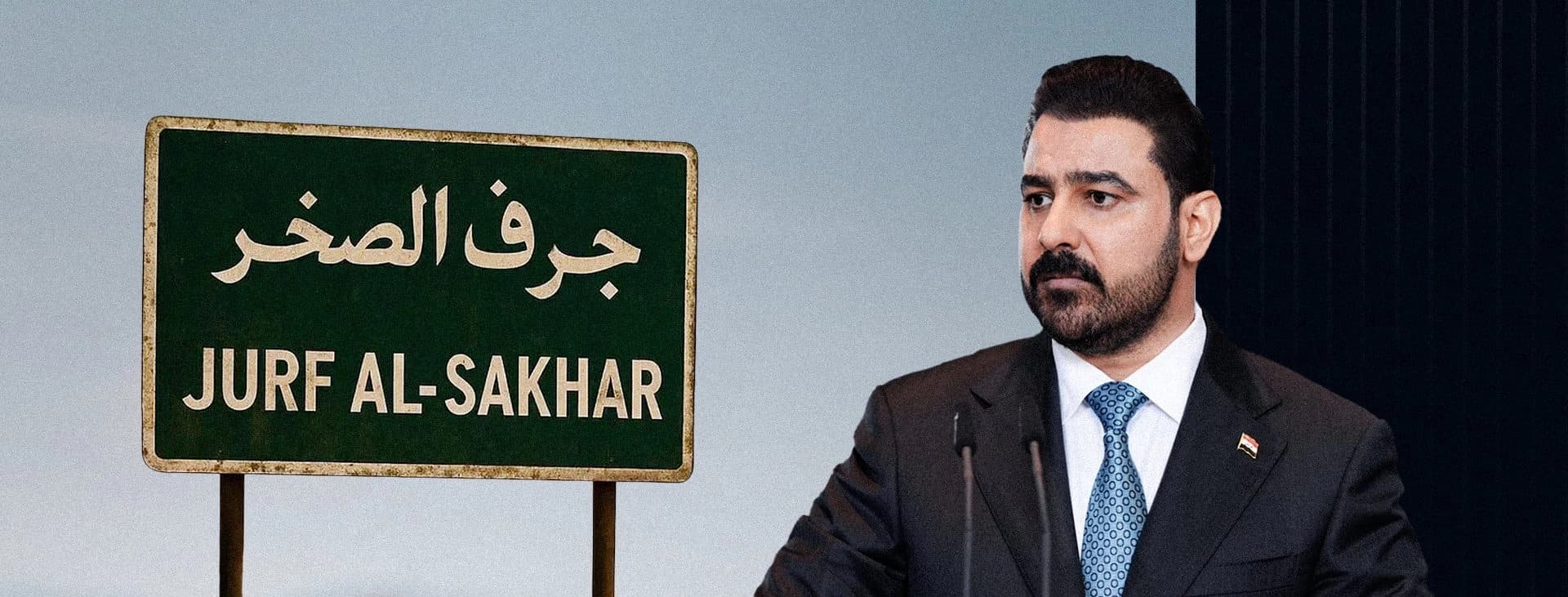

ERBIL, Kurdistan Region - Jurf al-Sakhr, a small town south of Baghdad, has emerged as a serious challenge for Iraqi Prime Minister Ali al-Zaidi and his government, which has combating corruption and restricting weapons to state control at the top of its political agenda. Zaidi is pushing the Iran-backed Kata’ib Hezbollah (KH) to relinquish control over the subdistrict following its 12-year clandestine operations in the town, including alleged oil theft.
The issue came to light earlier in November, when a leaked report from the Iraqi Intelligence Service revealed a complex network of oil smuggling in Jurf al-Sakhr. The findings prompted Zaidi to demand that KH cease their operations in the subdistrict while deploying other military units to the area.
The prime minister told Islamic Revolutionary Guard Corps Quds Force commander Esmail Qaani that KH could “either leave through negotiations or through force,” two Iraqi officials told Rudaw on Tuesday.
In the latest development, Zaidi on Thursday issued directives to establish a Federal Police headquarters in the town. Zaidi’s directive included an Iraqi Army brigade, a Federal Police brigade, two brigades from the state-funded Popular Mobilization Forces (PMF), and a regiment from the Energy Police to “secure and protect the oil pipelines in the area.”
“The headquarters shall open starting at 6:00 am on November 20, 2026, and shall exercise command and control over all security units under its authority,” his office said.
But Abu Hussein al-Hamidawi, the KH leader, said hours after Zaidi’s statement that they "the existing issues with the head of the authority will be addressed through private channels, so as to deny the primary enemies an opportunity,"
Rudaw learned from two PMF officials earlier in the day that the two assigned PMF brigades - the 72nd and 79th - are “moderate” factions that have previously served as guards for pilgrims marching to Shiite holy cities and have no affiliation with the armed factions.
The PMF consists of more than 70 Shiite-led units, with several linked to Iran, including the “Islamic Resistance in Iraq,” which encompasses KH and Harakat Hezbollah al-Nujaba. Both have rejected Zaidi’s request to lay down arms, a US-demanded process originally scheduled to be finalized by September 30 before being postponed to mid-2027.
Asaib Ahl al-Haq and Kata’ib Imam Ali, comrades of the KH, have recently announced commitment to Zaidi’s call, leaving the group feeling isolated as the government started to curb its reach to lucrative commercial contracts.
Risk of confrontation and Iranian mediation
What remains unclear is whether an armed confrontation could occur as a result of the mobilization and what KH's status will be under the new security arrangements.
Akeel Abbas, a Washington-based Iraqi scholar, believes that war has become “less possible now” following Qaani's Iraq visit to meet Zaidi and a meeting of the ruling Shiite-led Coordination Framework.
“Neither [Iran nor the Coordination Framework] wants a fight because it will undermine their authority and give more legitimacy to the state led by Zaidi,” Abbas told Rudaw English on Wednesday.
According to Ahmed Ali, a senior fellow at the Washington-based Enabling Peace in Iraq Center, Iran could use its leverage over the Shiite political elites to “produce a solution” that could preserve the KH facilities in Jurf al-Sakhr.
KH was founded in 2007 by Abu Mahdi al-Muhandis, who was assassinated in a US strike near Baghdad airport in 2020 alongside Qaani’s predecessor, Qasem Soleimani. Muhandis served as the leader of KH while maintaining the deputy chair of the PMF until his death. Hamidawi took his position.
Qaani met with Hamidawi and two other PMF leaders on Thursday, according to the armed factions-affiliated Kaf Telegram channel, which described the outcomes of the meeting as “good,” without providing further details about their position on Jurf al-Sakhr.
Nonetheless, Abu Taleb al-Saeedi, a senior KH commander, warned earlier that “Iraq is on the cusp of a major crisis, and some want this crisis exacerbated,” cautioning that political decisions could lead to "bloodshed" between the group and Iraqi security forces.
He accused Zaidi of engaging in “political adventurism” that risked pitting forces that had fought alongside one another against the Islamic State (ISIS).
Abbas noted that an armed confrontation would “set a bad precedent” for the Shiite-led political system in Iraq. It would signify that a prime minister who was appointed by Shiite parties under Iraq's quota-sharing system is willing to use “force” against factions of his own sect.
‘Triangle of Death’ and return of displaced
Located in Babil province, Jurf al-Sakhr sits inside Iraq’s infamous “Triangle of Death”- a nickname used by US troops during their fight against al-Qaeda and Sunni insurgent groups (2003–2011) to describe a farming belt and riverine corridor south of Baghdad. Dense orchards, canals, and road networks linking the capital to southern provinces gave armed groups cover to hide weapons, move fighters, and stage attacks in Baghdad or against Shiite travelers heading toward the holy cities of Najaf and Karbala. This turned the town into a deadly flashpoint during Iraq’s brutal sectarian civil war in the mid-2000s.
The town was unofficially renamed Jurf al-Nasr (The Bank of Victory) by KH and other Shiite armed groups in October 2014 after they recaptured it from ISIS. Around 140,000 Sunni residents were expelled from their homes, a displaced individual told Rudaw on Thursday. Successive Iraqi governments have yet to resolve this displacement crisis.
“We do not want to see the killing return,” a joint statement from Shitte tribal leaders of several provinces in Babil read on Thursday, following a gathering to show solidarity with KH’s cause.
The statement added that “any disturbance to the security of this area directly affects the security of Imam Hussein's shrine and its visitors.”
Separately, Saeedi, the KH commander, told Rudaw’s Ziyad Ismail near the gathering of the tribal leaders that 75 individuals were killed between 2003 and 2014 in the town by “terrorist sleeper cells who were and are still residing here.”
He further said the Shiite tribal leaders, who visited Jurf al-Sakhr on Thursday, “will not allow us to leave.”
Affirming the position, Hamidawi said in his Thursday’s statement they “will not allow the return of murderers, criminals, and takfiris as long as we draw breath,” demonstrating the resumption of a sectarian friction surrounding Jurf al-Sakhr.
Abbas said that a “genuine solution” for the crisis must involve the return of the displaced persons, describing it as “the best possible scenario” that could emerge from the standoff.
Meanwhile, Ramyar Mahmood, a Sulaimani-based Kurdish writer, said Jurf al-Sakhr has already been established as “a military camp” whose status cannot be reversed to a civilian town.
“What I see is a settlement to save face for both the premier and the faction, [and] the latter might cease activities temporarily,” Mahmood said, noting that “parallel authorities” and “government legitimacy hemorrhaging” have made state sovereignty an alien concept to Iraq.
According to Ali, the issue of return will be “hugely complicated.”
“Even if return is allowed, it may take years until it fully happens. There will have to be many layers of vetting and security checks,” he said.
Ali described Jurf al-Sakhr as a “delicate area from a sectarian perspective” that “clearly” has been used by KH as a “safe haven for its activities,” which included training and building “military capacity.”
Oil smuggling probe and outlook
A parliamentary committee dispatched on November 11 to investigate the oil smuggling allegations needs to submit its report before further action is taken. Harem Kamal Agha, a member of the committee, told Rudaw on Thursday that the report could be submitted next week.
Earlier in the week, he said the parliamentary delegation had inspected four of six identified locations but was prevented from accessing two others, which KH regarded as a “red line.”
Also, Mazin Ghareeb, a member of parliament's security and defense committee, said on Tuesday that more than 40,000 Kata’ib Hezbollah fighters were stationed in the area, citing information attributed to a committee member who had recently visited the town. He also said the group allegedly operated two refineries there, one capable of processing 4,000 barrels of crude oil daily.
Regardless of the outcome, Ali does not expect immediate stability, warning that the situation remains "a recipe for continued tensions."
While growing pressure may prompt KH to grant access to Jurf al-Sakhr, Ali noted that completely clearing the group from the area is impossible, describing a total withdrawal as "a big surprise."
Even if state forces such as the Counter Terrorism Service deploy to the town, KH could still retain control and military supremacy by remaining the largest "hold" force on the ground, he explained.
Alternatively, Ali suggested KH might allow general access and traffic in and out of Jurf al-Sakhr while retaining control over priority installations, including facilities that could be utilized in the event of a war involving Iran.