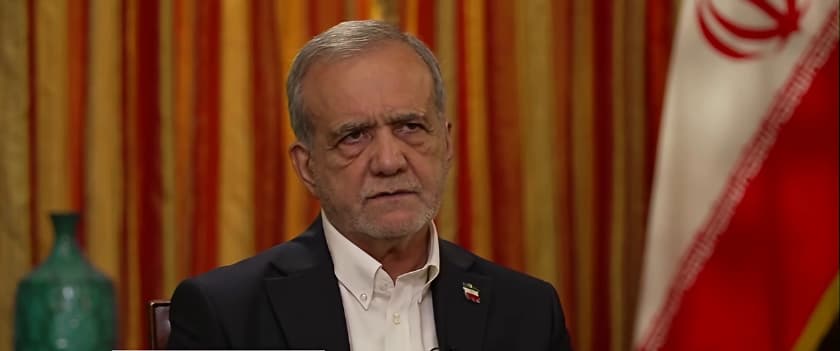

ERBIL, Kurdistan Region - Tehran will comply with international law regarding uranium enrichment regulations, Iranian President Masoud Pezeshkian said in an interview early Friday, expressly denying ambitions to attain a nuclear bomb.
Asked if Iran would "give up" 60 percent enriched uranium in an interview with Fox News, Pezeshkian responded in the affirmative, stating, “Whatever we are supposed to adhere to, we will” within "the framework of international law based on the non-proliferation treaty."
Pezeshkian’s remarks come two days after he addressed world leaders at the 81st United Nations General Assembly in New York City, in which he expressed readiness to resume stalled negotiations with the US without “the language of force.”
It also comes as Iran in mid-September was elected to the General Committee of the International Atomic Energy Agency (IAEA) General Conference - the UN’s nuclear watchdog - despite US bids to prevent the election, according to Iran’s state-run Mehr news agency.
In a statement shortly after its election, the Iranian mission denounced Washington’s “violation” of international law for “carrying out military attacks against Iran’s safeguarded nuclear facilities.”
Just one week prior, the IAEA condemned Iran for noncompliance in its nuclear program. IAEA director called on Iran to resume cooperation with the agency and provide the necessary information and access for verifying the status of Tehran’s declared nuclear material and facilities, framing the agency’s lack of information as a “matter of serious proliferation concern” that required “the utmost urgency.”
The IAEA estimated that Iran accumulated 440.9 kg of uranium enriched up to 60 percent purity, figures it said it hadn’t verified since the 12-day war between Israel and Iran in June 2025, during which Israel attacked several Iranian nuclear facilities and the US later struck the Natanz, Isfahan and Fordow sites.
Following the attacks, the IAEA halted its verification activities in Iran and withdrew its inspectors for safety reasons, after which Iran then enacted a law in July 2025 suspending cooperation with the agency.
Discussions regarding limits on Iran’s nuclear proliferation, which faces intense international scrutiny, remains a key point of diplomatic contention. Provisions in the Islamabad Memorandum of Understanding (MoU) signed in June left a 60-day window for negotiations which never came to fruition.
Asked why Iran holds 60 percent enriched uranium “buried deep under a mountain,” a likely reference to a complex at least 80 meters deep inside Pickaxe mountain, Pezeshkian instead retorted that Iran “has never sought nuclear weapons” and that Tehran was “willing to thin-out the material to a great extent” and "submit ourselves to verification.”
Pezeshkian denied that uranium was being diverted into secret weapons programs and further stated that Iran does not wish to attain a nuclear bomb “at all,” saying a religious decree prohibits the accumulation of weapons of mass destruction as "unholy" and "religiously illegal."
Pezeshkian in his interview reiterated Iran’s conditions for negotiations and urged a return to the MoU which include a lift blockade, sanctions, release of frozen assets, and recognizing Iran and Oman control shipping lanes.
Iranian Foreign Minister Abbas Araghchi, who met with US Special Envoy Steve Witkoff on the sidelines of UNGA, in what marked the first diplomatic encounter between the two adversaries since June, reiterated the same points.
Asked to what extent American elections affect Iranian decisions, Pezeshkian said that Iran “does not consider” their impact but hoped to reach an agreement, whether “before the elections or after the elections - what difference does it make for us.”