


Kurdistan

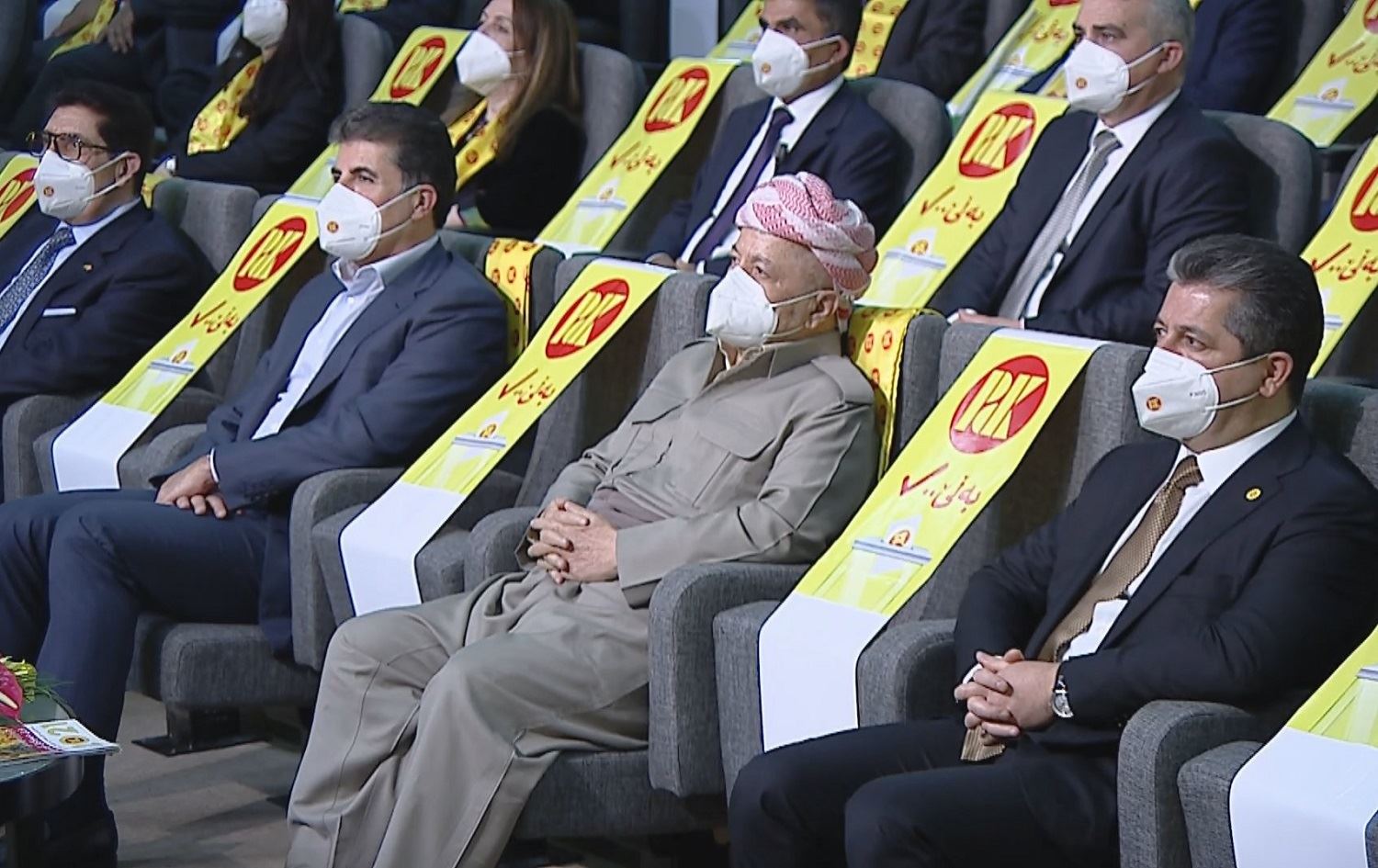
Left to right: Kurdistan Region President Nechirvan Barzani, KDP leader Masoud Barzani, and KRG Prime Minister Masrour Barzani attend an election event in Erbil on September 11, 2021. Photo: Rudaw
ERBIL, Kurdistan Region - The head of the Kurdistan Democratic Party (KDP) on Saturday said their party chose to contest the Iraqi election despite being unhappy with the new election law, and aims to stay the top party in the country.
Addressing the party’s candidates at an event in Erbil ahead of Iraqi parliamentary elections set for October 10, KDP leader Masoud Barzani said they decided to take part in the vote “to protect our leverage... despite our reservations.”
Among the KDP’s reservations is the allocation of seats. Barzani noted that there has been no recent census to help decide a fair distribution of seats and, as a result, some provinces have been allocated fewer spots than they should.
With this vote, Iraq will test out the new electoral law that divides the country into 83 smaller electoral districts. The previous election law divided Iraq into 18 constituencies in line with the number of provinces. The new system has been criticized by smaller parties as designed to favour the bigger parties.
The KDP has 25 seats in the current Iraqi parliament and Barzani vowed they will stay the number one party in the country.
This election, the KDP is fielding candidates in disputed areas. The party’s offices have been closed in Kirkuk since it came under the control of Iraqi forces in October 2017 following the Kurdish independence referendum held a month earlier. However, the party has decided to run in the oil-rich province, fielding two candidates.
Adnan Kirkuki told Rudaw on Friday the “environment is suitable” for the party to win two seats, as long as there is no “external interference and fraud” in the election.
The KDP has 51 candidates standing in the election, among them Arab candidates, including from the Sunni province of Anbar. Barzani said the mixture of Arab and Kurdish candidates on the KDP ticket is a beautiful image and shows “how KDP is democratic”.
Barzani was president of the Kurdistan Region when the Islamic State occupied swathes of land in Iraq and Syria. The militant group came within kilometres of Erbil in the summer of 2014. Barzani said at that time he received a phone call from then-United States Vice President Joe Biden who asked if the Peshmerga were willing to fight off the ISIS offensive with from the US military.
“I told him, with or without the US help, we will fight and defend Kurdistan,” Barzani said at the campaign event on Saturday afternoon. He added that he told Biden they welcome any military help that will help decrease casualties among the Kurdish forces.
The US-backed international coalition did provide military support to the Kurdistan Region.
President Nechirvan Barzani, and Prime Minister Masrour Barzani, both senior members of the KDP, also attended the event.
Campaigning for the election has been muted and turnout is expected to be low, amid concerns of fraud. According to the Iraqi High Election Commission, about 25 million people are eligible to vote and just over 14 million have collected their biometric voting cards.
Iraqi Prime Minister Mustafa al-Kadhimi met with security officials on Saturday to discuss elections, instructing them to investigate reports of attempts to buy votes. The United Nations is deploying one of its largest ever election assistance teams and 130 international experts will monitor the vote.
Nechirvan Barzani on Friday called on all parties to launch “civil” campaigns, avoiding “slander and smear attacks.”


Comments
Rudaw moderates all comments submitted on our website. We welcome comments which are relevant to the article and encourage further discussion about the issues that matter to you. We also welcome constructive criticism about Rudaw.
To be approved for publication, however, your comments must meet our community guidelines.
We will not tolerate the following: profanity, threats, personal attacks, vulgarity, abuse (such as sexism, racism, homophobia or xenophobia), or commercial or personal promotion.
Comments that do not meet our guidelines will be rejected. Comments are not edited – they are either approved or rejected.
Post a comment