

Kurdistan


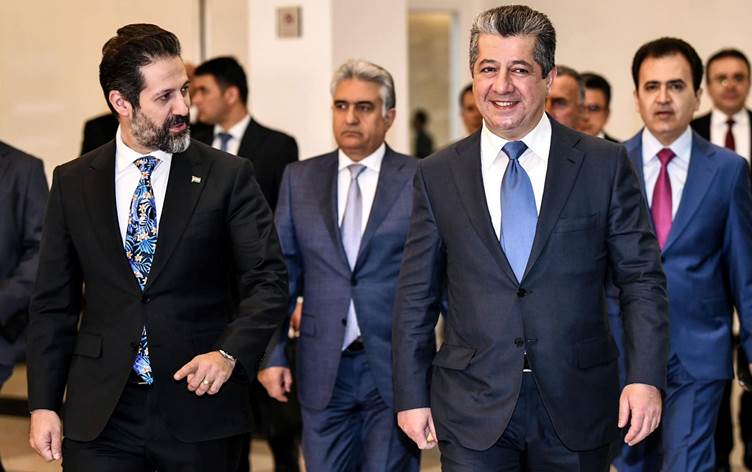
Kurdistan Region Deputy Prime Minister Qubad Talabani and Prime Minister Masrour Barzani on May 14, 2023. Photo: KRG
ERBIL, Kurdistan Region - The Kurdistan Region’s Council of Ministers on Sunday approved reorganizing the Region’s financial system and centralizing its revenue sources, a point highly demanded by the Patriotic Union of Kurdistan (PUK) who attended the cabinet meeting for the first time since December.
Deputy Prime Minister Qubad Talabani and the PUK team in the Kurdistan Regional Government (KRG) had boycotted weekly cabinet meetings since late last year due to rising tensions between the party and the Kurdistan Democratic Party (KDP), with one of the main points of contention being the transparency of the revenue for the provinces under their control.
The PUK has accused the KRG of favoring Erbil and providing fewer funds for Sulaimani. Both parties have accused one another of handing over only part of the local revenue to the KRG.
In a session chaired by Prime Minister Masrour Barzani and attended by Talabani and the PUK team, the cabinet discussed and unanimously approved the “General Financial Reorganization in the Kurdistan Region” project.
The project aims to centralize revenues, expenditures, and salaries across all the Kurdistan Region, through reorganizing all sources of revenue in banks, treasuries, border crossings, and tax directories and connecting them through an electronic system, according to a statement from the KRG.
Priority in expenditure will be given to paying the salaries of the Region’s civil servants, while other expenditures will be organized through “appropriate mechanisms” and in accordance with each province’s population.
The Kurdistan Region’s Presidency welcomed Sunday’s cabinet meeting and PUK’s return, hoping it would be the first step towards resolving the Region’s internal issues.
“Today more than any other time, the Kurdistan Region is in need of consensus, unity, and harmony,” read the statement from the presidency.
The PUK’s return to weekly cabinet meetings comes as the Kurdistan Region approaches its long-anticipated parliamentary elections.
The Kurdistan Region’s parliamentary elections are set to be held on November 18, over a year removed from its originally scheduled date. The Region was set to hold the elections last year, but it was postponed due to continued disagreements between the blocs over the current electoral law and the electoral commission.
The blocs are yet to reach an understanding on this issue, which could threaten a further delay the elections process.
Despite working together in the Kurdistan Regional Government (KRG), the two parties have established control over different parts of the Region, often being referred to as the “Yellow Zone” and “Green Zone“. The KDP is dominant in Erbil and Duhok provinces, while the PUK rules Sulaimani and Halabja.
Deputy Prime Minister Qubad Talabani and the PUK team in the Kurdistan Regional Government (KRG) had boycotted weekly cabinet meetings since late last year due to rising tensions between the party and the Kurdistan Democratic Party (KDP), with one of the main points of contention being the transparency of the revenue for the provinces under their control.
The PUK has accused the KRG of favoring Erbil and providing fewer funds for Sulaimani. Both parties have accused one another of handing over only part of the local revenue to the KRG.
In a session chaired by Prime Minister Masrour Barzani and attended by Talabani and the PUK team, the cabinet discussed and unanimously approved the “General Financial Reorganization in the Kurdistan Region” project.
The project aims to centralize revenues, expenditures, and salaries across all the Kurdistan Region, through reorganizing all sources of revenue in banks, treasuries, border crossings, and tax directories and connecting them through an electronic system, according to a statement from the KRG.
Priority in expenditure will be given to paying the salaries of the Region’s civil servants, while other expenditures will be organized through “appropriate mechanisms” and in accordance with each province’s population.
The Kurdistan Region’s Presidency welcomed Sunday’s cabinet meeting and PUK’s return, hoping it would be the first step towards resolving the Region’s internal issues.
“Today more than any other time, the Kurdistan Region is in need of consensus, unity, and harmony,” read the statement from the presidency.
The PUK’s return to weekly cabinet meetings comes as the Kurdistan Region approaches its long-anticipated parliamentary elections.
The Kurdistan Region’s parliamentary elections are set to be held on November 18, over a year removed from its originally scheduled date. The Region was set to hold the elections last year, but it was postponed due to continued disagreements between the blocs over the current electoral law and the electoral commission.
The blocs are yet to reach an understanding on this issue, which could threaten a further delay the elections process.
Despite working together in the Kurdistan Regional Government (KRG), the two parties have established control over different parts of the Region, often being referred to as the “Yellow Zone” and “Green Zone“. The KDP is dominant in Erbil and Duhok provinces, while the PUK rules Sulaimani and Halabja.


Comments
Rudaw moderates all comments submitted on our website. We welcome comments which are relevant to the article and encourage further discussion about the issues that matter to you. We also welcome constructive criticism about Rudaw.
To be approved for publication, however, your comments must meet our community guidelines.
We will not tolerate the following: profanity, threats, personal attacks, vulgarity, abuse (such as sexism, racism, homophobia or xenophobia), or commercial or personal promotion.
Comments that do not meet our guidelines will be rejected. Comments are not edited – they are either approved or rejected.
Post a comment