


Error occured during this request! Please try again later.
Kurdistan

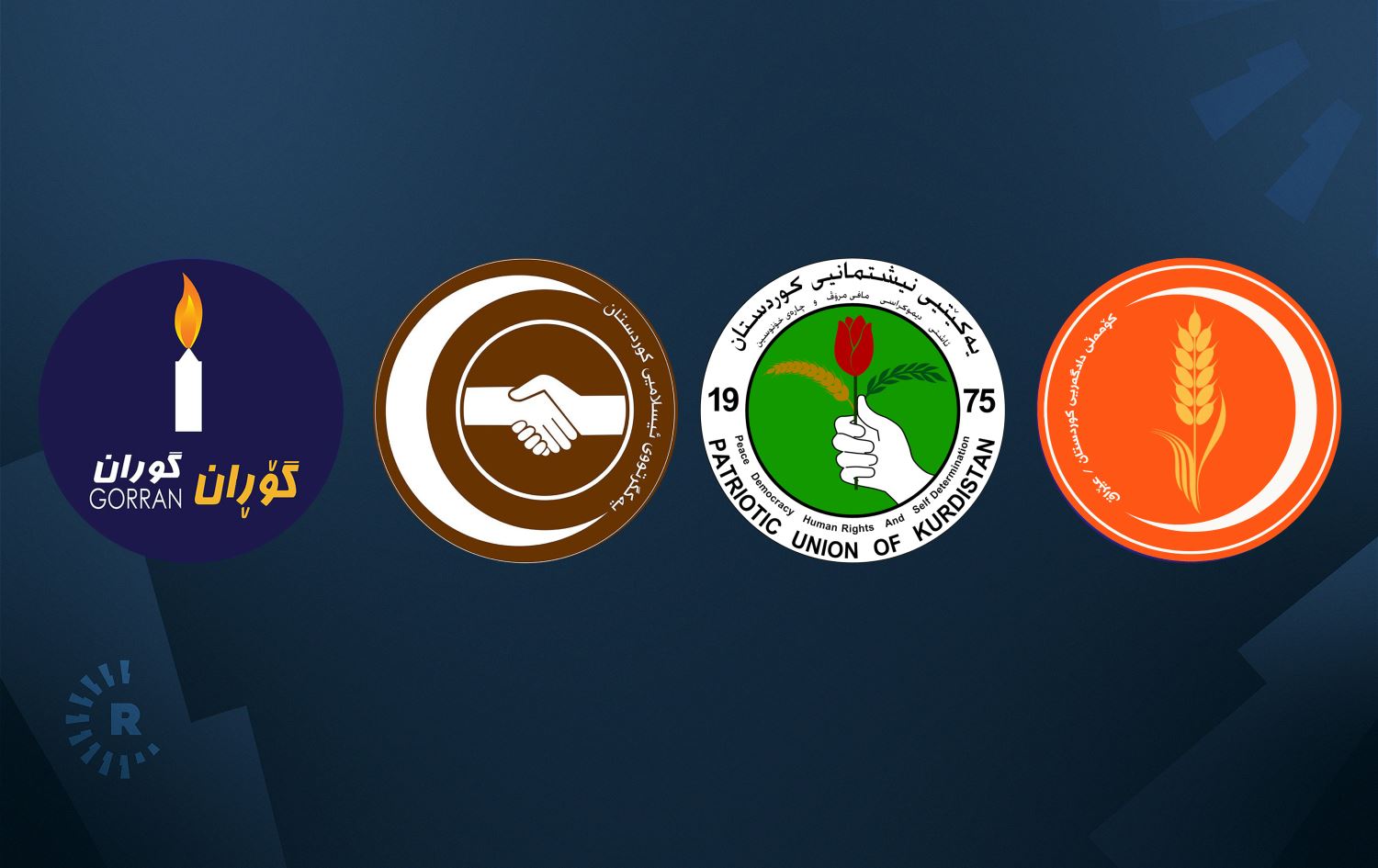
Logos of the PUK, Gorran, Kurdistan Islamic Union, and Kurdistan Justice Group. Graphic: Rudaw
ERBIL, Kurdistan Region - Four of the main political parties in the Kurdistan Region on Wednesday released a joint statement calling for parliamentary elections to be held in the Region and for electoral laws to be amended.
Representatives of the Patriotic Union of Kurdistan (PUK), Gorran, Kurdistan Islamic Union (KIU), and Kurdistan Justice Group (Komal) met in Sulaimani on Wednesday to discuss the Kurdistan Region’s parliamentary elections.
In a joint statement signed by all four parties, all sides ensured that they are with the arrangement of elections.
“The Kurdistan Parliament’s electoral law should be amended and the electoral commission should be re-activated,” read one of the sections of the joint statement, adding that all sides stress for political parties to provide a stable and suitable environment to pave way for a clean and democratic election.
The Kurdistan Region’s ruling parties, the Kurdistan Democratic Party (KDP) and the PUKhave been at loggerheads in recent months over the Region’s parliamentary elections, the transparency of the oil and local income of the provinces under their influence, and the assassination of a former PUK colonel in Erbil in October.
KDP Leader Masoud Barzani on Tuesday met with a high-level US delegation consisting of White House Coordinator for the Middle East and North Africa Brett McGurk, Special Presidential Coordinator for Global Infrastructure and Energy Security Amos Hochstein, and US Ambassador to Iraq Alina Romanowski, during which Barzani said that “a clean and fair election should be held in the Kurdistan Region this year and no excuse for postponing the elections will be accepted”.
Despite working together in the KRG, the two parties have established control over different parts of the Region, often being referred to as the “Yellow Zone” and “Green Zone.“ The KDP is dominant in Erbil and Duhok provinces, while the PUK rules Sulaimani and Halabja.
Members of the Kurdistan Region’s parliament in October voted by a majority to extend the current four-year term of the legislature by one year, after disagreements between the blocs over the current elections law and the electoral commission prevented the carrying out of new elections.
Representatives of the Patriotic Union of Kurdistan (PUK), Gorran, Kurdistan Islamic Union (KIU), and Kurdistan Justice Group (Komal) met in Sulaimani on Wednesday to discuss the Kurdistan Region’s parliamentary elections.
In a joint statement signed by all four parties, all sides ensured that they are with the arrangement of elections.
“The Kurdistan Parliament’s electoral law should be amended and the electoral commission should be re-activated,” read one of the sections of the joint statement, adding that all sides stress for political parties to provide a stable and suitable environment to pave way for a clean and democratic election.
The Kurdistan Region’s ruling parties, the Kurdistan Democratic Party (KDP) and the PUKhave been at loggerheads in recent months over the Region’s parliamentary elections, the transparency of the oil and local income of the provinces under their influence, and the assassination of a former PUK colonel in Erbil in October.
KDP Leader Masoud Barzani on Tuesday met with a high-level US delegation consisting of White House Coordinator for the Middle East and North Africa Brett McGurk, Special Presidential Coordinator for Global Infrastructure and Energy Security Amos Hochstein, and US Ambassador to Iraq Alina Romanowski, during which Barzani said that “a clean and fair election should be held in the Kurdistan Region this year and no excuse for postponing the elections will be accepted”.
Despite working together in the KRG, the two parties have established control over different parts of the Region, often being referred to as the “Yellow Zone” and “Green Zone.“ The KDP is dominant in Erbil and Duhok provinces, while the PUK rules Sulaimani and Halabja.
Members of the Kurdistan Region’s parliament in October voted by a majority to extend the current four-year term of the legislature by one year, after disagreements between the blocs over the current elections law and the electoral commission prevented the carrying out of new elections.


Comments
Rudaw moderates all comments submitted on our website. We welcome comments which are relevant to the article and encourage further discussion about the issues that matter to you. We also welcome constructive criticism about Rudaw.
To be approved for publication, however, your comments must meet our community guidelines.
We will not tolerate the following: profanity, threats, personal attacks, vulgarity, abuse (such as sexism, racism, homophobia or xenophobia), or commercial or personal promotion.
Comments that do not meet our guidelines will be rejected. Comments are not edited – they are either approved or rejected.
Post a comment