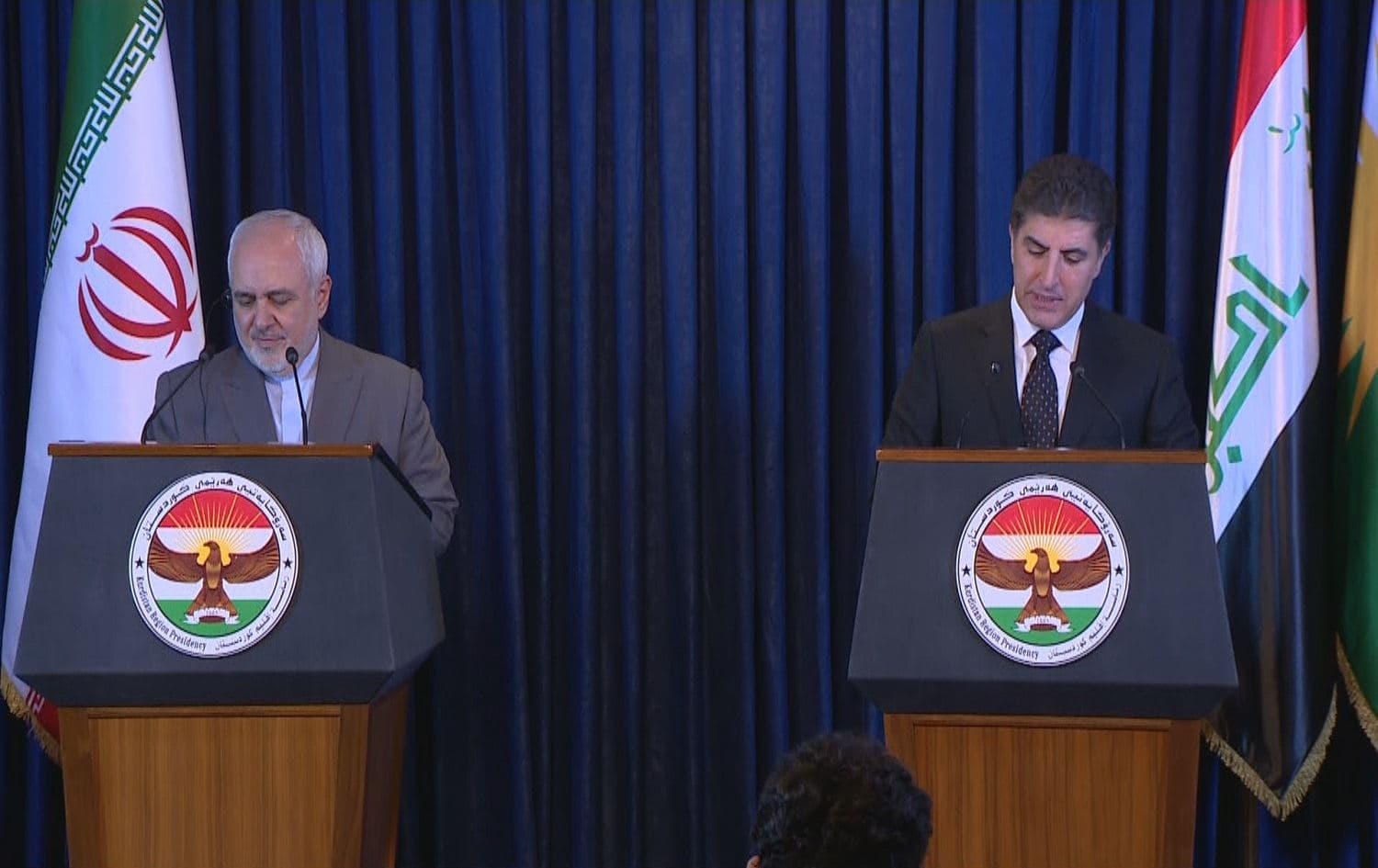

ERBIL, Kurdistan Region —Kurdistan Region President Nechirvan Barzani praised Tehran's contributions to "regional stability" as he welcomed Iranian Foreign Minister Mohammad Javad Zarif to Erbil on Sunday.
At a press conference with Zarif, Barzani thanked Iranian ambassador to Baghdad, Iraj Masjidi and the consul-general in the Kurdistan Region for their “continued efforts” to improve the relations between Kurdistan Regional Government (KRG) and Tehran.
“We have discussed bilateral relations and the great role of Iran in regional developments and stability," Barzani said.
“We have always aimed to increase our relations with Tehran, as it is very important for us to do so,” he added.
Iran's relations with the Kurdistan Region came to an abrupt halt when Iran opposed the Region’s independence referendum held in September 2017, and subsequently sided with the central government forces to retake the city of Kirkuk and other disputed areas from the Kurdish Peshmerga forces.
Iranian Revolutionary Guard Corps operatives were active on the frontlines assisting the Iran-backed Popular Mobilization Forces (PMF, or Hashd al Shaabi in Arabic) in attacking the Peshmerga using heavy artillery.
Relations improved but a deep distrust remains between the two sides.
Zarif thanked Barzani for the warm welcome he received in the Kurdistan Region capital, and said that Tehran is ready to increase trade with Erbil.
“We have great economic relations with Kurdistan Region and Iraq,” Zarif said during the press conference.
The minister said Iran also hopes to increase trade with the Region.
“Covid-19 could not affect our relations, especially economic relations and trade, and we will not close our border crossings anymore,” he said.
Earlier in the day, Zarif visited the Iraqi capital of Baghdad where he met with President Barham Salih, Prime Minister Mustafa al-Kadhimi and Foreign Minister Fouad Hussein.
The meeting is said to pave the way for Kadhimi’s upcoming trip to Tehran.
The Iranian foreign minister also met with officials from the PMF, a network of predominantly Shiite paramilitaries, many of which are backed by Iran.
High on the agenda was the US assassination of top Iranian general Qasem Soleimani and PMF deputy Abu Mahdi al-Muhandis at Baghdad airport in January, which sent US-Iran tensions skyrocketing and prompted a spate of rocket attacks on military bases in Iraq.
“Qasem Solaimani played a great role in defeating ISIS with Iraqi and Peshmerga heroes, and not letting Erbil to fall into the hands of ISIS,” Zarif said in Erbil.
Trade revenue between Iran and Iraq stood at 13 billion dollars in March 2019 which consisted mostly of Iranian goods, electricity and natural gas exported to the Iraqi markets. Iran hoped to reach 20 billion dollars in trade in the coming years but the political instability, the spread of coronavirus and the drop in oil prices will make that difficult.
Iran exports 1200-1500 megawatts of electricity to Iraq on a daily basis, in addition to 38 million cubic meters of natural gas to feed several of Iraq’s power stations, according to Sayyid Hamid Hosseini, secretary general of Iran-Iraq Joint Chamber of Commerce.
Zarif’s visit comes at a time when an official Iraqi delegation, led by Iraqi Finance Minister Ali Allawi, landed in the Saudi Arabia capital of Riyadh to meet with Saudi officials and discuss bilateral relations, as well as increasing the trade between the two countries, according to Saudi state-media SPA.
According to AFP, Kadhimi will follow the delegation to Saudi Arabia on Monday to kick off a round of meetings with Saudi officials, including crown prince Muhammad Bin Salman, to discuss increasing trade between the two countries, and finalize a deal to import electricity from the Gulf countries.
The deal, which aims to increase the electricity supply in Iraq and push Baghdad to be less dependent on Iran’s energy imports, was signed last year with the Arab Gulf Cooperation Council Interconnection Authority (GCCIA). Under the plan that has yet to be implemented, Iraq was slated to import 500 megawatts of electricity from Sunni Arab Gulf countries on the payroll of the GCCIA before this summer.
.png&w=3840&q=75)