


Error occured during this request! Please try again later.
Kurdistan

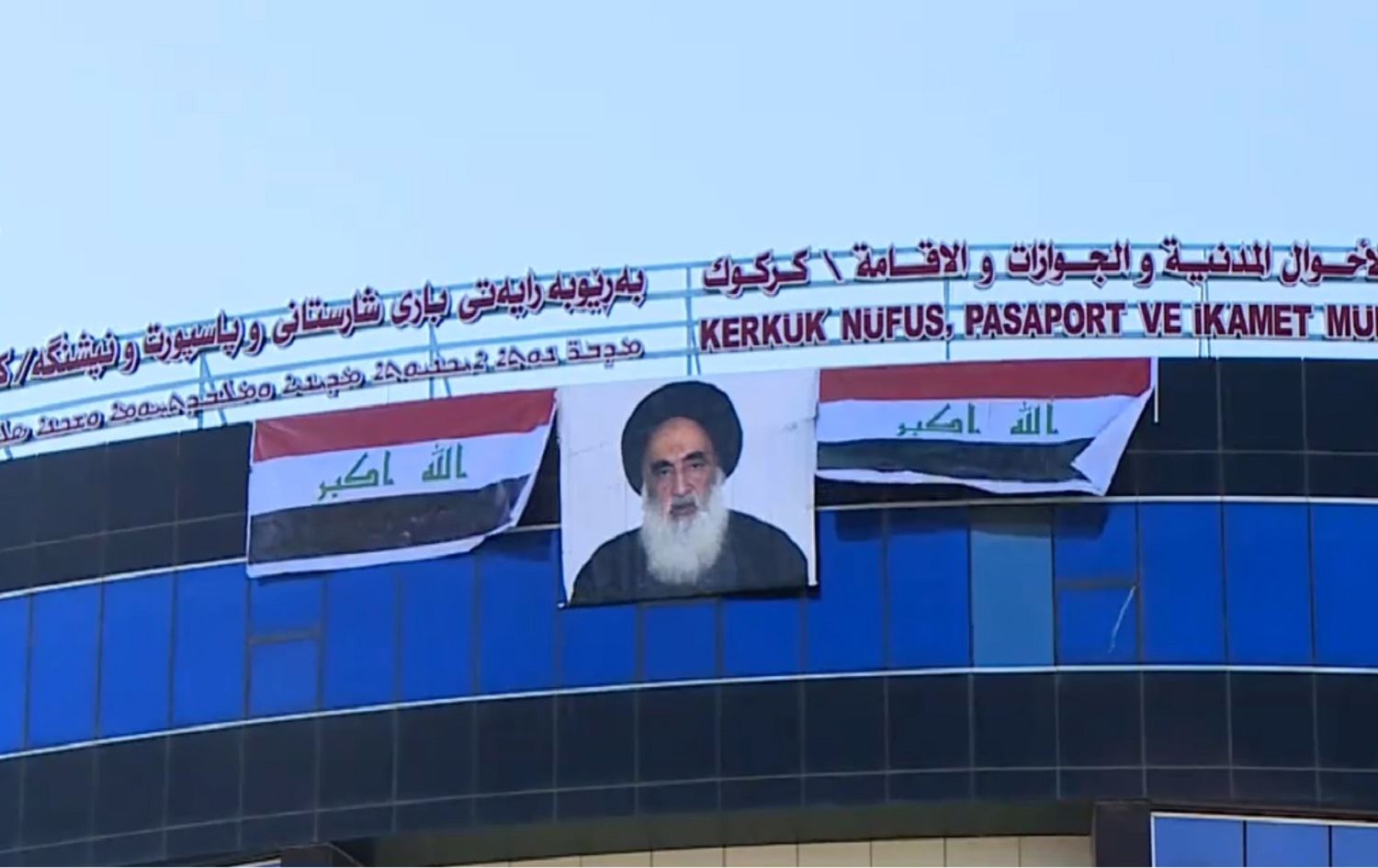
A banner featuring the face of Ayatollah Ali al-Sistani, the highest Shiite religious authority of Iraq, hangs between two Iraqi national flags from a government building in Kirkuk, November 2019. Photo: Rudaw TV
ERBIL, Kurdistan Region – It is not uncommon these days in the disputed oil-rich city of Kirkuk to see posters of Ayatollah Ali al-Sistani, the highest Shiite religious authority of Iraq, hanging atop governmental buildings and in the windows of security vehicles.
Rudaw was recently filming outside the offices of the Passports, IDs, and Residency Directorate of Kirkuk when one such banner was dropped from the rooftop, hanging between two Iraqi flags.
The appearance of such icons is significant in Kirkuk – a province disputed between Kurds, Arabs, Turkmen, Christians, and other minorities, which both Iraq’s federal government and the Kurdistan Regional Government (KRG) claim as their rightful possession.
The spread of Sistani’s face across Kirkuk is a recent phenomenon.
Vehicles, including those of Kirkuk’s Traffic Police, now feature his bearded face of the top Shiite authority in their back windows.
Brigadier General Sarhad Qader, the former head of Kirkuk’s suburban police who fled the city after Iraqi forces seized command on October 16, 2017, told Rudaw local police have been given a verbal order to stick the posters in their vehicles.
“The police follow the orders of their higher ups. The policeman has no choice but to implement whatever instruction or order that he is given,” Brig. Gen. Qader told Rudaw.
“The police cannot hang the picture of Mr. Sistani on his own. We are aware that they have been notified by their relevant higher up authorities to hang those pictures,” the former police commander added.
The legality of the step is questionable, however. Only pictures of the Iraqi President and Prime Minister are permitted to be hung inside official buildings.
Sistani himself, now almost 90 years of age, rarely makes public appearances, yet he is deeply revered by Shiite Iraqis. His word carries significant weight among the public and the political establishment.
Bashir Haddad, the second deputy speaker of Iraqi parliament, told Rudaw the new phenomenon is the result of pressure by a political group that wants to “impose itself” upon the city of Kirkuk.
Iraq’s Ministry of Interior, which oversees police and federal police, has long been influenced by the Iran-backed Badr Organization.
“A party wants to impose itself on events of Kirkuk, and a certain sect also wants to impose itself on events of Kirkuk. This will fail, however, as other components [of Kirkuk] don’t accept it either. We can achieve a result through a political agreement,” said Haddad.
Kirkuk is a multi-ethnic city, but the majority of the province subscribes to the Sunni variant of Islam, not the Shiite branch.
The phenomenon has made some of Kirkuk’s residents anxious.
“Sistani’s picture is unrelated to politics or laws... If you go and hang his picture on governmental buildings, it is both despicable and illegal,” Herish Jasim, a resident of Kirkuk, told Rudaw.
“We see that there is no legal basis for its hanging. We really don’t like such things,” Abdulsabour Mohammed, a university student in Kirkuk, told Rudaw.
Kirkuk was under the control of Kurdish Peshmerga forces and a Kurdish administration from 2014, when the Peshmerga filled the void left by the Iraqi Army, which had fled in the face of an Islamic State (ISIS) advance.
In response to the Kurdistan Region’s independence bid, Iraq sent its military and Iran-backed Hashd al-Shaabi paramilitaries to force the Peshmerga out of Kirkuk. Deeply divided along its own political lines, the Peshmerga forces withdrew.
The status of Kirkuk as a federal province or a part of the Kurdistan Region is disputed, but Article 140 of the Iraqi constitution was intended to settle its fate by 2007 through a referendum. This never took place.
Since October 16, 2017, the Kurdistan Region’s flag has been banned from display in Kirkuk, as have pictures of Kurdish leaders except for the late Iraqi President Jalal Talabani.
Although the Iraqi government and the KRG have been long been locked in negotiations in the hope of normalizing the Kirkuk situation, efforts to increase Arab influence in the disputed province and dilute its multi-ethnic identity have continued.
With reporting from Kirkuk by Hiwa Husamadeen


Comments
Rudaw moderates all comments submitted on our website. We welcome comments which are relevant to the article and encourage further discussion about the issues that matter to you. We also welcome constructive criticism about Rudaw.
To be approved for publication, however, your comments must meet our community guidelines.
We will not tolerate the following: profanity, threats, personal attacks, vulgarity, abuse (such as sexism, racism, homophobia or xenophobia), or commercial or personal promotion.
Comments that do not meet our guidelines will be rejected. Comments are not edited – they are either approved or rejected.
Post a comment