


Kurdistan

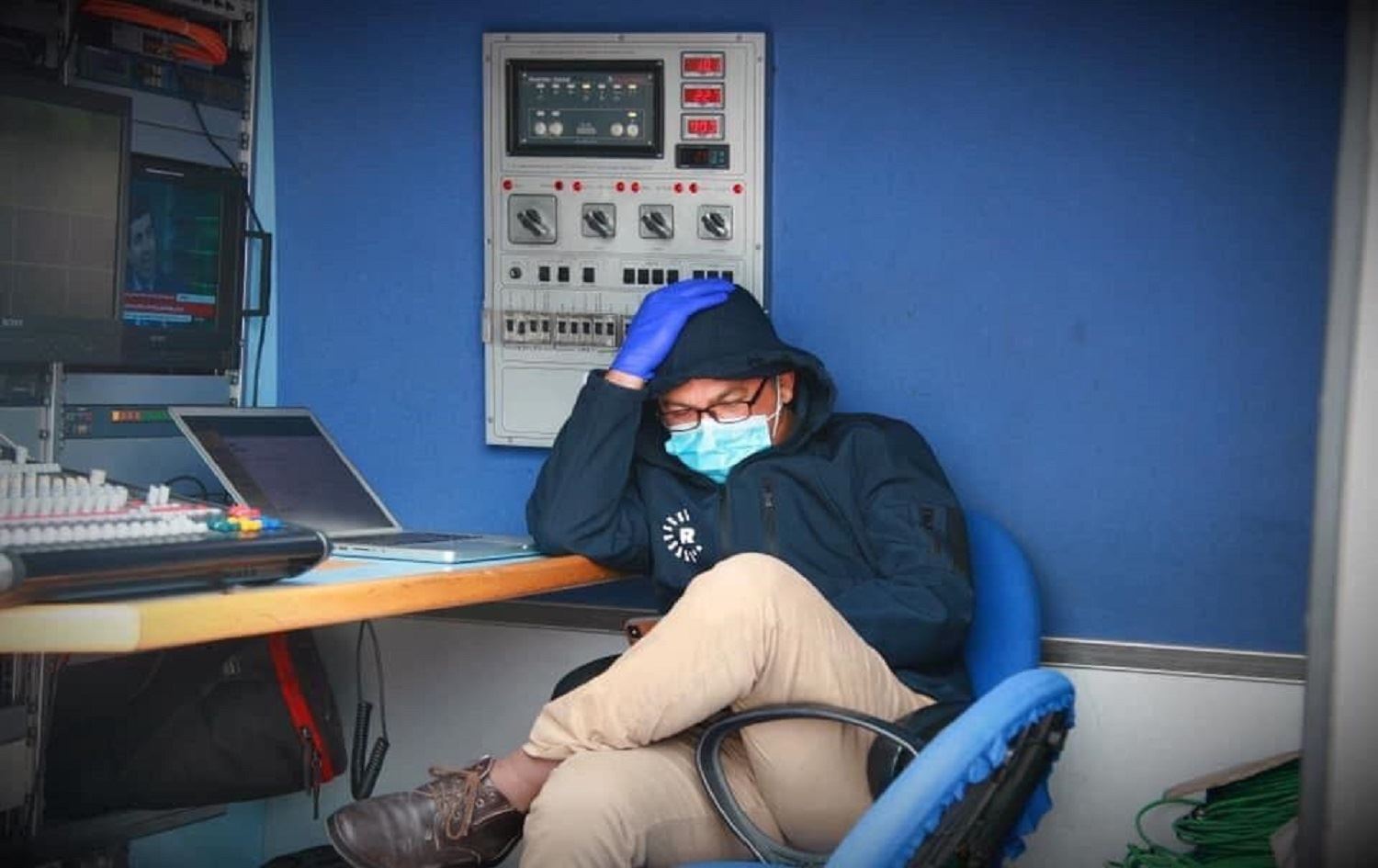
A Rudaw staff member rests while wearing a face mask to protect against the coronavirus in March 2020. Photo via Metro Center on Facebook
ERBIL, Kurdistan Region – Coronavirus has become the defining news story of the year – perhaps even the decade. Kurdish leaders have used the occasion of Kurdish Journalism Day to thank the Kurdistan Region’s media workers for keeping the public informed through the crisis.
Kurdish Journalism Day is marked each year to commemorate the publication of the first Kurdish newspaper on April 22, 1898 – 122 years ago. The paper, called ‘Kurdistan’, was first printed in Cairo by the renowned Kurdish literary figure, Miqdad Baderkhan, who was exiled to Egypt in late 1890s.
April 22 also marks the 22nd anniversary of the establishment of the Kurdistan Journalists Union.
This year, commemorations have taken the theme of COVID-19.
“We mark this day at a time when Kurdistan and the world are still facing the threat of the COVID-19 pandemic,” Nechirvan Barzani, president of the Kurdistan Region, said in a statement.
“Journalists and reporters have played an important role and deserve praise for publishing information on how to avoid infection and how to follow protective measures.”
The Kurdistan Region has suffered far fewer infections and fatalities as a result of the COVID-19 outbreak than its neighbouring countries. As of Wednesday, the Kurdistan Region has confirmed 337 cases of the virus. The overwhelming majority of those infected have now recovered, according to health ministry figures, and four have died. Only 29 active cases remain.
Masrour Barzani, prime minister of the Kurdistan Region, echoed his cousin’s sentiment.
Journalists are “playing an important role in communicating government guidelines designed to protect the public from the coronavirus pandemic,” he said in a statement.
The first Kurdish-language paper to be published in the Kurdistan Region was called Peshkawtn (Progress). It was printed in Sulaimani from 1920 to 1922, when Iraq was under British rule.
Just under a century later, Kurds at home and in the diaspora have access to a plethora of media outlets – though many are political party-affiliated.
Freedom of the press in the Kurdistan Region has been questioned in the past by local and international media watchdogs, following rights violations including the imprisonment and even deaths of journalists known for their anti-establishment writing.
The Metro Center for Journalists Rights and Advocacy, a leading press watchdog in the Kurdistan Region, issued a statement congratulating ongoing press coverage of the coronavirus pandemic while calling for the remembrance of journalists past “martyred“ in their line of work.
The center also called on the Kurdistan Regional Government to "implement the rule of law on journalism and information access rights."
According to figures published by the monitor in January, 43 journalists were detained and subsequently tried outside the legal frameworks of the Kurdistan Press Law in 2019.
“Journalist cases are not dealt with according to the press law at all,” the Metro Center said at the time.
Rewaz Fayaq, speaker of the Kurdistan Parliament, used the occasion to highlight legal protections for journalists, including the Press Law of 2007.
“From our legal perspective, I would like to once again reiterate my firm support to all the... [journalists] who strongly advocate for rights and freedom and the just demands of our nation,” Fayaq said.
“Journalists should be dealt with in accordance with the law’s articles. Other than that, they should not be dealt with under any one other law to limit their media work,” she said.
“I hope the Kurdistan courts implement the press law independently and in a just way.”
Qubad Talabani, the KRG deputy prime minister, used the occasion to celebrate the role of Kurdish media in promoting tolerance and freedom of expression.
“For us, media has been more than an element of communication, but that it has acted as a bulwark to protect language, culture, and our national identity,” Talabani said in a Facebook post.


Comments
Rudaw moderates all comments submitted on our website. We welcome comments which are relevant to the article and encourage further discussion about the issues that matter to you. We also welcome constructive criticism about Rudaw.
To be approved for publication, however, your comments must meet our community guidelines.
We will not tolerate the following: profanity, threats, personal attacks, vulgarity, abuse (such as sexism, racism, homophobia or xenophobia), or commercial or personal promotion.
Comments that do not meet our guidelines will be rejected. Comments are not edited – they are either approved or rejected.
Post a comment