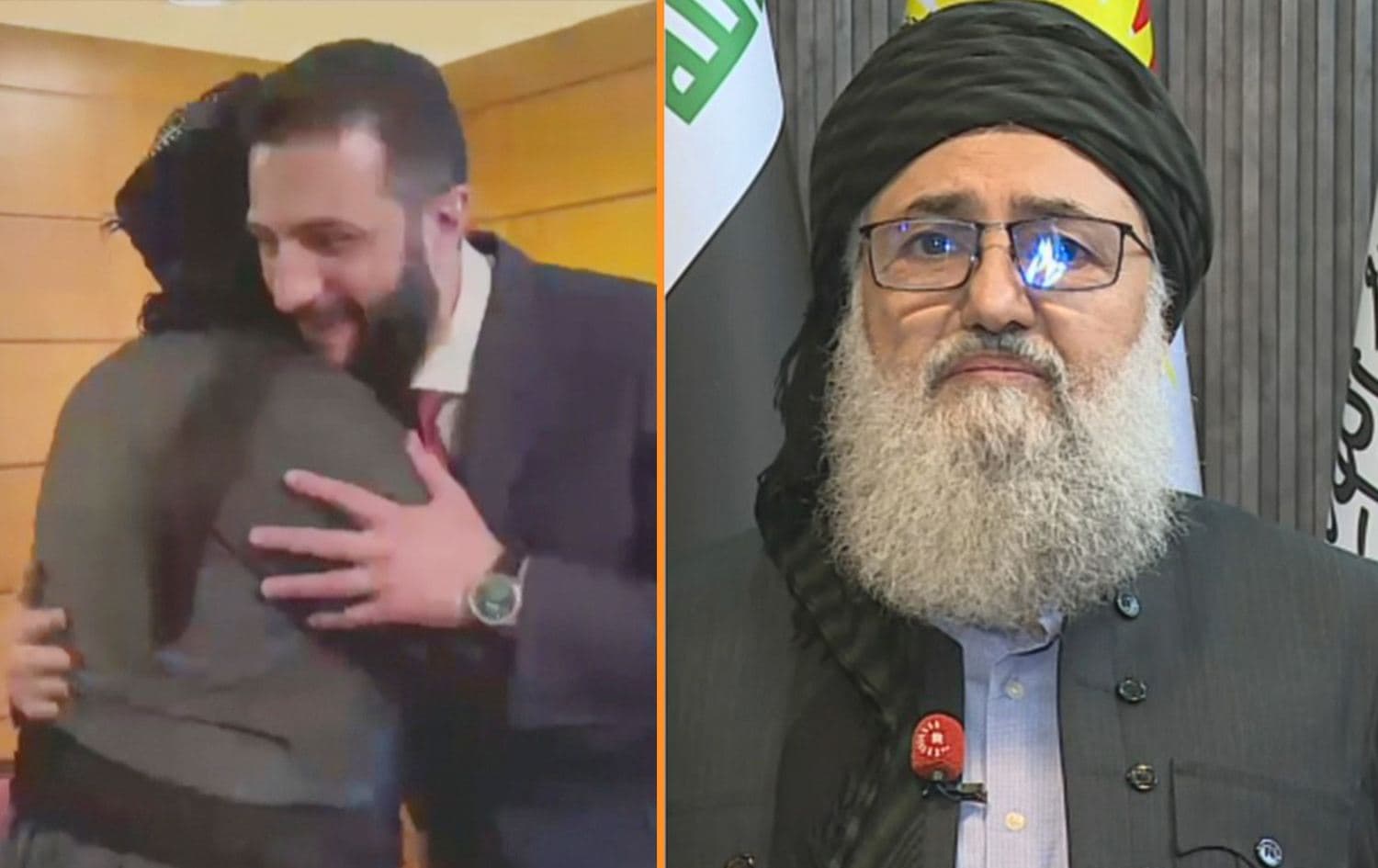
ERBIL, Kurdistan Region - The leader of the Islamic Movement in Kurdistan (IMK), a well-known Islamist political party in the Kurdistan Region, told Rudaw on Tuesday that Syrian interim President Ahmed al-Sharaa had invited him to visit Damascus. Irfan Ali Abdulaziz’s remarks came after he met the Syrian leader during a high-level diplomatic conference in Turkey last week, and amid ongoing efforts to integrate institutions in northeast Syria (Rojava).
“Indeed, he [Sharaa] invited me to visit Damascus,” Abdulaziz told Rudaw’s Sangar Abdulrahman, noting that the “invitation had been extended even before we met in [Turkey’s] Antalya. However, I suggested we meet there since he was already attending the diplomacy forum.”
A photograph of the Sharaa-Abdulaziz meeting on the sidelines of the Antalya Diplomacy Forum (ADF) on Friday has been widely circulated by Kurdish users on social media in recent days.
The head of the IMK further said he had engaged with the Syrian interim president through “communication channels” prior to the Antalya conference, adding that Sharaa “had expressed interest in my visit to discuss the Kurdish issue and to visit Kurdish areas [in Rojava].”
Sharaa’s request came as “we had indicated our willingness to act as mediators between Damascus and the Kurdish authorities in northeast Syria,” Abdulaziz said, then affirming “preparedness and interest in facilitating dialogue between them [the Syrian interim authorities] and our Kurdish brothers [in Rojava].”
Damascus and the Syrian Democratic Forces (SDF) on January 29 brokered a landmark agreement, with significant mediation from the United States, represented by its Special Envoy for Syria, Tom Barrack, and Kurdish leaders from the Kurdistan Region.
The accord followed a sharp military escalation in mid-January, during which Syrian government forces and affiliated armed groups seized territory previously held by Kurdish-led forces in eastern Aleppo, Raqqa, Deir ez-Zor, and the Kurdish-majority Hasaka province.
The SDF, which functions as the de facto military force in Rojava and is a key on-the-ground partner of the US-led Global Coalition to Defeat the Islamic State (ISIS), had maintained control of these areas since liberating them from the extremist group to prevent its resurgence.
The 14-point agreement establishes a permanent and comprehensive ceasefire and calls for the integration of all civil and military institutions in Rojava into the Syrian state.
“From what I understand, he wants to move beyond past conflicts, including issues that stem from the Syrian uprising and divisions among [opposition] factions,” Abdulaziz said, quoting Sharaa as affirming that “the phase [of internal divide] is over and that the priority now is ensuring Kurdish areas - once subjected to repression [under the toppled Assad regime] - feel like counterparts in Syria, without fear. He said they are ready to do whatever is necessary to serve these areas.”
Abdulaziz on Wednesday told Rudaw that Sharaa was a leader “who represents the entirety of the Syrian state and now acts as a national figure,” and who has “good intentions” regarding the Kurdish issue in Rojava.
“From what I understand, he wants to move beyond past conflicts, including issues that stem from the Syrian uprising and divisions among [opposition] factions,” Abdulaziz said, quoting Sharaa as affirming that “the phase [of internal divide] is over and that the priority now is ensuring that communities in Kurdish areas - once subjected to repression [under the toppled Assad regime] - feel like counterparts in Syria, without fear.”
Sharaa noted that “they are ready to do whatever is necessary to serve these areas,” Abdulaziz said.
The IMK leader’s remarks come just days after Kurdish authorities in Rojava announced they are preparing lists of candidates to potentially assume positions in Syria’s interim government, as part of the ongoing integration process outlined in the January 29 agreement, aimed at ensuring “meaningful participation” of Rojava communities in state institutions.
Since the agreement came into effect earlier this year, SDF commanders and Rojava officials have already assumed several government roles, including deputy defense minister, deputy head of local security forces in the Kurdish-majority Hasaka province, as well as a number of mayoral positions.
The newly appointed Hasaka governor, Nour al-Din Issa Ahmed - an affiliate of the SDF - told Rudaw last week that while the integration process is progressing smoothly, no timeline has been set for its completion.
However, another senior Rojava official said on Monday that the process is moving “slowly.”
“Syria needs a new constitution, and its drafting committee must include representatives from all components,” Elham Ahmad, co-chair of Rojava’s foreign relations department, further underlined.