


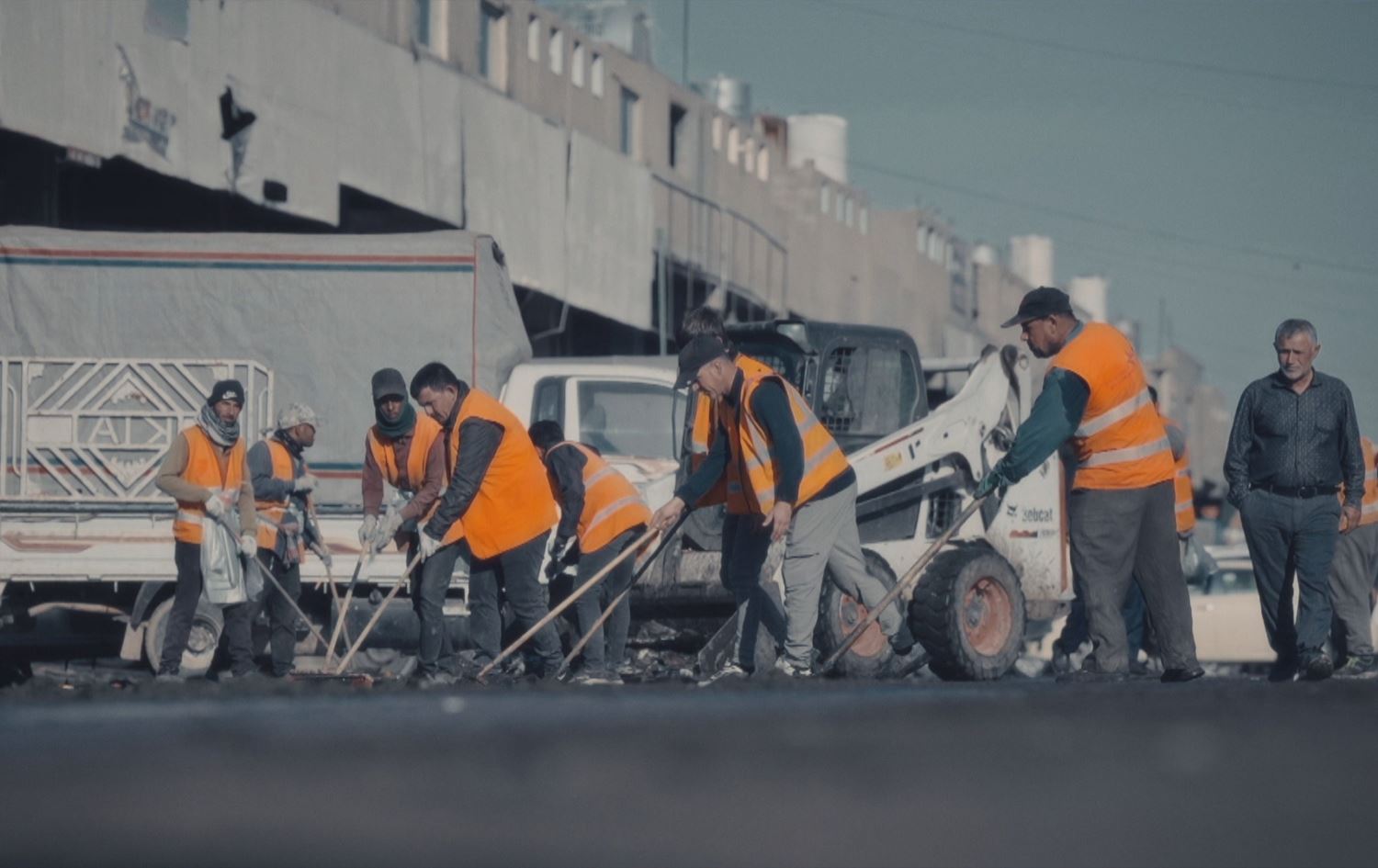
ERBIL, Kurdistan Region - Sanitation workers across the Kurdistan Region say they are struggling under harsh working conditions and salaries as low as 300,000 Iraqi Dinars (around $213) a month, calling their daily efforts an “uneven war” against mounting waste amid inadequate safety gear and widespread public disregard for proper disposal.
“We are fighting a war with the environment: the people are the polluting side in this war; we are the cleaners, and it is a disproportionate battle,” said Shwan Jamal, service manager at a sanitation company in Erbil, during Sunday’s episode of Rudaw’s Lagal Ranj program.
Jamal noted that in Erbil, “some two million people pollute daily, and we, with all the staff of the companies, are maybe only a thousand employees.”
“It is truly a disproportionate war, and if people don’t cooperate and don’t help us, honestly, we will always be losers,” he warned.
The program, hosted by Rudaw’s Ranj Sangawi, highlighted the daily struggles of sanitation workers - many of them elderly - who endure extreme heat and cold with limited safety equipment while performing the work that keeps cities clean.
Littering from cars
One of the key issues workers emphasized is the profound lack of public awareness and civic responsibility regarding waste disposal.
They say people throw trash from moving cars, discard bottles that can cause injuries, and weigh down trash bags with water, making them difficult to lift.
“It hurts me when I’m working like this, and a young man throws waste from a car right in front of me. He doesn’t care… if it was glass, it could blind me,” said Fayaq Sidiq, an elderly sanitation worker from the Kurdistan Region’s eastern Sulaimani province.
Sidiq urged schools and education institutions to “teach them [the younger generation] to respect the environment,” warning that “if the environment is not clean, everyone suffers. Even the doctor himself suffers, because if the environment is dirty, everyone is harmed.”
Another Sulaimani worker pointed to habits seen among younger residents in part.
“You see a young man holding a tissue right next to a trash can, and he won’t throw it in. They throw Soda cans out of car windows, not caring whether or not it hits another car. A [sanitation] worker has to clean it up,” said Namiq Fayaq, urging greater public awareness.
In a similar vein, another sanitation worker lamented that “people are not compliant,” adding that “sometimes in the morning when I clean an area, I come back at noon and it’s back to how it was … I bend down 2,000 times for cigarette butts, nylon bags and disposable cups.”
Low pay, hard labor
Sanitation workers say their monthly salaries are meager - less than $300 for full-time work - barely covering basic needs despite the physical strain of lifting bins, sweeping streets, and collecting waste.
“Honestly, our salary is not enough for a single thing. If we face a severe illness, it is barely enough for a clinic visit or two,” said Adil Hamaamin, a worker in Sulaimani.
Another worker said bending over “thousands of times” every day leaves him soaked in his sweat, adding that his salary is “400,000 dinars [around $283],” which can be spent in the first ten days of the month.
For older workers who have spent decades sweeping the streets, the situation is even more difficult.
Ibrahim Omer is a 75-year-old worker with hand tremors, who has spent 26 years sweeping the streets in Erbil. “Our salary is 300,000 dinars [around $229],” Omer said, adding, “We don’t have vacation because we are temporary-contracted workers.”
Omer receives no benefits, no retirement pension, and no support when he falls ill, despite waking up before dawn and working until afternoon every day. His years of service have been spent on temporary company contracts, offering neither stability nor long-term security.
In August, Kurdistan Region Prime Minister Masrour Barzani issued a directive setting the minimum wage at 450,000 dinars (around $319). However, Rudaw’s investigation revealed that many private companies have yet to implement the increase.
Most workers interviewed reported salaries between 300,000 and 400,000 dinars ($213 - $285) - a sum they say is insufficient to meet basic needs.
For its part, the Kurdistan Region’s Independent Human Rights Commission - an official institution - expressed alarm over the workers’ low pay.
Also participating in Lagal Ranj on Sunday, Mohammed Gomashini, the Commission’s media and awareness director, told Rudaw they are formally following up with the KRG cabinet.
“Honestly, the salary these workers receive is not worthy of the lives [they lead],” he said.
Rozhgar Khalid, a supervisor overseeing sanitation workers in Sulaimani, said he often feels “ashamed” handing out such low pay, noting that many workers cannot stretch 400,000 dinars (around $285) beyond a week due to rent, basic needs and the rising living costs.
“The 400,000 [dinars] we give them… however you calculate it … it doesn’t last a week,” Khalid said. He further urged the KRG to raise salaries to 600,000 dinars (around $425), emphasizing that it should be fixed at that level in upcoming tenders to better support environmental protection efforts across the Region.


Comments
Rudaw moderates all comments submitted on our website. We welcome comments which are relevant to the article and encourage further discussion about the issues that matter to you. We also welcome constructive criticism about Rudaw.
To be approved for publication, however, your comments must meet our community guidelines.
We will not tolerate the following: profanity, threats, personal attacks, vulgarity, abuse (such as sexism, racism, homophobia or xenophobia), or commercial or personal promotion.
Comments that do not meet our guidelines will be rejected. Comments are not edited – they are either approved or rejected.
Post a comment