
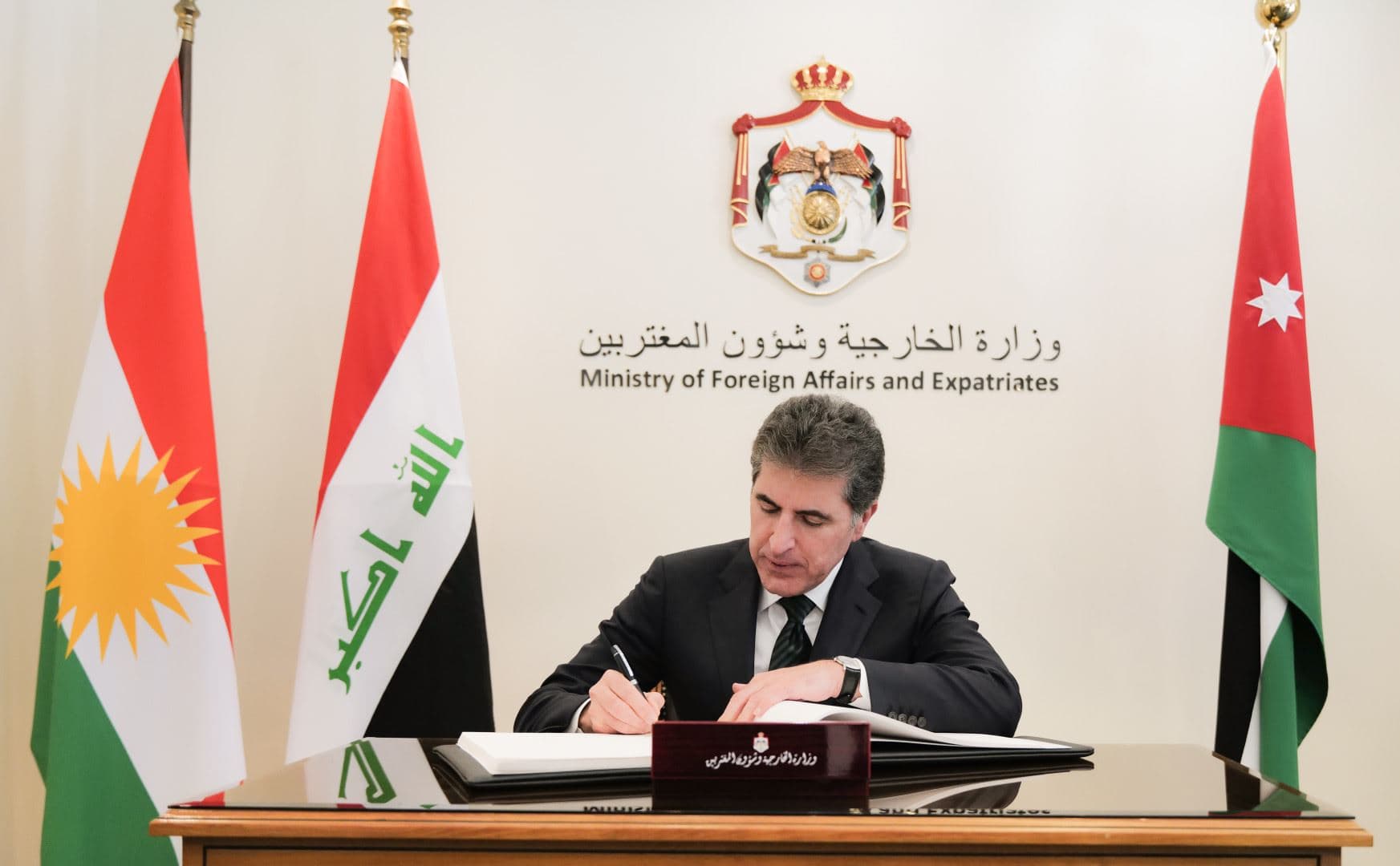

ERBIL, Kurdistan Region - Kurdistan Region President Nechirvan Barzani visited the Jordanian capital, Amman, on Sunday, where he met with top officials to discuss enhancing bilateral relations, joint cooperation, and regional and international developments.
The key visit comes shortly after President Barzani in mid-April affirmed Erbil’s rejection of plots targeting Jordan’s national security and expressed "full solidarity" with Amman.
The meetings
The visit began with a meeting between President Barzani and Jordan's King Abdullah II where the two leaders discussed ways to strengthen bilateral relations and deepen cooperation.
In a statement posted on X, President Barzani wrote, “I’m honored to meet His Majesty King Abdullah II in Amman today. I thanked HM and the people of the Kingdom of Jordan for their warm welcome, gracious hospitality, and continued support for Iraq and the Kurdistan Region.”
He added, “We deeply value the strong and historic ties between Jordan, Iraq, and the Kurdistan Region and remain committed to further strengthening our relations.”
The Kurdistan Region Presidency issued a statement noting that the meeting between President Barzani and King Abdullah II “focused on strengthening relations between the Kingdom of Jordan, Iraq, and the Kurdistan Region, and exploring opportunities for increased collaboration in the political, economic, and security fields.”
The two leaders further “discussed recent regional developments and matters of shared concern,” and “underlined the importance of joint efforts to uphold stability and peace in the region, while addressing a range of issues of mutual interest.”
President Barzani expressed “his heartfelt gratitude for the support extended by the Hashemite Kingdom of Jordan to Iraq and the Kurdistan Region,” praising “the longstanding relationship and camaraderie between the two nations.”
The Kurdistan Region Presidency quoted King Abdullah II as “reaffirming his country’s commitment to enhancing relations and cooperation with Iraq and the Kurdistan Region,” and emphasizing “Jordan’s dedication to supporting initiatives that promote security, stability, and prosperity across the region.”
The state-run Jordanian news agency, Petra, reported that the meeting between the two leaders “addressed the brotherly relations between Jordan and Iraq, and ways to enhance cooperation” between Erbil and Amman.
King Abdullah II was cited as emphasizing “the need to intensify regional and international efforts to achieve a comprehensive de-escalation in the region, contributing to enhanced security and stability.”
The meeting “also touched on the latest developments in the region, particularly in Gaza, the West Bank, Syria, and Lebanon,” Petra reported, adding that it was “attended by Deputy Prime Minister and Minister of Foreign Affairs and Expatriates Ayman Safadi” among others.
In addition to his meeting with King Abdullah II, the Kurdistan Region President also met with Jordanian FM Safadi.
In a statement he posted on X, President Barzani wrote, “I had a good conversation with my friend, Deputy Prime Minister and Minister of Foreign Affairs of Jordan, Ayman Safadi, in Amman today. We discussed deepening Jordan, Iraq and the Kurdistan Region ties, regional developments and ways to further promote peace and stability in the region.”
Petra reported that the meeting with Safadi focused on “strengthening the brotherly relations between Jordan and Iraq, increasing cooperation between the Kingdom and the Kurdistan Region of Iraq in various fields, and addressed the situation in the region.”
The timing
President Barzani’s visit to Amman comes shortly after he, in mid-April, condemned uncovered plots targeting Jordan’s national security and expressed "full solidarity" with Amman.
In a statement posted on X, President Barzani then said, “We strongly condemn the plots that were targeting the security and stability of the friendly Hashemite Kingdom of Jordan,” adding, “We affirm our full solidarity with Jordan and stand by its side in confronting anything that threatens its security and the safety of its people.”
These remarks followed Amman's announcement that it had arrested "16 individuals" involved in manufacturing rockets and drones with the intent of "spreading chaos and sabotage" within the Kingdom.
Jordan's Communication Minister and Government Spokesperson, Mohammad al-Momani, had confirmed that the suspects had been “closely monitored by the General Intelligence Department [GID] since 2021” and were involved in “illegal activities.”
Meanwhile, the GID reported that it had “foiled plans aimed at targeting national security,” stating that the suspects were attempting to manufacture rockets using locally made and illegally imported components.
Jordanian authorities also seized explosive devices and firearms, and noted that the group had been planning to build drones and recruit and train operatives both inside Jordan and abroad.
The incident came amid growing concerns of resurgence of the Islamic State (ISIS) in the region.
In early March, Iraq’s Foreign Minister, Fuad Hussein, attended a summit in Amman with foreign ministers, defense ministers, and intelligence chiefs from Iraq, Jordan, Lebanon, Syria, and Turkey.
At the summit, Hussein issued a stark warning about the growing threat posed by ISIS to Iraq, Jordan, and Syria. He emphasized the need for a coordinated international and regional effort to counter the increasing security risks posed by the group.
Insiders’ take
President Barzani’s visit to Jordan follows a previous trip in 2021, during which he was also warmly received by King Abdullah II.
Jordan’s Consul General in Erbil told Rudaw on Sunday that President Barzani was received by “his brother” the Jordanian King, adding that the visit was both “brotherly and successful.” Fuad Khazer al-Majali further described the relations between Jordan, Iraq and the Kurdistan Region as “historic” and “strong.”
Majali highlighted that officials in Amman and Erbil always lead “high-profile visits” and maintain “high-level communication,” stressing that the ties between the two sides are “exceptional,” spanning key areas such as “economic, education, health, trade, and social relations.”
For his part, spokesperson for the Kurdistan Region’s Chamber of Commerce, Karwan Surci, told Rudaw on Sunday that while “there is no official data on the trade volume between Amman and Erbil, I can say with confidence that there are currently more than 100 Jordanian companies operating in the Kurdistan Region, and some of these companies work in cooperation with entrepreneurs in the Region.”
He added that while the Kurdistan Region imports “dairy products, medicine and medical equipment, and construction material” from Jordan, “in the last one or two years, nearly 10,000 tons of potatoes have been exported to Jordan,” in addition to “honey, pomegranates and other foodstuff.”
Economic expert and specialist in oil and energy affairs, Amer al-Showbaki, also told Rudaw that President Barzani’s visit to Jordan comes at a “delicate time” for the region and the entire world, and that maintaining good ties with Erbil is pivotal for Amman’s “neighborliness policies.”
Showbaki noted the importance of the Kurdistan Region to Jordan’s energy needs, stating that it “provides Jordan with seven percent of its energy needs,” amounting to “between 10 to 15 thousand barrels of oil per day at special prices.” He added that “Amman is keen on expanding energy cooperation with Erbil.”
Pointing to the cultural ties, the Jordanian researcher emphasized that this relationship further stems from the presence of “Jordanian Kurds who are an integral part of Jordanian society.”
Historic ties
Bilateral relations between Amman and Erbil have flourished over the years, underpinned by shared historical ties and mutual interests in regional stability and development.
Jordan formalized its diplomatic and economic exchanges with the Kurdistan Region by opening its consulate in Erbil in 2011. These ties have been further strengthened through high-level visits and agreements, such as the 2024 memorandum of understanding (MoU) between the Jordanian and Kurdistan Region's Ministries of Agriculture, which aims to enhance cooperation in agriculture and the food industry.
Beyond agriculture, the partnership extends to other critical sectors such as education and healthcare.
In 2023, discussions between Jordanian and Kurdish officials focused on addressing challenges in these fields, including nursing staff shortages and the potential establishment of a Jordanian medical university branch in the Kurdistan Region.
Erbil and Amman have also worked on strengthening security cooperation in recent years, focusing on shared challenges such as terrorism, organized crime, and border security.
In August 2023, Jordan and Iraq signed a Memorandum of Understanding (MoU) aimed at enhancing security collaboration. The agreement outlines joint efforts to combat terrorism, illicit trafficking, human smuggling, and other transnational crimes. It also emphasizes the exchange of intelligence and expertise between the two nations' security forces. The Kurdistan Region is a key participant in implementing these initiatives.
Moreover, the Kurdish Peshmerga play a vital role in maintaining stability along the borders with Syria and Turkey. Jordan has expressed support for the Kurdistan Region's security efforts and has engaged in discussions to bolster cooperation in areas such as border control and counterterrorism. These collaborative efforts are part of a broader strategy to ensure regional stability and address common security threats.
.jpg&w=3840&q=75)