


Error occured during this request! Please try again later.
Iraq

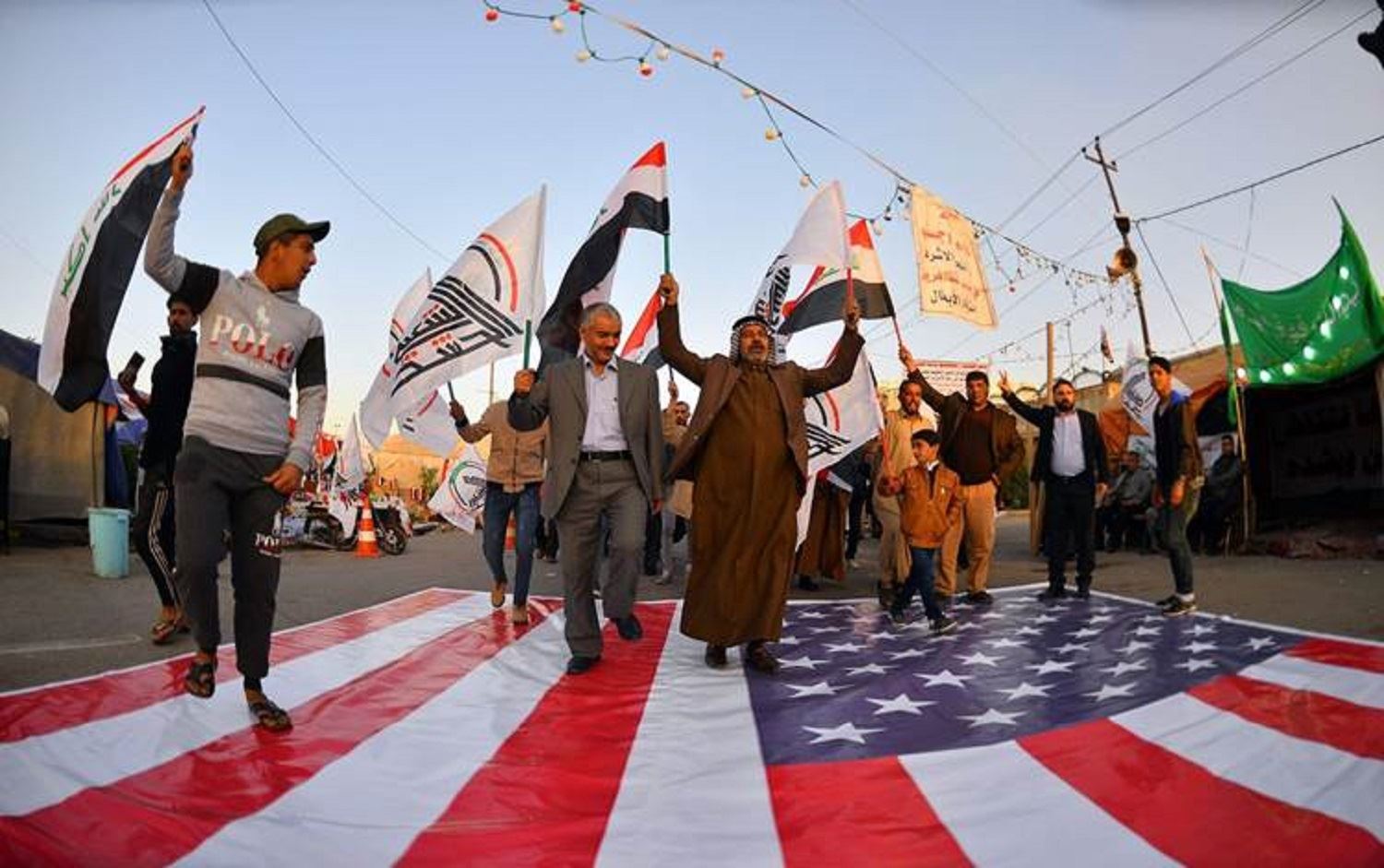
Iraqis in Najaf walk on a US flag on December 30, 2019, during a demonstration to denounce the previous night's attacks by US forces in Al-Qaim. Photo: Haidar Hamdani / AFP
ERBIL, Kurdistan Region – With the second round of US-Iraq strategic dialogue scheduled for later this month, commander of Iran-backed militia Kataib Hezbollah articulated the group’s “readiness” to continue fighting US troops in Iraq.
Abu Ali al-Askari, senior Kataib Hezbollah commander, tweeted on Sunday that the group is prepared to continue their armed “resistance” to the continued US military presence in the country.
“The resistance [fighting US troops] must continue with popular, political, security, and media pressure, with full military readiness,” Askari said. “They only understand the language of force and we are ready for that.”
This comes after the militia group’s official channel on the Telegram messaging application reported late Saturday that a convoy on the Baghdad-Diwaniyah main road that was transporting vehicles to a US military base was targeted. The group did not, however, claim responsibility for the attack.
According to Kataib Hezbollah, at least three vehicles that belong to the “American invaders” were destroyed. The militia also shared photos of the scenes that show vehicles set ablaze.
Rudaw English reached out to the US-led Coalition for comment.
Newly formed militia group Saraya Thorat al-Ashreen al-Thania claimed responsibility for the attack on their official Telegram channel.
Kataib Hezbollah is an Iranian-backed militia that falls under the umbrella of Iraq's Popular Mobilization Forces (PMF), a predominantly Shiite militia network known in Arabic as Hashd al-Shaabi.
The group has repeatedly threatened and carried out rocket attacks against US forces.
Following months of heightened tensions between the US and Iran, rocket attacks on US infrastructure and personnel in Baghdad’s fortified Green Zone and elsewhere in Iraq have become increasingly frequent.
On December 27, a rocket attack on the K-1 military base in Kirkuk, widely blamed on Kataib Hezbollah, killed a US civilian contractor and injured other personnel.
The US responded with airstrikes on Kataib Hezbollah targets on December 29, killing 25 of the militia’s fighters. A few days later, supporters of Kataib Hezbollah stormed the US embassy compound in Baghdad.
This was followed on January 3 by a US drone strike on Baghdad airport, killing Iranian General Qasem Soleimani and PMF deputy chief Abu Mahdi al-Muhandis. Iran responded on January 8 with a barrage of missiles targeting Iraqi bases hosting US troops.
The deadliest rocket attack was conducted on March 11, in which more than a dozen Katyusha rockets targeted Taji military base, around 27 km north of Baghdad, killing two US personnel (one contractor and one soldier) and a Briton, in which Kataib Hezbollah militia was accused for the attack.
Most recently on March 14, Kataib Hezbollah targeted Taji military base in a rare daytime attack with more than 30 Katyusha rockets, wounding three coalition troops and two Iraqis.
The US has set up Patriot air defense batteries at their Ain al-Asad military base in Anbar province, as well as in Erbil.
The Iraqi government has long promised to capture the groups behind the attacks.
In a first of its kind in years, the country’s Prime Minister Mustafa al-Kadhimi ordered the Iraqi Counter Terrorism Forces (ICTS) on June 26 to conduct a raid on a Kataib Hezbollah base in Baghdad, resulting in the arrest of 14 fighters.
Supporters and fighters of Kataib Hezbollah and other PMF groups gathered with their military vehicles in front of the ICTS headquarter in Baghdad following the raid, protesting the detention of their fellow fighters.
However, after three days in custody, 13 fighters were released and “only one remained in custody”, according to Ahmed Mullah Talal, Iraqi government spokesperson announced at a press conference on June 30.
After the release of the fighters, photos circulated on social media showing militia members stepping on posters of Iraqi Prime Minister Mustafa al-Kadhimi while waving Iraqi flags. Some other photos shared multiple times on social media showed the fighters burning US and Israeli flags.
Following the raid, Askari issued a scathing attack on Kadhimi, who is also commander-in-chief of Iraq's armed forces, for what he claimed was carrying out US bidding.
“Kadhimi once again followed his American master’s orders, and implemented another plan of theirs in Iraq, after he was involved in the assassination of the two martyrs [Qasem Soleimani and Abu Mahdi al-Muhandis], while the fighters of the Hashd immediately gathered and released their fellow fighters in custody,” Askari published on his official Telegram channel on June 26.
One day after the raid, Secretary General of Iran-backed militia Asaib Ahl al-Haq, Qais al-Khazali accused Kadhimi of following western agendas to target the PMF.
“A piece of advice for Kadhimi, do not stand against the PMF fighters, as they have the support of the people,” Khazali said on June 27.
Abu Ali al-Askari, senior Kataib Hezbollah commander, tweeted on Sunday that the group is prepared to continue their armed “resistance” to the continued US military presence in the country.
“The resistance [fighting US troops] must continue with popular, political, security, and media pressure, with full military readiness,” Askari said. “They only understand the language of force and we are ready for that.”
This comes after the militia group’s official channel on the Telegram messaging application reported late Saturday that a convoy on the Baghdad-Diwaniyah main road that was transporting vehicles to a US military base was targeted. The group did not, however, claim responsibility for the attack.
According to Kataib Hezbollah, at least three vehicles that belong to the “American invaders” were destroyed. The militia also shared photos of the scenes that show vehicles set ablaze.
Rudaw English reached out to the US-led Coalition for comment.
Newly formed militia group Saraya Thorat al-Ashreen al-Thania claimed responsibility for the attack on their official Telegram channel.
Kataib Hezbollah is an Iranian-backed militia that falls under the umbrella of Iraq's Popular Mobilization Forces (PMF), a predominantly Shiite militia network known in Arabic as Hashd al-Shaabi.
The group has repeatedly threatened and carried out rocket attacks against US forces.
Following months of heightened tensions between the US and Iran, rocket attacks on US infrastructure and personnel in Baghdad’s fortified Green Zone and elsewhere in Iraq have become increasingly frequent.
On December 27, a rocket attack on the K-1 military base in Kirkuk, widely blamed on Kataib Hezbollah, killed a US civilian contractor and injured other personnel.
The US responded with airstrikes on Kataib Hezbollah targets on December 29, killing 25 of the militia’s fighters. A few days later, supporters of Kataib Hezbollah stormed the US embassy compound in Baghdad.
This was followed on January 3 by a US drone strike on Baghdad airport, killing Iranian General Qasem Soleimani and PMF deputy chief Abu Mahdi al-Muhandis. Iran responded on January 8 with a barrage of missiles targeting Iraqi bases hosting US troops.
The deadliest rocket attack was conducted on March 11, in which more than a dozen Katyusha rockets targeted Taji military base, around 27 km north of Baghdad, killing two US personnel (one contractor and one soldier) and a Briton, in which Kataib Hezbollah militia was accused for the attack.
Most recently on March 14, Kataib Hezbollah targeted Taji military base in a rare daytime attack with more than 30 Katyusha rockets, wounding three coalition troops and two Iraqis.
The US has set up Patriot air defense batteries at their Ain al-Asad military base in Anbar province, as well as in Erbil.
The Iraqi government has long promised to capture the groups behind the attacks.
In a first of its kind in years, the country’s Prime Minister Mustafa al-Kadhimi ordered the Iraqi Counter Terrorism Forces (ICTS) on June 26 to conduct a raid on a Kataib Hezbollah base in Baghdad, resulting in the arrest of 14 fighters.
Supporters and fighters of Kataib Hezbollah and other PMF groups gathered with their military vehicles in front of the ICTS headquarter in Baghdad following the raid, protesting the detention of their fellow fighters.
However, after three days in custody, 13 fighters were released and “only one remained in custody”, according to Ahmed Mullah Talal, Iraqi government spokesperson announced at a press conference on June 30.
After the release of the fighters, photos circulated on social media showing militia members stepping on posters of Iraqi Prime Minister Mustafa al-Kadhimi while waving Iraqi flags. Some other photos shared multiple times on social media showed the fighters burning US and Israeli flags.
Following the raid, Askari issued a scathing attack on Kadhimi, who is also commander-in-chief of Iraq's armed forces, for what he claimed was carrying out US bidding.
“Kadhimi once again followed his American master’s orders, and implemented another plan of theirs in Iraq, after he was involved in the assassination of the two martyrs [Qasem Soleimani and Abu Mahdi al-Muhandis], while the fighters of the Hashd immediately gathered and released their fellow fighters in custody,” Askari published on his official Telegram channel on June 26.
One day after the raid, Secretary General of Iran-backed militia Asaib Ahl al-Haq, Qais al-Khazali accused Kadhimi of following western agendas to target the PMF.
“A piece of advice for Kadhimi, do not stand against the PMF fighters, as they have the support of the people,” Khazali said on June 27.


Comments
Rudaw moderates all comments submitted on our website. We welcome comments which are relevant to the article and encourage further discussion about the issues that matter to you. We also welcome constructive criticism about Rudaw.
To be approved for publication, however, your comments must meet our community guidelines.
We will not tolerate the following: profanity, threats, personal attacks, vulgarity, abuse (such as sexism, racism, homophobia or xenophobia), or commercial or personal promotion.
Comments that do not meet our guidelines will be rejected. Comments are not edited – they are either approved or rejected.
Post a comment