
ERBIL, Kurdistan Region — The head of Iraq’s Hashd al-Shaabi committee Advisor Falih Alfayyadh requested for Prime Minister Adil Abdul-Mahdi to extend the Popular Mobilization Forces’ (PMFs) integration into the Iraqi Army past Wednesday’s deadline, according to a letter he released on Tuesday.
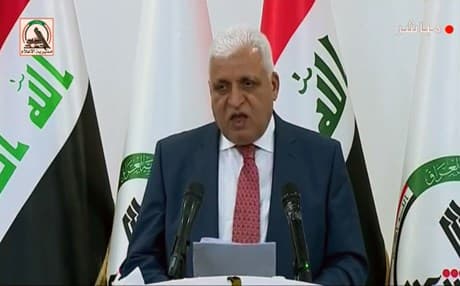
“The Hashd al-Shaabi is fully committed to the decree that the Iraqi Prime Minister issued on July 1, 2019, which is focusing on integrating the Hashd al-Shaabi units into the Iraqi army,” Fayyadh, who is also national security advisor, told reporters in Baghdad on Tuesday.
“We ask the Iraqi Prime Minister for a two-month extension of the deadline in order to finalize the integration of all the Hashd al-Shaabi units into Iraqi Army,” the Hashd boss added.
He also announced Hashd al-Shaabi leadership has already been finalized and their structure is in-line with the Army.
Fayyadh also commented on the recent US treasury sanctions against two Hashd members.
“We refuse the US treasury sanctions, because they have no evidence and they clearly are humiliating Iraqi sovereignty,” Fayyadh said.
On July 1, Abdul-Mahdi decreed July 31 as the deadline for all the PMFs, known as the Hashd al-Shaabi in Arabic, to integrate into the Iraqi Army — an attempt to bring them under centralized state control.
Officially, the prime minister is the commander-in-chief of all Iraqi security forces.
“All Hashd al-Shaabi forces will work as an inseparable part of the armed forces. All rules applied to the armed forces will be applied to them, unless special letters decree otherwise,” Abdul-Mahdi said at the time.
Formally incorporated into Iraq’s armed forces in 2016 following a parliamentary bill, the forces are officially under the control of Abdul-Mahdi and Fayyadh. A falling out between previous PM Haider al-Abadi and Alfayyadh is widely credited with helping Abdul-Mahdi obtain support for the prime ministership as a technocrat.
The almost entirely Shiite paramilitias were formed in 2014 following on a fatwa (religious decree) by Ayatollah Ali al-Sistani, the highest Shiite religious authority in Iraq, when the Islamic State group (ISIS) advanced on Baghdad and controlled roughly one-third of Iraq.
Abdul-Mahdi has been under pressure to curb the actions of Iran-affiliated groups after a spate of rocket attacks against US military and economic targets in Iraq, with attacks carried out on ExxonMobil’s Basra headquarters and military camps where US troops are stationed, as well as a near-miss attack against the US embassy in Baghdad.
Additionally, a May 14 attack on US-ally Saudi Arabia’s oil infrastructure, attributed to Iran-backed Houthis, is suspected by US officials to have been launched from Iraq. The attacks have largely been attributed to PMF factions, some of which have expressed support for Iran as tensions between it and the United States rise.
Currently, the Hashd are participating with Iraqi Security Forces in the “Will of Victory” operation in desert areas primarily in Nineveh, Anbar and Saladin provinces. Its second phase has moved into northern parts of Baghdad.