


Error occured during this request! Please try again later.
Turkey

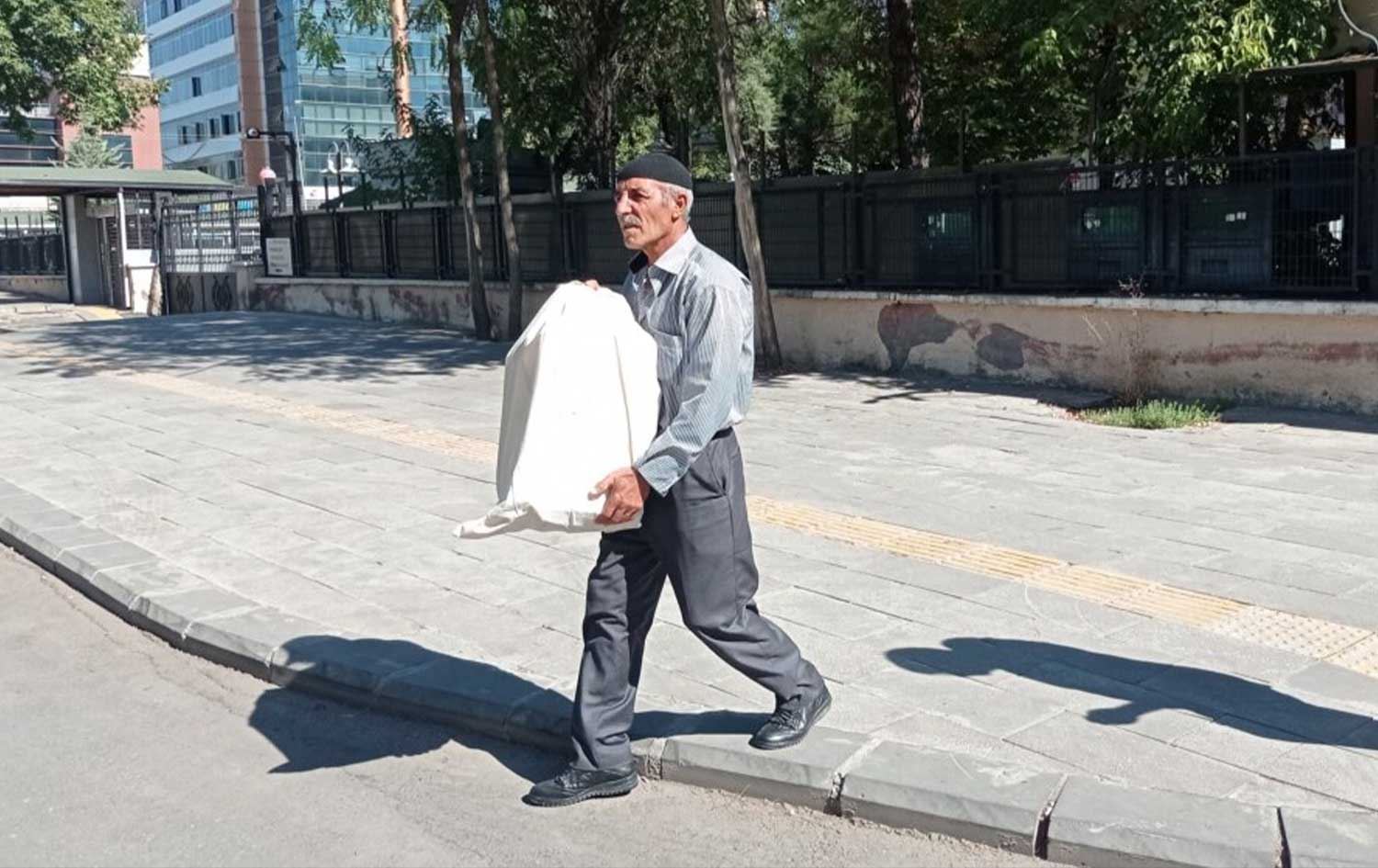
Ali Riza Arslan carries the remains of his son in a bag in front of courthouse in Diyarbakir on August 29, 2022. Photo: MA
ERBIL, Kurdistan Region - The family of a Kurdish young fighter on Monday received the remains of their son from a Turkish court in Diyarbakir (Amed) in a bag nearly seven years after his death in clashes with Turkish security forces. The court has come under fire for the "inhumane" practice.
Turkish security forces and Kurdish fighters - Civil Protection Units (YPS) - affiliated to the Kurdistan Workers’ Party (PKK) began clashes in summer 2015 following the failure of a short-lived ceasefire between the PKK and Ankara. The Kurdish fighters controlled many areas in the southeastern part of the country. The army imposed curfews and began attacking these areas to re-control them.
A 22-year-old Kurdish young man, Hakan Arslan, who lived in Erzurum province, rushed to Diyarbakir’s Sur district in 2015 to join the YPS. On December 2 the same year, he was killed during a clash. However, no one knew about his fate until the remains of a dead person were found on February 7, 2021 during an excavation near a church in Diyarbakir, according to the Kurdish news outlet, Mezopotamya Agency (MA).
Hakan’s family heard about the news and were somehow sure that it was their son. They hired a lawyer who helped them claim the remains through a DNA test. The results of his parents’ DNA showed that the bones belonged to Hakan.
Ali Riza Arslan, who lives in Erzurum, was informed by a Diyarbakir court recently that he could pick up the remains of his son. He went to Amed on Sunday and visited the court the next day. The father told local news agencies that he was puzzled and heartbroken to see that a court officer handed him the remains of his son in a can which was put in a bag.
“I felt bad when he [the clerk at the court] opened the bag. When I saw the bones in the can, I was heartbroken because my son was only 22,” the father told Duvar news outlet on Wednesday.
AngerDiyarbakır’ın Sur ilçesinde 2 Aralık 2015’te ilan edilen sokağa çıkma yasağı sürecinde yaşanan çatışmalarda yaşamını yitiren Hakan Arslan’ın kemikleri 7 yıl aradan sonra babasına bir torba içerisinde teslim edildi.https://t.co/YofOzUJXazhttps://t.co/AWnQR8ygYj pic.twitter.com/akdWoBQqm1
— Mezopotamya Ajansı (@MAturkce) August 29, 2022
Once the video, which showed the father leaving the court building with a bag containing the bones of his son, was published by MA, it went viral in a short period of time and the scene angered many Kurds on social media. A local rights group described it as offensive, saying it will seek the prosecution of those responsible.
Feleknas Uca, a lawmaker for the pro-Kurdish Peoples’ Democratic Party (HDP), said in a tweet on Monday that this is not the first “persecution” against Kurds, adding that the cemeteries of Kurds were previously destroyed and the families of the dead were not given special vehicles to carry the dead bodies of their beloved ones.
The Turkish government was criticised in 2020 after it handed over the dead body of a PKK fighter to his family via post.
Canan Okay, an official from the opposition Deva Party, said on Twitter on Monday that “it is unfair to hand over the bones of the children they killed to their parents in bags.”
Many Twitter users shared the picture of Ali Riza Arslan carrying the remains of his son in a bag and slammed the Turkish government for it. The Italian caricaturist Gianluca Costantini turned this scene into a caricature which soon went viral.
The Human Rights Association’s (İHD) Diyarbakır branch said in a statement on Monday that the court aimed to “offend/humiliate the relatives of the deceased.”A court in #Turkey’s southeastern province of #Diyarbakır has returned the remains of Hakan Arslan unceremoniously to his family in a plastic bag nearly seven years after he died during a military crackdown in the city.
— Gianluca Costantini (@channeldraw) August 30, 2022
Info: https://t.co/v07RxH8Knn pic.twitter.com/3gMS3jBqMi
“We would like it to be known that we will follow the legal process for the prosecution of those responsible for the inhuman treatment suffered by our applicant family,” it added.
Melike Arslan, mother of the deceased, told Duvar news outlet on Wednesday that she could not go with her husband to the court to receive the remains of their son due to sickness, therefore she could not see the remains of his son. The mother watched from home the scene which shows her husband carrying the remains of their son. “When I watched it, I died. By the time I went to the cemetery, he was already buried.”
‘Wrong practice’
Muhammet Serif Aydin, head of the ruling Justice and Development Party’s (AKP) office in Amed, told Rudaw’s Mashallah Dakak on Thursday that the remains of the Kurdish fighter, whom he described as a “terrorist,” were given to his father by an officer without the knowledge of judges.
The remains were handed over to the father “while the courthouses were closed due to the judicial holiday. What happened was a wrong practice which was done without the knowledge of the judges and prosecutors in charge,” said the AKP official.
“I do not find it humanely right for a father to experience this, even if his son is a terrorist. However, it is not right to look for reasons and behave in a way as if it was done on purpose,” he added.
Turkish pro-government media outlets have targeted those opposition politicians who have criticized the court for the practice, claiming that the Kurdish fighter was buried by the PKK in 2016.
PKK is an armed group which was founded in 1978 with the stated aim of struggling for the increased rights of Kurds in Turkey. Ankara has listed the group as a terrorist organization and carries out military operations against it at home and abroad.


Comments
Rudaw moderates all comments submitted on our website. We welcome comments which are relevant to the article and encourage further discussion about the issues that matter to you. We also welcome constructive criticism about Rudaw.
To be approved for publication, however, your comments must meet our community guidelines.
We will not tolerate the following: profanity, threats, personal attacks, vulgarity, abuse (such as sexism, racism, homophobia or xenophobia), or commercial or personal promotion.
Comments that do not meet our guidelines will be rejected. Comments are not edited – they are either approved or rejected.
Post a comment